






Articles
- BLOG / Articles / View
- Articles
Baker Hughes Quietly Became an AI Infrastructure Enabler
By Avik on June 26, 2026 in Articles
Power Emerges as AI's Critical Constraint
Artificial intelligence is creating a new constraint on digital infrastructure. For much of the past two years, the race centered on securing advanced semiconductors and expanding computing capacity. Increasingly, however, the bottleneck is shifting from chips to electricity. As AI models become larger and hyperscale data centers consume more power, reliable energy supply is emerging as one of the industry's most critical challenges. The International Energy Agency expects global data center electricity demand to roughly double by 2030, while Goldman Sachs Research estimates power demand from data centers could increase by around 160% over the same period.
In response, a new group of industrial companies is emerging to support the AI buildout by supplying the power infrastructure needed to sustain it. Baker Hughes is becoming one of the clearest examples of this transition.
Baker Hughes assembles its AI infrastructure platform
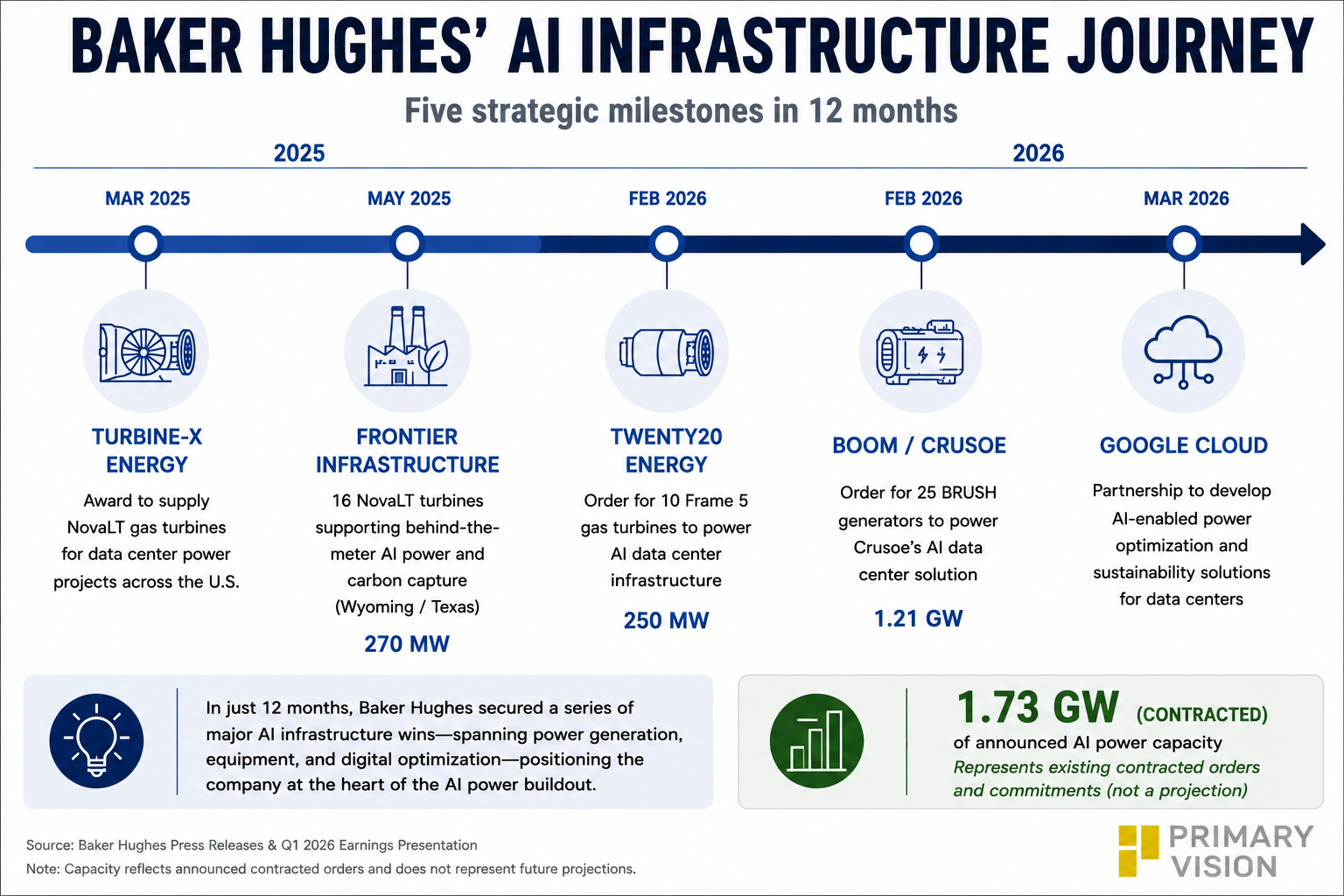
Rather than announcing a single transformational contract, Baker Hughes has built its AI strategy through a series of connected projects. The timeline begins in March 2025 with a turbine order from TURBINE-X Energy for U.S. data center applications. Two months later, the company announced a partnership with Frontier Infrastructure to supply sixteen NovaLT gas turbines supporting 270 MW of behind-the-meter power integrated with carbon capture.
Momentum accelerated in early 2026. Baker Hughes secured an order from Twenty20 Energy to provide ten Frame 5 gas turbines for AI infrastructure projects totaling 250 MW. Shortly afterward, the company announced its largest disclosed AI-related project to date: twenty-five BRUSH generators supplying approximately 1.21 GW of generation capacity for Boom Supersonic's partnership with Crusoe.
The strategy expanded further in March through a collaboration with Google Cloud, bringing AI-enabled power optimization software into the portfolio and extending Baker Hughes' role beyond hardware. So, each announcement addresses a different part of the AI power value chain. Collectively, they suggest Baker Hughes is positioning itself as an integrated supplier rather than simply a turbomachinery manufacturer.
Commercial traction is accelerating.
Baker Hughes reported ~$1 billion of data center-related orders during 2025. During the first quarter of 2026 alone, the company booked another $1 billion, effectively matching the previous year's performance in a single quarter. Management subsequently increased its cumulative 2025–2027 data center-related orders target to $3 billion, doubling its earlier objective.
Publicly disclosed projects currently represent approximately 1.73 GW of contracted AI infrastructure capacity. Importantly, this figure reflects announced projects and existing commitments rather than forward projections.
Power Systems Moves the Financial Needle
The past five quarters suggest that Power Systems has become an increasingly important contributor to Baker Hughes' Industrial & Energy Technology segment. As OFSE faced a softer operating environment, the company consistently highlighted power-related orders—including AI infrastructure, gas-fired generation and grid solutions—as key drivers of IET growth, record backlog and margin expansion.
This progression culminated in the first quarter of 2026, when Baker Hughes reported $1.4 billion of Power Systems orders within a record $4.9 billion of IET orders. While LNG and gas infrastructure remain important growth engines, the company's disclosures indicate that Power Systems has evolved from an emerging opportunity into a meaningful commercial driver of IET performance.
Key Takeaways
The AI infrastructure opportunity is beginning to reshape parts of the industrial landscape that have historically been tied to energy markets. For Baker Hughes, the significance extends beyond incremental equipment sales. The company is establishing relationships with developers building the next generation of AI infrastructure while leveraging existing expertise in turbines, rotating equipment, and digital technologies.
The combination of accelerating data center orders, gigawatt-scale contracted projects, and an expanding portfolio of integrated power solutions suggests Baker Hughes is emerging as one of the more interesting industrial beneficiaries of the AI buildout. The market may continue to view Baker Hughes primarily as an energy services company. Increasingly, however, part of its future growth story appears likely to be written alongside the rapid expansion of AI infrastructure. Stay tuned for our series on OFS industry and its role in the AI power market next.
Tags:
Permission denied
Upgrade to Pro Today and get…
• This article — plus dozens more each month, all within our full Research Module
• Frac Hits — our National-Level Frac Spread Count and Frac Job Count, updated weekly
• Frac Operator Monitor — detailed FSC & FJC by operator
• And so much more, designed to help you track, forecast, and outperform