






Articles
- BLOG / Articles / View
- Articles
Baker Hughes's Perspective in Q3 2026: KEY Takeaways
By Avik on November 16, 2026 in Articles
BKR’s Power Business: Growth & Potential
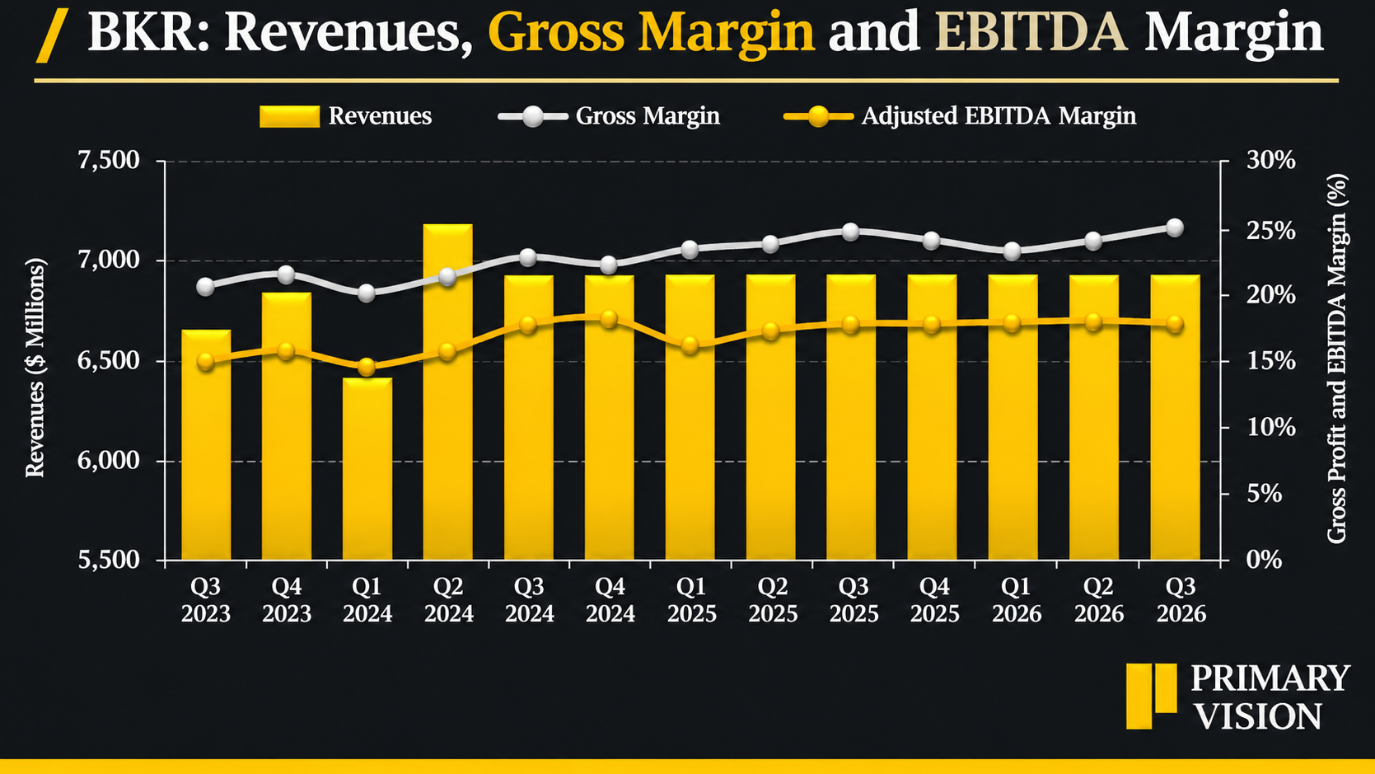
We have already discussed Baker Hughes’s (BKR) Q3 2026 financial performance in our recent article. Baker Hughes continues to benefit from strong demand for power generation and gas infrastructure, led by data centers and LNG. Q3 IET orders reached $5.9 billion, including $2.2 billion in Power Systems orders, while year-to-date data center awards reached $4.9 billion. Management raised its FY2026 IET order outlook to $21.5–$23.5 billion and now expects Horizon 2 IET orders to exceed $50 billion.
The latest awards underline the breadth of demand beyond data centers. Baker Hughes secured 1.1 GW of power generation capacity for a U.S. technology company and about 500 MW for a U.S. energy company, while a framework agreement with Venture Global and GE Vernova covers up to 10 GW of behind-the-meter capacity. These projects reinforce the company’s role in reliable, on-site power as AI workloads and grid constraints increase demand.
LNG & Gas Market Outlook
LNG and gas infrastructure remain major growth drivers. Baker Hughes booked $1 billion in LNG equipment awards during Q3, including a major Venture Global Plaquemines expansion award using Chart cold-box technology. LNG equipment orders could approach $5 billion for 2026, with management seeing a path toward nearly $10 billion of LNG orders during Horizon 2.
Demand also remains strong across pipelines, gas processing, offshore production, and aftermarket services. Awards include Venture Global’s Cloud Connector pipeline project and a long-term service agreement covering 27 gas turbines across four FPSOs. The growing installed base should create follow-on opportunities in maintenance, upgrades, and digital services, extending revenue beyond initial equipment deliveries.
OFSE Projects and Chart Acquisition Benefits
OFSE improved sequentially in Q3, with revenue up 6% to $3.66 billion and EBITDA margin expanding 50 basis points to 18.1%. International markets, including Latin America, Europe, and the Middle East, supported the recovery. New awards across mature-asset solutions, offshore stimulation, drilling, and subsea reinforce the business’s role in production optimization and long-cycle projects.
The Chart acquisition broadens Baker Hughes’ capabilities in thermal management, cryogenics, carbon capture, data centers, geothermal, and industrial gases. Chart generated $888 million in Q3 revenue and $156 million in EBITDA, while Baker Hughes has already executed actions representing about $70 million in annualized cost savings. Management remains on track for $325 million in annualized synergies within three years, with further upside from cross-selling and operating improvements.
Q4 & FY2026 Outlook
Baker Hughes expects Q4 revenue to increase approximately 3% sequentially, with adjusted EBITDA rising about 3%. IET revenue is expected to grow 2%, while EBITDA increases roughly 4%, supported by backlog conversion and improving equipment mix. Chart revenue and EBITDA are projected to rise approximately 24% and 25%, respectively.
OFSE revenue is expected to decline about 2% sequentially, with EBITDA down roughly 3%, as weaker Middle East and North American activity weighs on results. For FY2026, management raised its adjusted EBITDA guidance and expects free-cash-flow conversion of 45%–50%. IET order guidance also increased, although longer project lead times point to more measured revenue growth in 2027.
Relative Valuation
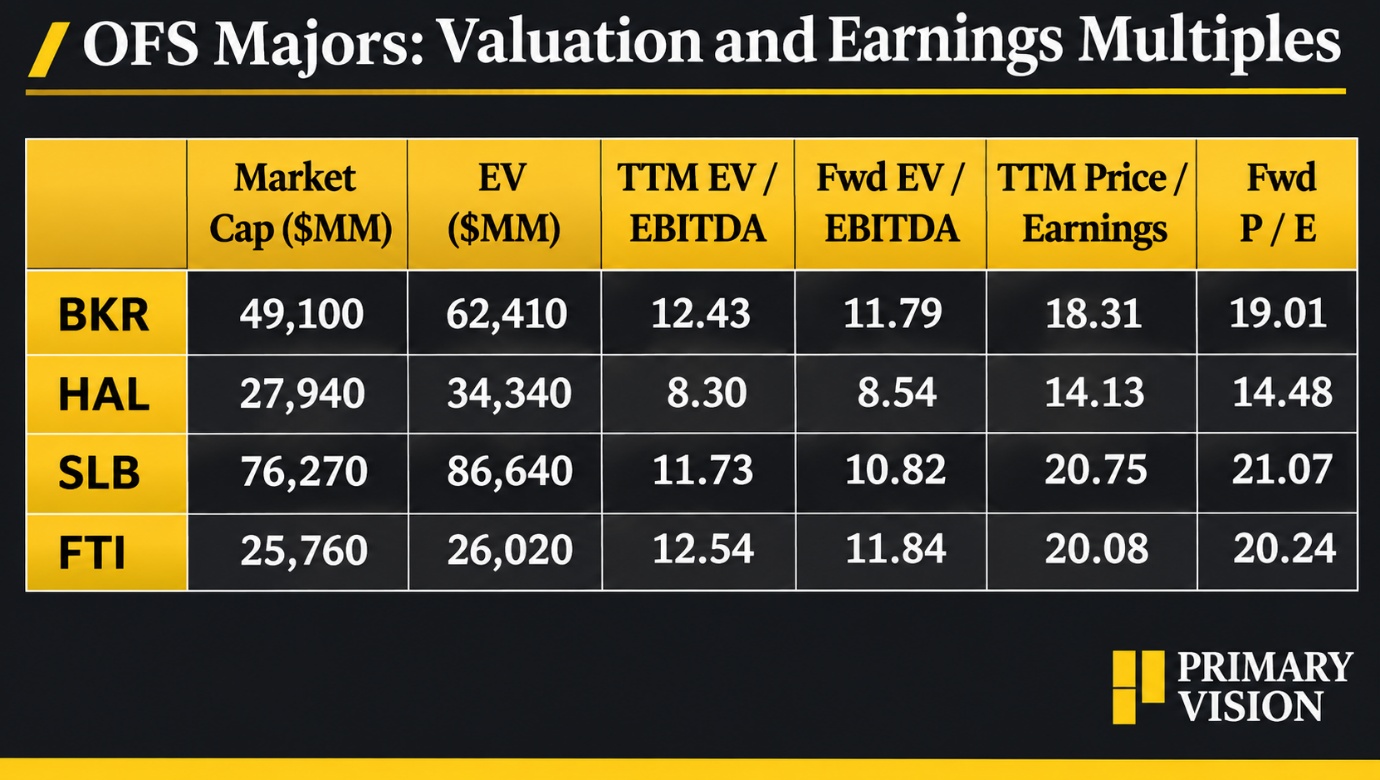
BKR is currently trading at an EV/EBITDA multiple of 12.4x. Based on sell-side analysts' EBITDA estimates, the forward EV/EBITDA multiple is lower. The current multiple is higher than its five-year average EV/EBITDA multiple.
BKR's forward EV/EBITDA multiple contraction versus the current EV/EBITDA is slightly steeper than its peers because the company's EBITDA is expected to rise more sharply than its peers in the next four quarters. This typically results in a moderately higher EV/EBITDA multiple than peers. The stock's EV/EBITDA multiple is higher than its peers' (HAL, SLB, and FTI) average of 10.9. So, the stock appears to be reasonably valued compared to its peers. Chart-related acquisition debt lifted leverage, and management plans to use free cash flow and divestiture proceeds to reduce debt, targeting net leverage below 1.5x in 2H 2028. This supports its even relative valuation logic.
Final Commentary
Baker Hughes is expanding across data center power, LNG, gas infrastructure, and industrial markets while improving OFSE performance. Record IET backlog, a higher order outlook, and Chart’s $325 million synergy target support the long-term growth case. Near-term priorities are converting backlog, executing the integration, and using strong cash generation to reduce leverage. The stock appears to be reasonably valued compared to its peers.
Tags:
Permission denied
Upgrade to Pro Today and get…
• This article — plus dozens more each month, all within our full Research Module
• Frac Hits — our National-Level Frac Spread Count and Frac Job Count, updated weekly
• Frac Operator Monitor — detailed FSC & FJC by operator
• And so much more, designed to help you track, forecast, and outperform