






Articles
- BLOG / Articles / View
- Articles
From Acreage to Capital: How U.S. Shale Is Reshuffling Its Assets
By Avik on November 19, 2026 in Articles
Capital Discipline Is Driving Different Strategies
This analysis focuses on selected significant transactions involving publicly traded companies and assets in U.S. shale basins announced in recent weeks. It is not intended to provide an exhaustive review of upstream M&A activity.
The recent transactions involving Comstock Resources, EQT, Range Resources, Devon Energy and Crescent Energy reflect different responses to the industry's capital requirements. Rather than simply acquiring acreage to expand production, these companies are addressing specific financial and operational priorities. Three strategic drivers stand out: access to development capital, operating scale and portfolio rationalization.
External Capital to Sustain Development
Comstock Resources illustrates the financing challenge facing a growth-oriented producer. Its Haynesville development program requires substantial investment, while capital spending has consistently exceeded internally generated cash flow.
Between Q1 2025 and Q3 2026, capex exceeded operating cash flow in six of seven quarters, creating a cumulative shortfall of approximately $846 million. In Q3 2026, total capex reached $400 million against operating cash flow of $180 million.
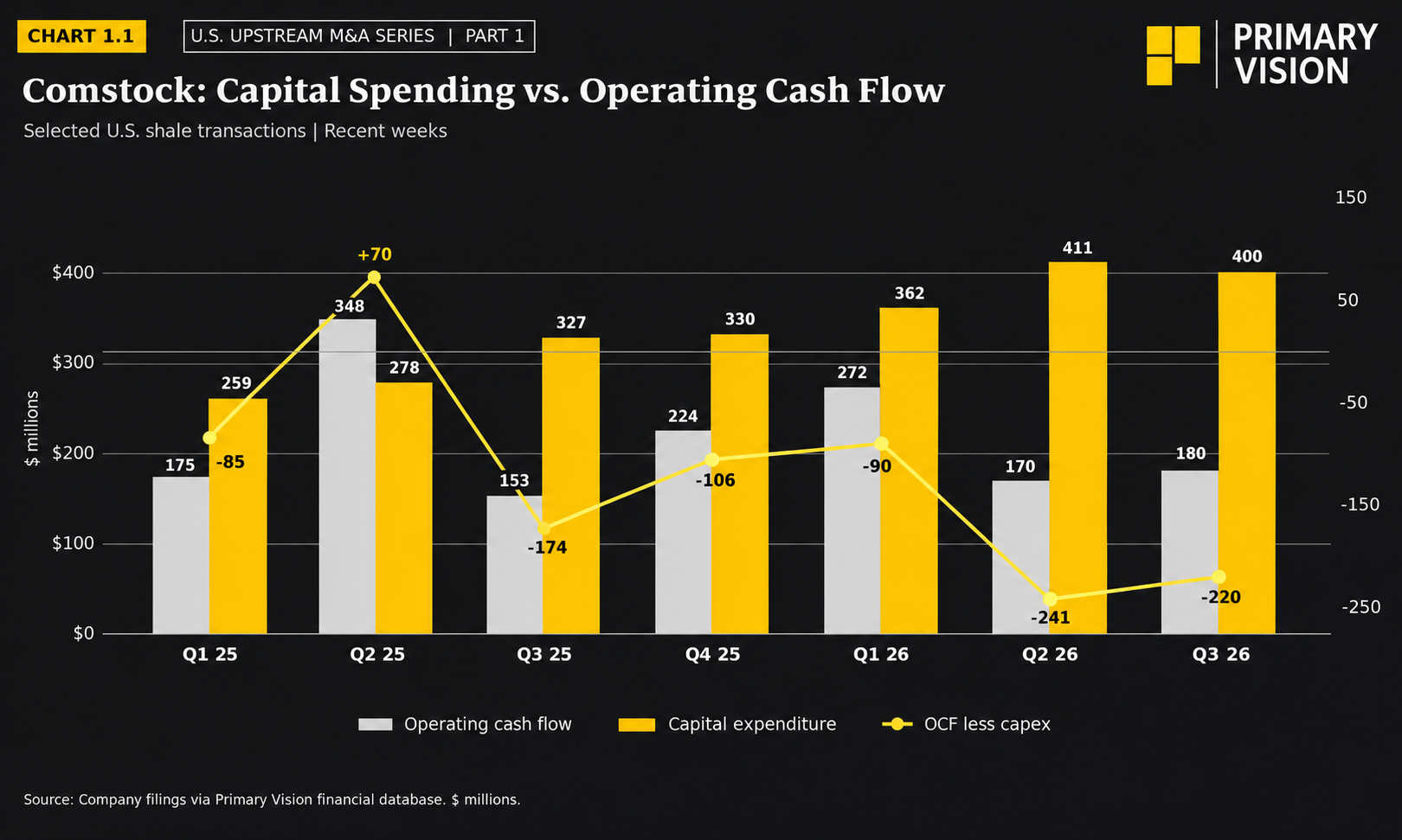
Comstock's $1.65 billion agreement with SOCAR brings in a non-operated partner while allowing Comstock to retain operatorship. A separate $450 million drilling venture with a partnership owned by majority shareholder Jerry Jones provides additional funding for 27 wells.
These arrangements allow Comstock to continue developing its core acreage without financing the entire program internally. The strategy supports production growth and balance-sheet improvement, although rising Western Haynesville well and completion costs remain a consideration.
Scale and Cost Reduction Through Consolidation
EQT's proposed acquisition of Range Resources addresses a different challenge: improving the economics of natural gas production through scale.
The combined company would control nearly 3 million net acres, produce more than 9 Bcfe/d and operate over 3,700 miles of midstream infrastructure. Management expects $325 million in annual synergies within two years, with potential to exceed $600 million.
The rationale is not necessarily to increase drilling. A larger operating footprint, infrastructure integration and lower costs can improve returns without materially expanding activity.
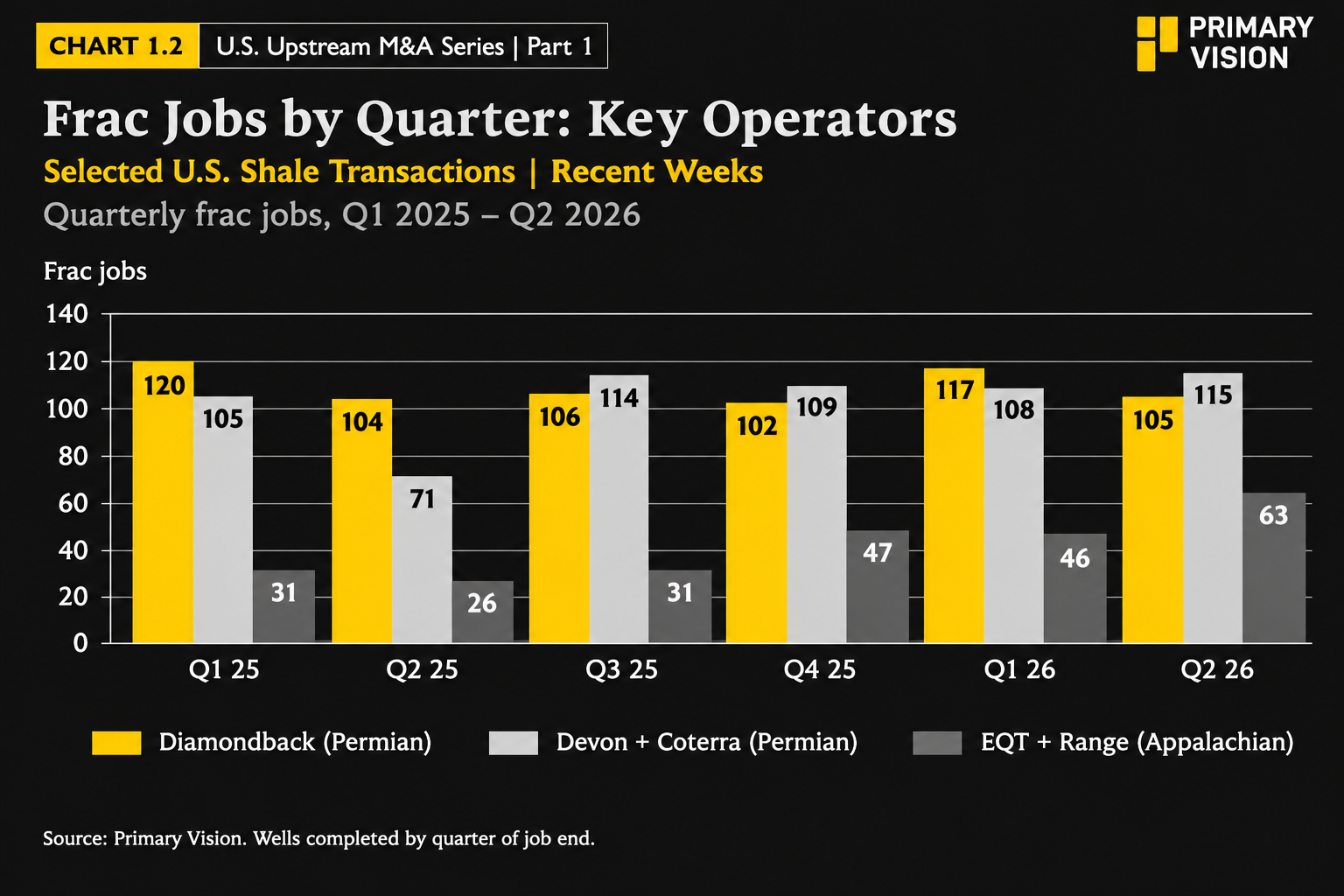
Primary Vision data shows EQT and Range averaged 55 frac jobs per quarter in H1 2026, compared with 34 in 2025. However, their combined share of Appalachian activity remained below its 2024 level. The proposed combination is therefore primarily a cost and scale strategy, rather than evidence of an emerging activity expansion.
Portfolio Rationalization and Capital Returns
Devon's sale of its Eagle Ford assets to Crescent Energy illustrates another priority: concentrating capital on selected producing areas following corporate consolidation.
After completing its merger with Coterra, Devon agreed to sell the Eagle Ford position for $4.2 billion. It expects approximately $3.5 billion in net proceeds, directing capital toward shareholder returns and debt reduction.
Crescent, meanwhile, identified approximately $140 million in annual synergies and plans to maintain the existing two-to-three-rig program while pursuing longer laterals.
The transaction gives Crescent additional production and inventory, while allowing Devon to simplify its portfolio and redirect capital. Importantly, the buyer is not necessarily pursuing a substantial increase in development intensity.
What This Means for OFS Companies
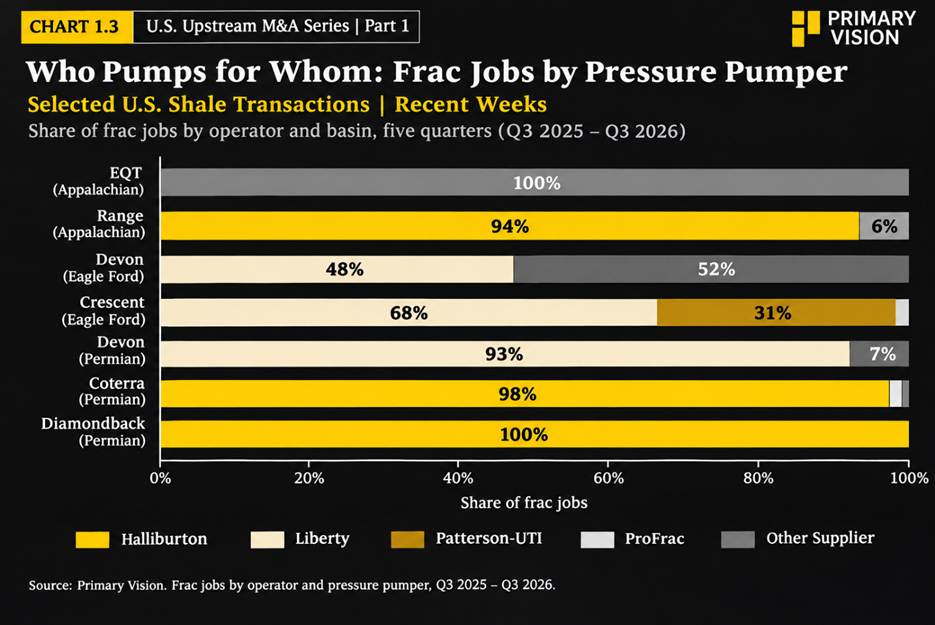
These transactions do not signal a uniform increase in completion demand. Diamondback's average Permian frac jobs increased marginally in H1 2026, while Devon and Coterra maintained broadly stable combined activity. The more immediate implication may be changing customer relationships. Primary Vision data shows Halliburton handled most of Range’s Appalachian jobs. In the Permian, Liberty handled the majority of Devon’s jobs, compared with Halliburton’s leading share of Coterra’s (later merged with Devon) work.
These supplier relationships could evolve as companies integrate, although no changes have been announced. Part 2 examines another dimension of this shift: producers investing beyond acreage and into the infrastructure surrounding their wells, including water handling, gas takeaway and power—and the implications for OFS companies.
Tags:
Permission denied
Upgrade to Pro Today and get…
• This article — plus dozens more each month, all within our full Research Module
• Frac Hits — our National-Level Frac Spread Count and Frac Job Count, updated weekly
• Frac Operator Monitor — detailed FSC & FJC by operator
• And so much more, designed to help you track, forecast, and outperform