






Articles
- BLOG / Articles / View
- Articles
PROPWR Is Becoming A Second Company Inside ProPetro
By Avik on May 12, 2026 in Articles
PROPWR Reshapes PUMP’s Future
ProPetro (PUMP) was typically viewed as a pure-play pressure pumping company tied to Permian completion activity. That identity is now changing rapidly. Over the last two years, the company has quietly built PROPWR into a major growth platform. What began as an adjacent oilfield service is evolving into a distributed power infrastructure business with its own capital cycle, customer base, and long-term earnings profile.
Management now describes ProPetro as having “two powerful engines” — the traditional completions business and the emerging power generation platform. That shift matters because PROPWR is no longer being funded like a side business. It is becoming central to the company’s long-term strategy.
Why ProPetro Is Betting On Power
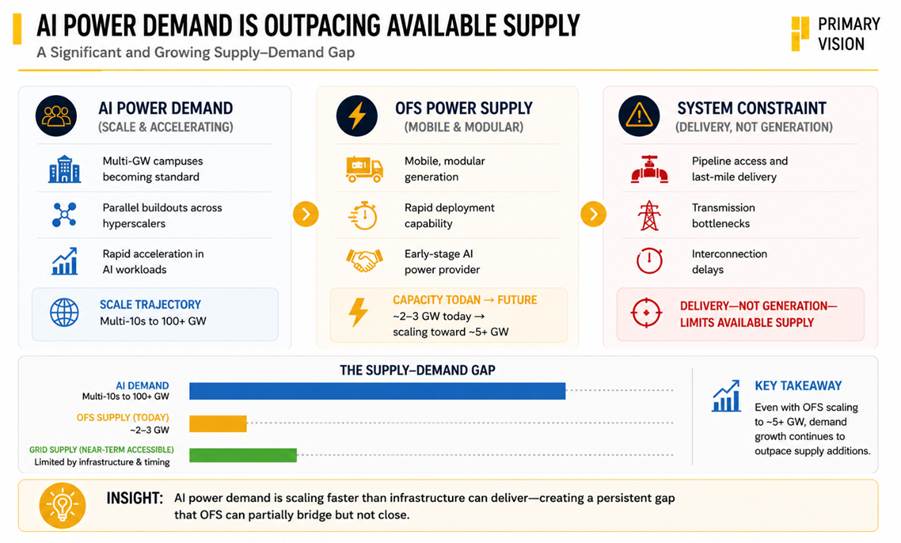
ProPetro believes North America is entering a prolonged power shortage cycle. AI data centers, industrial electrification, LNG expansion, and energy security concerns are all driving higher electricity demand. AI-related electricity demand in the U.S. is now projected to exceed 100 GW over the coming years, driven by hyperscaler data center expansion and large-scale AI infrastructure buildouts. Major technology companies including Meta, Microsoft, Amazon, Oracle, and OpenAI are already developing multiple campuses requiring 1-7 GW of power capacity each across various projects and regions.
At the same time, U.S. grid expansion remains constrained by transmission bottlenecks and multi-year permitting cycles. That gap is creating an opportunity for the OFS industry, which already controls an estimated 15-18 million HHP of mobile natural gas-capable infrastructure that can increasingly be repositioned toward distributed power generation for AI and industrial customers.
PROPWR was initially launched to support oilfield customers needing mobile power. However, management now sees the largest opportunity in data centers and industrial infrastructure. The Permian Basin also gives ProPetro a strategic advantage. The region produces massive amounts of natural gas while maintaining a large diesel-to-natural gas price discount. That creates an attractive setup for behind-the-meter power generation.
PROPWR’s Scale Is Expanding Rapidly
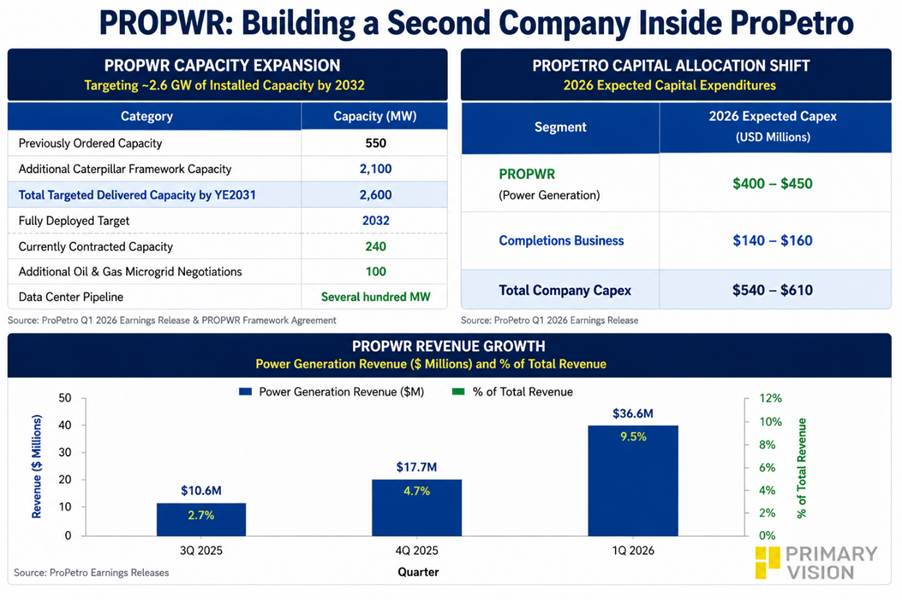
The biggest development came in April 2026 when PROPWR signed a strategic framework agreement with Caterpillar for up to 2.1 GW of additional generation capacity through 2031. Combined with previously ordered equipment, the company now targets roughly 2.6 GW of installed capacity by 2032. That is a massive target for a business that only began generating revenue during the third quarter of 2025.
Management disclosed roughly 240 MW of current committed capacity under signed contracts as of early 2026. This comes alongside advanced negotiations tied to another 100 MW of oilfield microgrid projects. The company also highlighted several hundred megawatts of potential data center opportunities currently moving through its commercial pipeline. The pace of deployment shows that ProPetro is building PROPWR like an infrastructure platform rather than a traditional OFS service line.
The OFS Industry Is Quietly Evolving
ProPetro is not the only OFS company trying to reduce dependence on traditional frac activity. Liberty Energy has expanded into integrated power and advanced energy systems. Solaris Energy Infrastructure has built a dedicated distributed power platform tied heavily to hyperscaler and AI demand.
ProFrac is taking a different approach. The company has focused on vertical integration across stimulation services, proppant production, manufacturing, chemicals, and complementary industrial offerings. ProFrac also disclosed distributed power generation exposure within its broader services portfolio. However, the scale of ProPetro’s commitment stands out.
Capital Allocation Is Shifting Fast
The clearest sign of the company’s transition is capital spending. ProPetro expects to spend roughly $400M-$450M on PROPWR during 2026. Meanwhile, expected completions business capex is only $140M-$160M. Most of the company’s growth capital is now going toward power generation rather than frac spreads.
Management is effectively using cash flow from the legacy frac business to fund a second infrastructure company inside ProPetro. The financing structure is also evolving. During Q1 2026, approximately $71 million of PROPWR-related capex was incurred, but a portion was financed directly by lending partners and equipment financing arrangements. That matters because it allows ProPetro to scale aggressively without fully funding every asset directly from its balance sheet.
PROPWR To Reshape The Business?
The power business remains small relative to ProPetro’s total revenue base. However, growth is accelerating rapidly. Power generation revenue increased sharply between Q4 2025 and Q1 2026 as additional deployments came online. More importantly, PROPWR could eventually generate a very different type of revenue stream.
Takeaway
PROPWR is no longer behaving like a small adjacent service line. ProPetro is attempting to build a large-scale infrastructure business inside a cyclical oilfield services company. The strategy carries meaningful execution risk because distributed power generation is capital-intensive and operationally demanding.
However, the opportunity is equally significant. If PROPWR scales successfully, ProPetro’s future earnings mix and valuation framework could eventually look very different from those of a traditional pressure pumping company.
Tags:
Permission denied
Upgrade to Pro Today and get…
• This article — plus dozens more each month, all within our full Research Module
• Frac Hits — our National-Level Frac Spread Count and Frac Job Count, updated weekly
• Frac Operator Monitor — detailed FSC & FJC by operator
• And so much more, designed to help you track, forecast, and outperform