The Efficiency Improvement Is Becoming a Basin-Level Story
By
Avik
on October 12, 2026
in
Articles
Efficiency Story Looks Different at the Basin Level
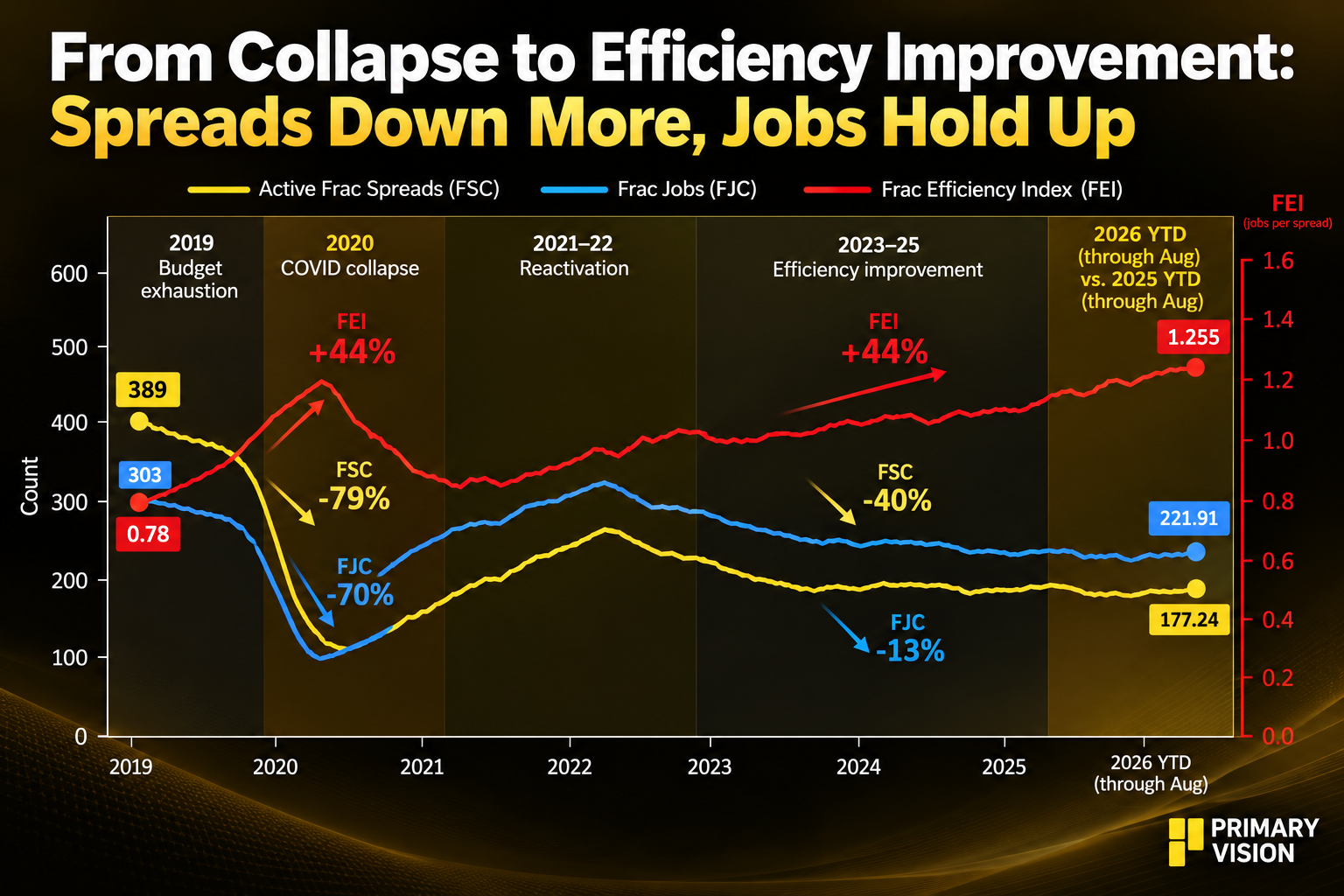
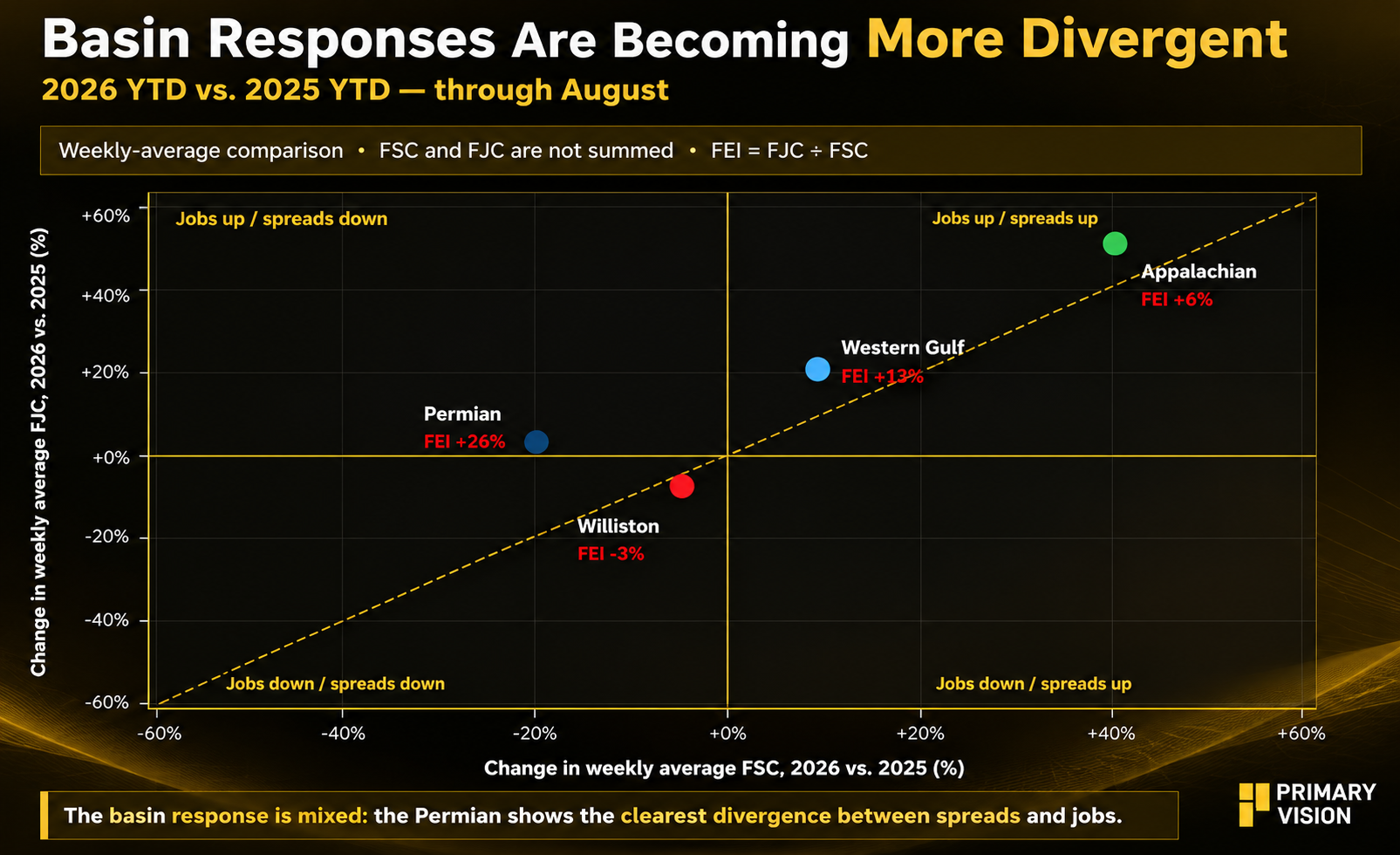
The national FEI improvement is clear, but the basin data tell us more about why it is happening. Fleet rationalization, equipment quality, operator concentration and completion intensity are changing the relationship between spreads and jobs. The 2026 oil-price cycle now provides a useful test of how durable those changes are.
The Permian Shows the Clearest Shift
The Permian is the strongest example. From 2024 to 2026, weekly-average FSC declined 41%, while FJC increased 9%. FEI consequently increased 85%. A smaller fleet is therefore handling roughly the same amount of work — and slightly more.
One driver is fleet rationalization. Work has increasingly concentrated on newer, higher-specification equipment, while older or less competitive fleets are more likely to be stacked or retired when demand softens. That allows capacity to leave the market without an equivalent reduction in frac work.
Completion Efficiency Matters
The Permian data also point to greater completion efficiency. A 41% decline in weekly-average spreads alongside a 9% increase in jobs cannot simply reflect lower completion activity. The remaining fleet is being used more intensively.
Longer or more continuous pumping schedules, tighter fleet scheduling, simul-frac activity and better utilization of high-specification fleets can all contribute. These are operational changes, not simply oil-price effects.
Why 2026 Matters
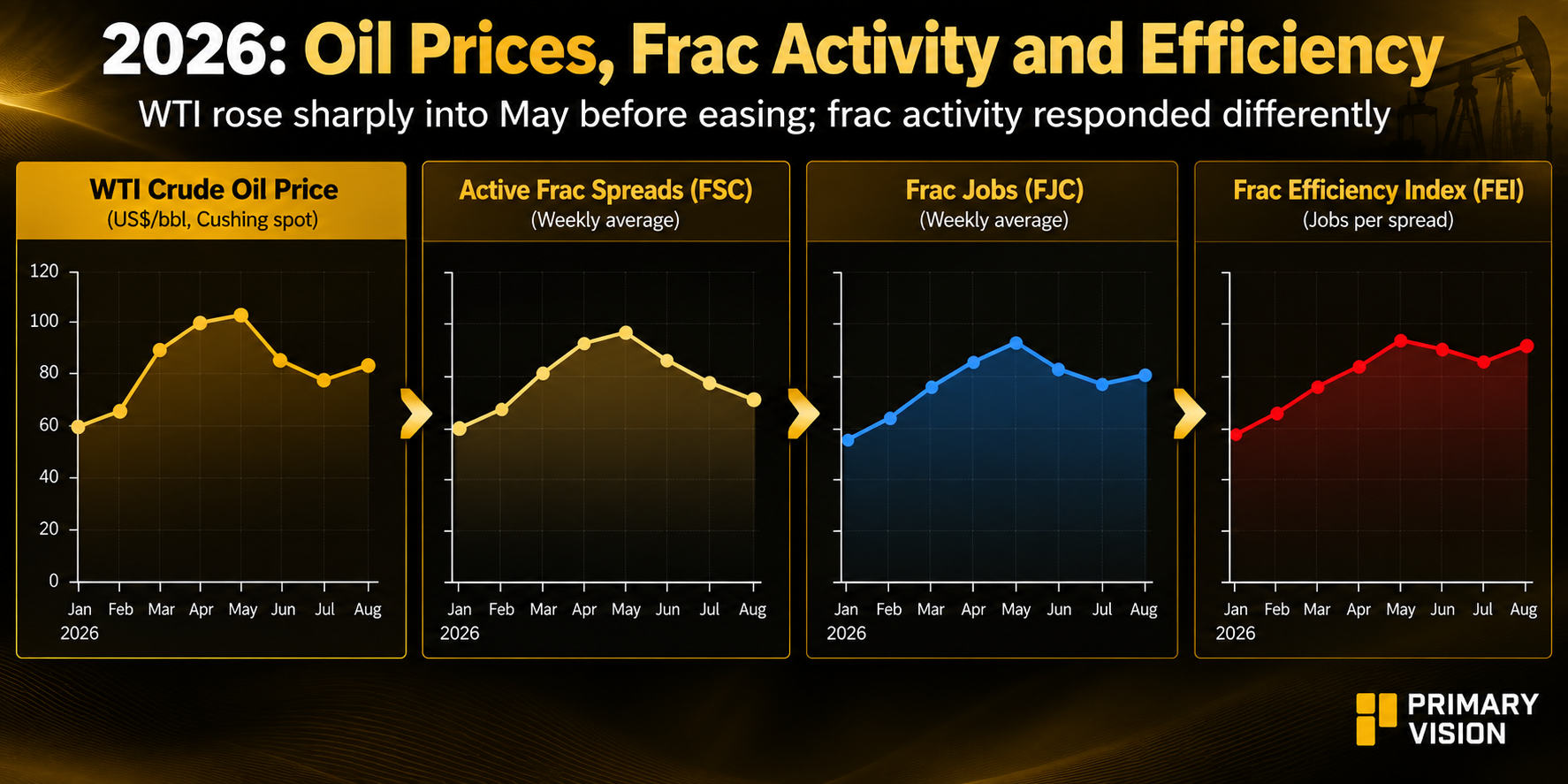
The 2026 oil-price cycle provides another test. During the price rally, operators had greater economic support for maintaining or increasing completion activity. Yet the industry did not simply rebuild the entire frac fleet. Higher-specification equipment remained concentrated among active contractors.
That is consistent with the post-2022 rationalization: operators can increase work without bringing the entire legacy fleet back.
The subsequent price easing provides the opposite test. Historical data show that oil-price changes do not translate immediately into frac activity. The strongest WTI/FSC relationship in the workbook occurs with a lag of roughly six weeks, suggesting that budgets, completion schedules and basin economics mediate the response.
The Adjustment Mechanism Matters
When oil prices weaken, operators can reduce active spreads, concentrate work on better acreage, reduce completion intensity or eventually cut jobs. The first two responses can support FEI. The latter two eventually pressure it.
So the key 2026 question is not simply whether crude prices fall. It is which adjustment mechanism the industry chooses. If lower-quality equipment continues to be stacked while operators protect higher-return acreage, fewer spreads could absorb a relatively stable workload. If weaker prices eventually reduce the workload of those remaining spreads, FEI will reverse.
The basin data suggest the industry has built an efficiency buffer. The next oil-price cycle will show how much of that improvement is structural.
Upgrade to Pro Today and get…
• This article — plus dozens more each month, all within our full Research Module
• Frac Hits — our National-Level Frac Spread Count and Frac Job Count, updated weekly
• Frac Operator Monitor — detailed FSC & FJC by operator
• And so much more, designed to help you track, forecast, and outperform