






Articles
$100 oil is back - it is here to stay?
By Osama on July 23, 2026 in Free Articles
Brent crude was trading near $96.50 a barrel on July 23, while West Texas Intermediate had moved above $88. This was the fifth consecutive daily increase and placed Brent at its highest level since early June. The latest market move is not simply a reaction to another round of geopolitical statements. Traders are now assessing the possibility that disruption could affect the Strait of Hormuz and Bab el-Mandeb at the same time. The market still has oil available outside the Gulf, but its confidence in the reliability and timing of deliveries has weakened. This is why price has risen faster than physical supply data alone would normally justify, although sustained gains will still require evidence that cargo losses are lasting rather than temporary.

U.S. diesel inventories increased by 1.4 million barrels in the week ending July 17, reaching 109.6 million barrels. That weekly build is useful, but stocks remain roughly 10% below their five-year seasonal average and almost unchanged from a year earlier. The weekly petroleum report also showed distillate production rising to about 5.25 million barrels per day. This means American refiners are producing more diesel, yet the inventory cushion is rebuilding slowly because domestic consumption and export demand are absorbing much of the additional output.
Diesel prices are therefore giving a clearer indication of tightness than crude inventories alone. The average U.S. retail diesel price reached $5.134 per gallon on July 20, rising almost 34 cents in one week and $1.322 from a year earlier. The US diesel prices show how quickly international supply problems are reaching domestic consumers. Middle Eastern refinery disruptions, reduced Russian availability and tight Asian product markets have increased demand for barrels from the United States. A country can have rising diesel production and still face higher prices when the wider international market is competing for the same supply.

U.S. refineries processed about 17.1 million barrels of crude per day over the latest four-week period and operated at an average utilisation rate of 96.2%. The refinery utilisation data support the Financial Times report that the system is running close to its practical limit. This provides an important source of fuel for the global market, but it also reduces flexibility. When utilisation is already this high, an unplanned shutdown, equipment failure or Gulf Coast hurricane cannot easily be offset by another refinery increasing its own throughput.
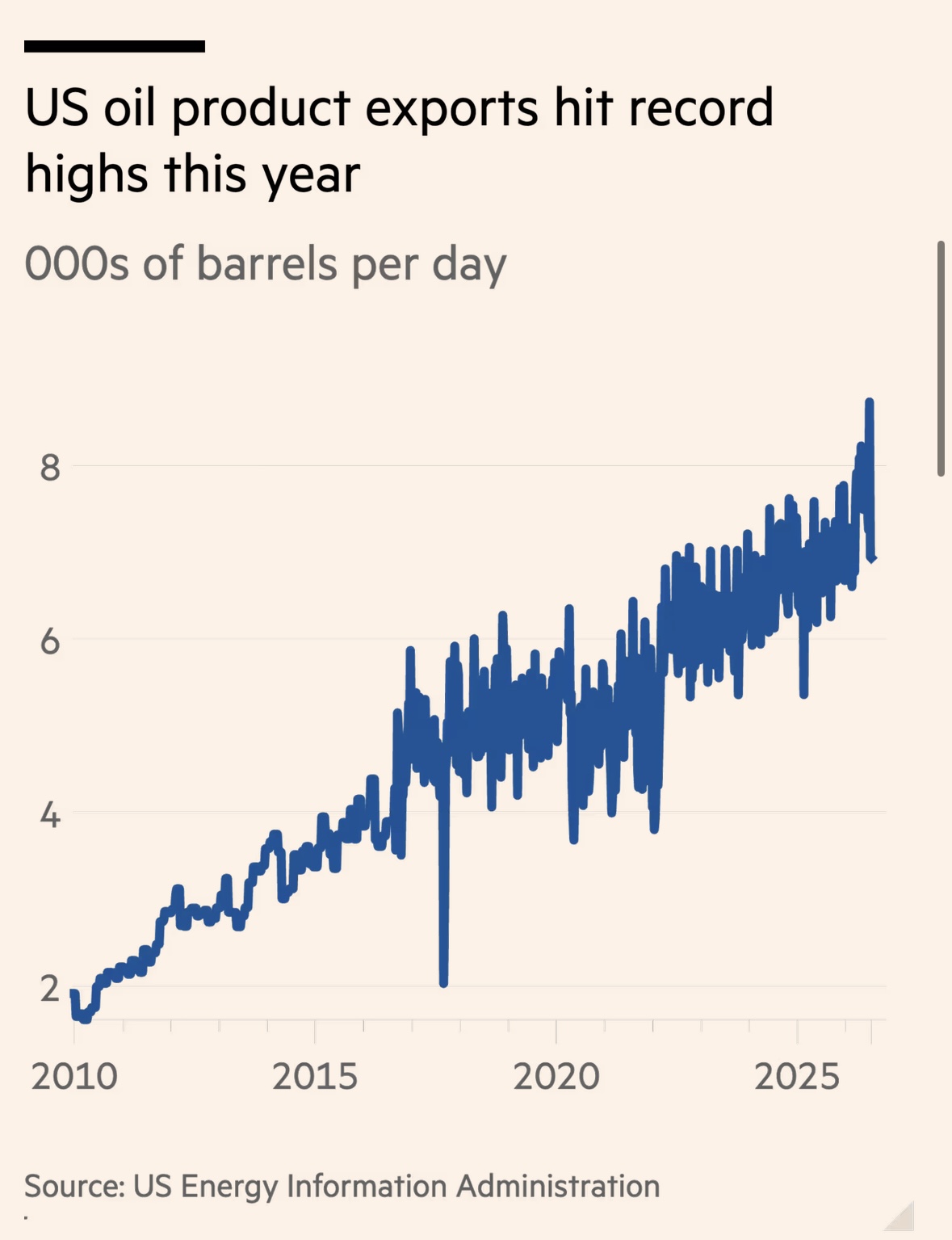
High utilisation can consequently support supply and increase risk at the same time. Strong refining margins encourage plants to operate harder and maximise production of diesel and jet fuel, but sustained operation near full capacity can make maintenance more difficult and leave fewer idle units available during an outage. The global refining recovery is also uneven. American and European refiners are running strongly, while parts of Asia and the Middle East remain constrained. If U.S. facilities encounter disruption, the global system currently has limited capacity elsewhere to replace the lost products quickly.

The Red Sea has now become a more direct concern after the Houthis declared a blockade against Saudi-linked shipping and said they had targeted two Saudi oil tankers. Maritime reports indicated that one vessel was hit, while several ships altered course or turned back. The Red Sea blockade is not yet a complete closure of Bab el-Mandeb, but even partial enforcement can raise insurance costs, delay cargoes and discourage shipowners from accepting Saudi voyages. The effect begins with logistics, but longer journeys and slower vessel turnover can eventually reduce the volume of oil available to refiners.

Yanbu should not be treated as a newly created alternative to Hormuz. Saudi Arabia has used the Red Sea port and the East-West Pipeline for decades, and Yanbu was already a regular part of its export system before the present conflict. What has changed is the volume. Recent Yanbu shipment volumes have averaged about 4 million barrels per day, compared with roughly 973,000 barrels per day a year earlier. This implies that approximately 3 million additional barrels per day are now moving through Yanbu relative to last year, rather than the full 4 million being entirely new traffic.

So far in July, around 75% of Saudi Arabia’s 5.29 million barrels per day of crude and condensate exports have left through Yanbu. These Saudi export flows show how heavily the kingdom is relying on an established route that has been pushed to a much larger role. If Bab el-Mandeb becomes inaccessible, cargoes bound for Asia could be rerouted north through Suez and then around Africa, but this would add time, freight and insurance costs. The central issue for oil prices is therefore no longer only whether Saudi Arabia can produce and load crude. It is whether those barrels can reach customers without both major regional exits becoming unreliable.
Tags: