






Articles
Free Read: Is UAE ready for frac'ing now?
By Osama on April 28, 2026 in Free Articles
Something big happened today in the global oil market, and most people haven't caught up to it yet. The UAE — OPEC's third-largest producer, a founding-era member, and one of the lowest-cost barrel producers on the planet — walked out of the group. The UAE's exit didn't happen in a vacuum. It is the culmination of a decade of simmering frustration, accelerated by a war that exposed the cartel's inability to protect its own members. For nearly sixty years, Abu Dhabi sat behind only Saudi Arabia and Iraq in OPEC's production hierarchy, and largely played by the rules. That era ended this week.
The immediate trigger was the Iran war. When Iranian attacks battered Gulf infrastructure and the Strait of Hormuz became a liability, UAE production collapsed by roughly 44%. Fellow Arab OPEC members offered logistical sympathy but little else. Abu Dhabi, which had been the quiet disciplined member for decades, drew its own conclusions. The geopolitical glue that held the cartel together — shared Arab interest, coordinated pricing power, collective bargaining against Western consumers — dissolved under the pressure of real conflict and real losses.
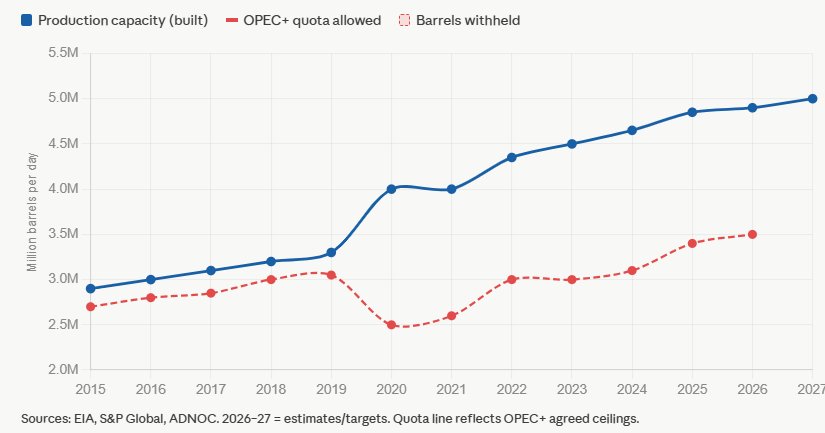
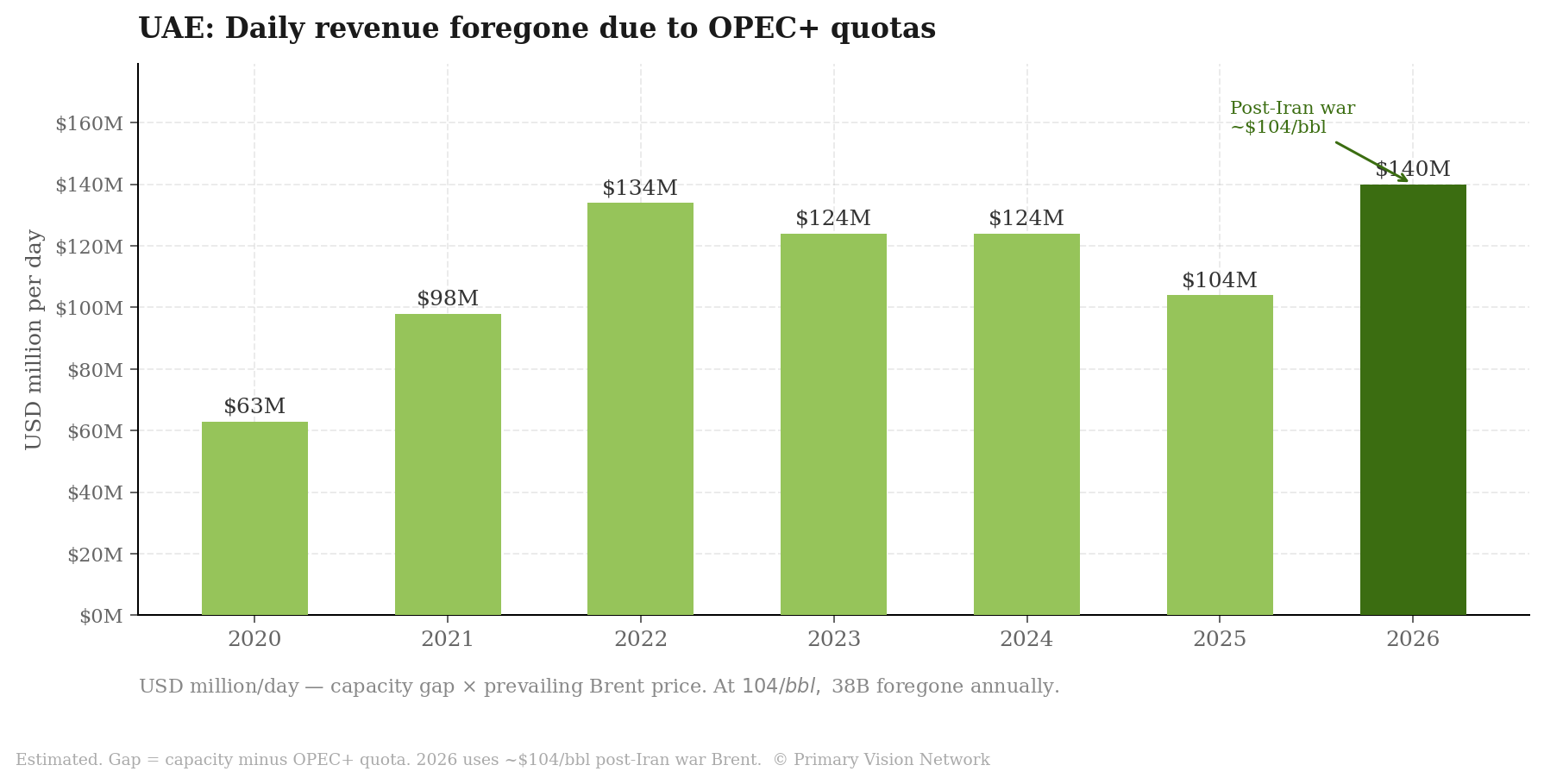
But the economics had been building toward this moment long before the first missile flew. ADNOC spent years expanding capacity toward 5 million barrels per day while OPEC quotas kept actual production pinned at 3.4 to 3.7 million. That gap — roughly 1 to 1.3 million barrels per day of deliverable production sitting idle by policy decree — represents somewhere around $100 million a day in foregone revenue at current prices. OPEC's concession was a grudging 300,000 bpd relief valve, phased in slowly. Abu Dhabi wanted the full tap open. With a fiscal breakeven now below $60 a barrel and Brent trading above $100 on Iran war risk premiums, the math for staying inside the cartel simply stopped making sense.
The broader geopolitical context matters too. Trump had spent months pressuring Gulf states to pump more and price lower, explicitly linking U.S. military backing to oil market behavior. The UAE, which relies on American security guarantees more than it likes to admit publicly, read that message clearly. Leaving OPEC is simultaneously a commercial decision, a diplomatic signal to Washington, and a statement that Abu Dhabi no longer sees the cartel as either a reliable pricing mechanism or a political shield.
What follows is worth watching closely. Free of quota constraints, ADNOC can now pursue its 5 million bpd target on its own timeline and its own terms. The revenue upside is significant. The damage to OPEC is structural — after Qatar in 2019 and Angola in 2024, the group is increasingly a club of constrained producers and declining members rather than the swing-capacity engine it once was.
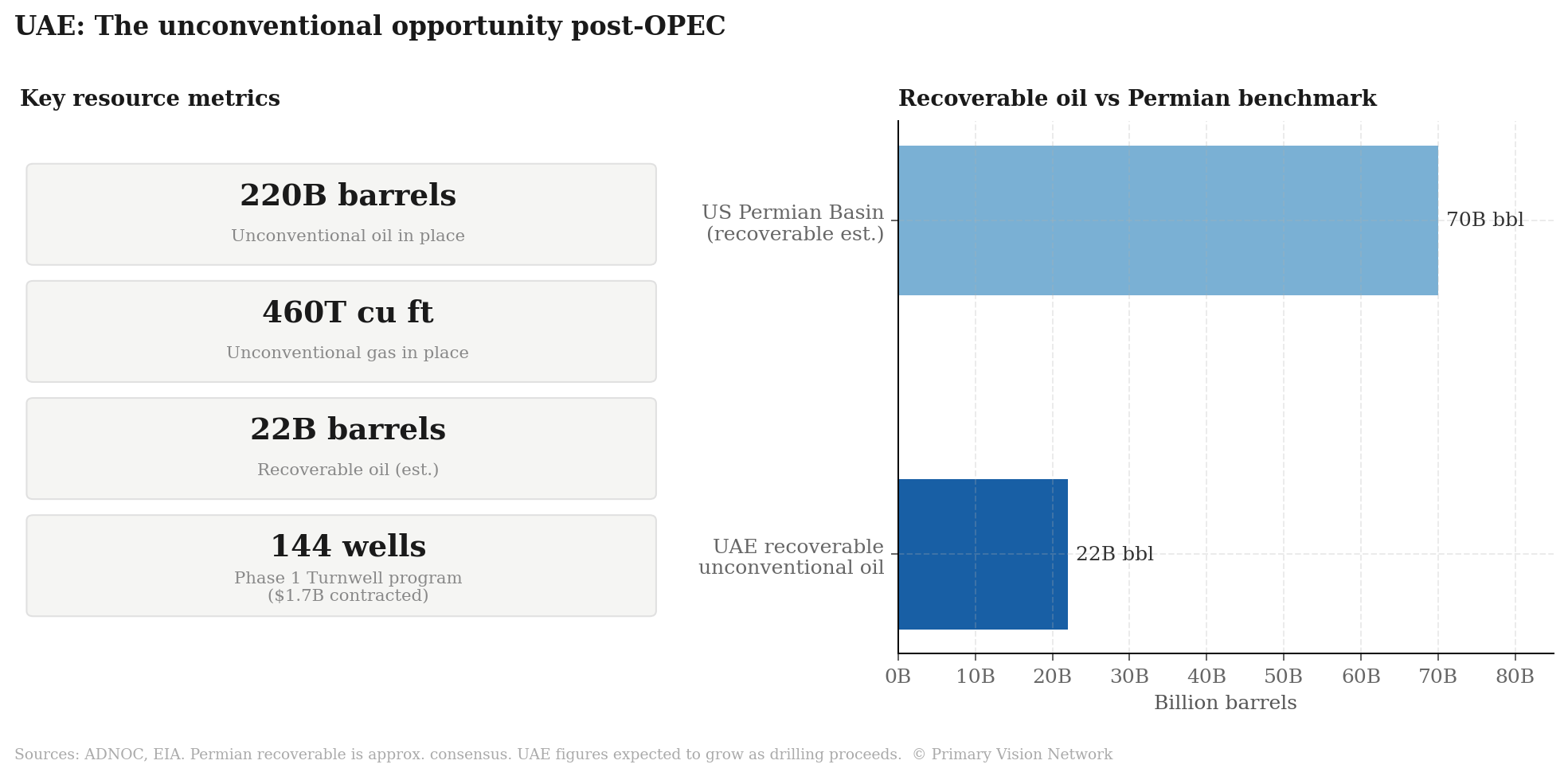
The question that should interest the frac industry most is what Abu Dhabi does next with its unconventional resources. The numbers are staggering — Abu Dhabi holds an estimated 220 billion barrels of unconventional oil and 460 trillion cubic feet of unconventional gas in place. ADNOC has already produced the UAE's first gas from an unconventional reservoir, deploying advanced fracking techniques through its Turnwell joint venture with SLB and Patterson-UTI — with the $1.7 billion Phase 1 contract covering 144 wells described as just the beginning of a campaign that could run to thousands. EOG Resources has also been awarded a concession for nearly 900,000 acres in the Al Dhafra region, with horizontal wells already drilled and oil tested to surface. Inside OPEC, aggressive unconventional development would have complicated quota negotiations and drawn political friction. Outside it, there is no ceiling.
The real question now is whether the UAE — flush with war-elevated oil prices, emboldened by its OPEC exit, and already running a live fracking program that its own engineers say is outperforming U.S. benchmarks in some areas — decides to go big on unconventionals. And whether the Permian's service companies are about to get a very large call from Abu Dhabi.
Tags: