






Articles
How Much of the World’s Refining Capacity Is Offline?
By Osama on July 30, 2026 in Free Articles
I am writing about global refineries today because the strongest pressure in the oil market has moved downstream. Crude flows have partially recovered from the first shock of the Iran war, yet plants converting crude into gasoline, diesel and jet fuel are still dealing with damaged capacity, restricted feedstock and thin inventories. Autumn maintenance is also approaching, when refinery runs usually decline as diesel buyers begin preparing for winter.
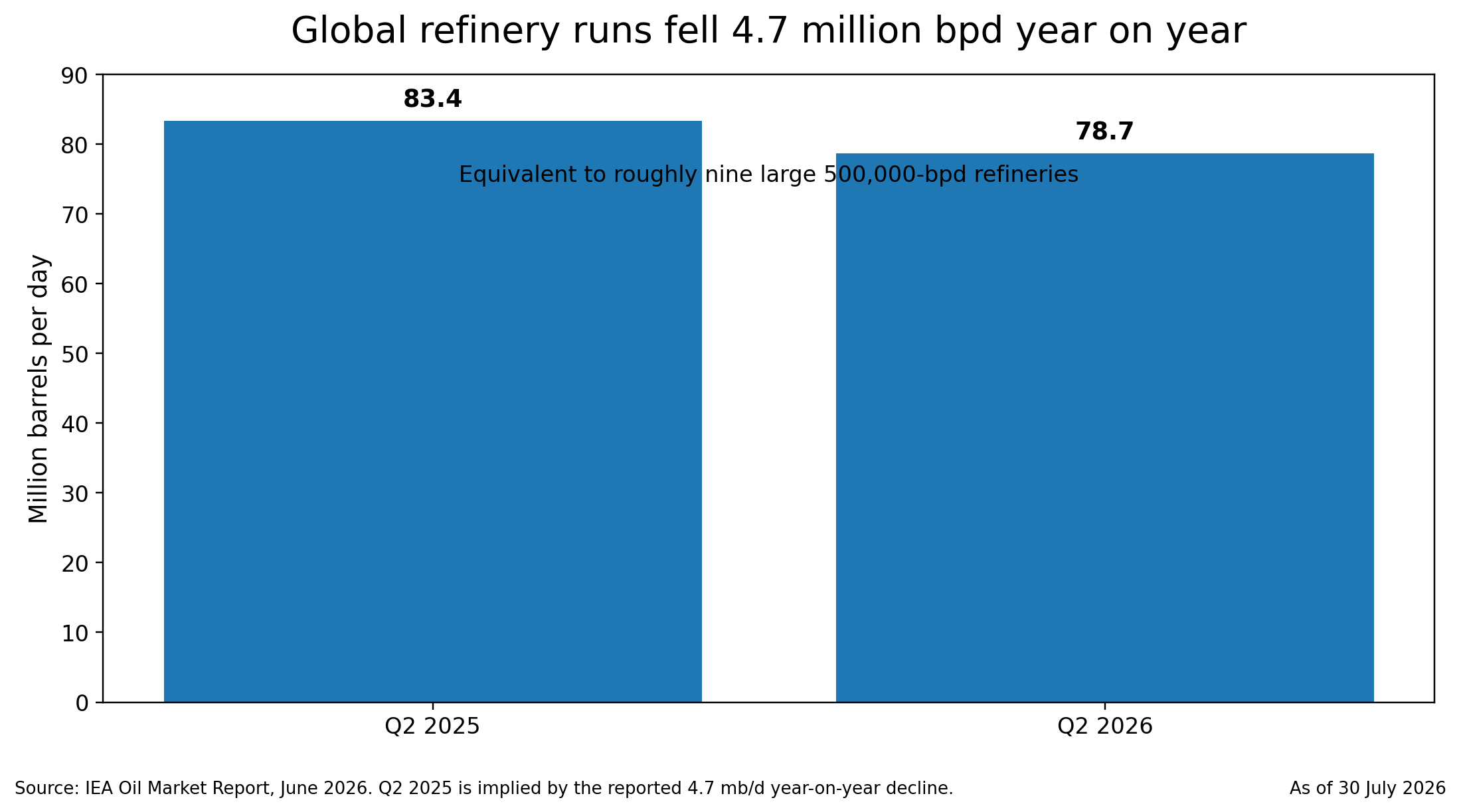
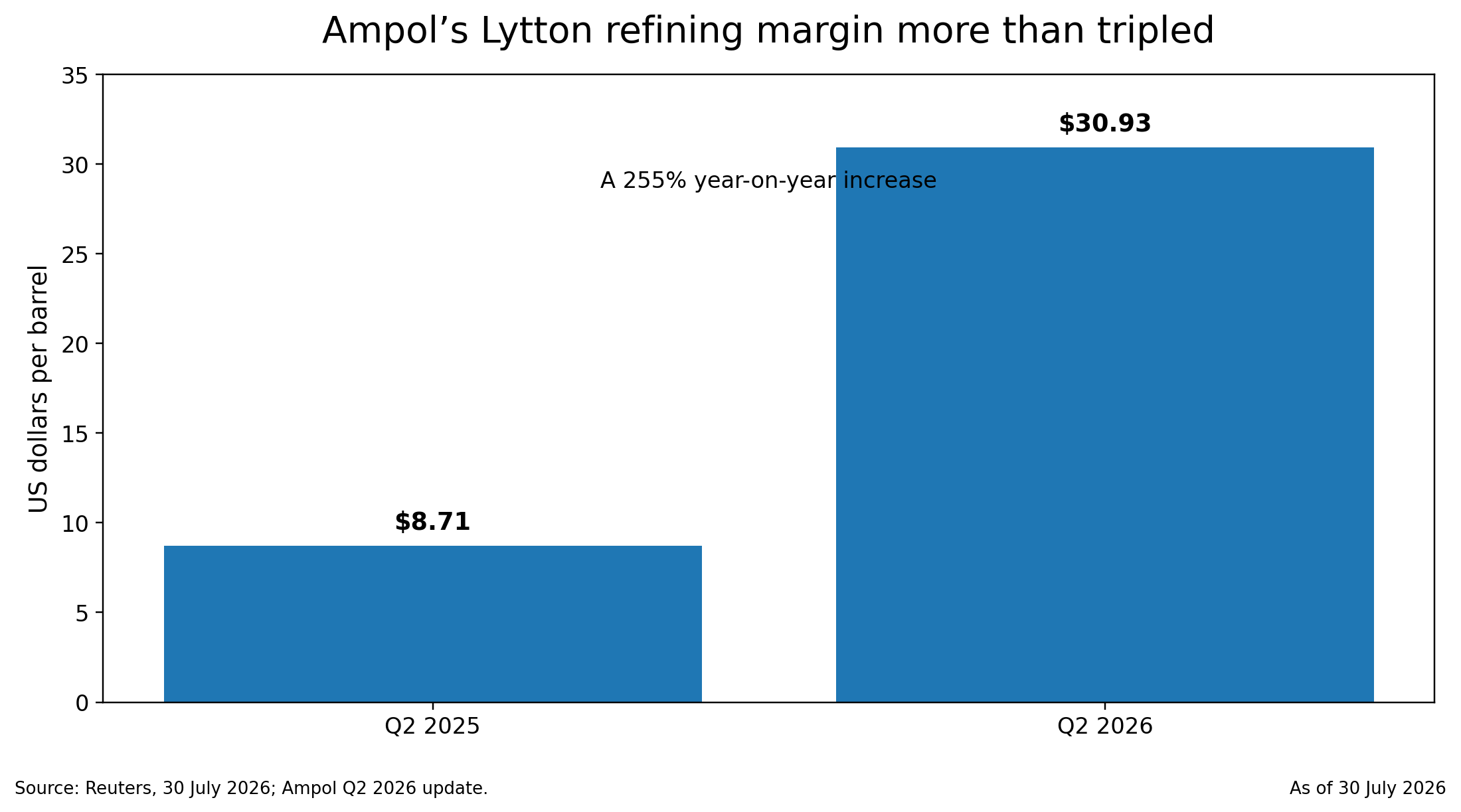
The year-on-year comparison captures the scale. Global refining runs averaged about 78.7 million barrels per day in the second quarter, roughly 5 million barrels per day below the same period in 2025. That is equivalent to removing ten large 500,000-barrel-per-day refineries. Runs recovered by 1.5 million barrels per day in June, although they remained 6 million lower than a year earlier. The U.S. 3-2-1 crack approached $70 per barrel, Northwest European margins reached nearly $30, and European diesel margins touched about $66. Ampol’s Lytton margin in Australia rose 255% year on year, from $8.71 to $30.93 per barrel.
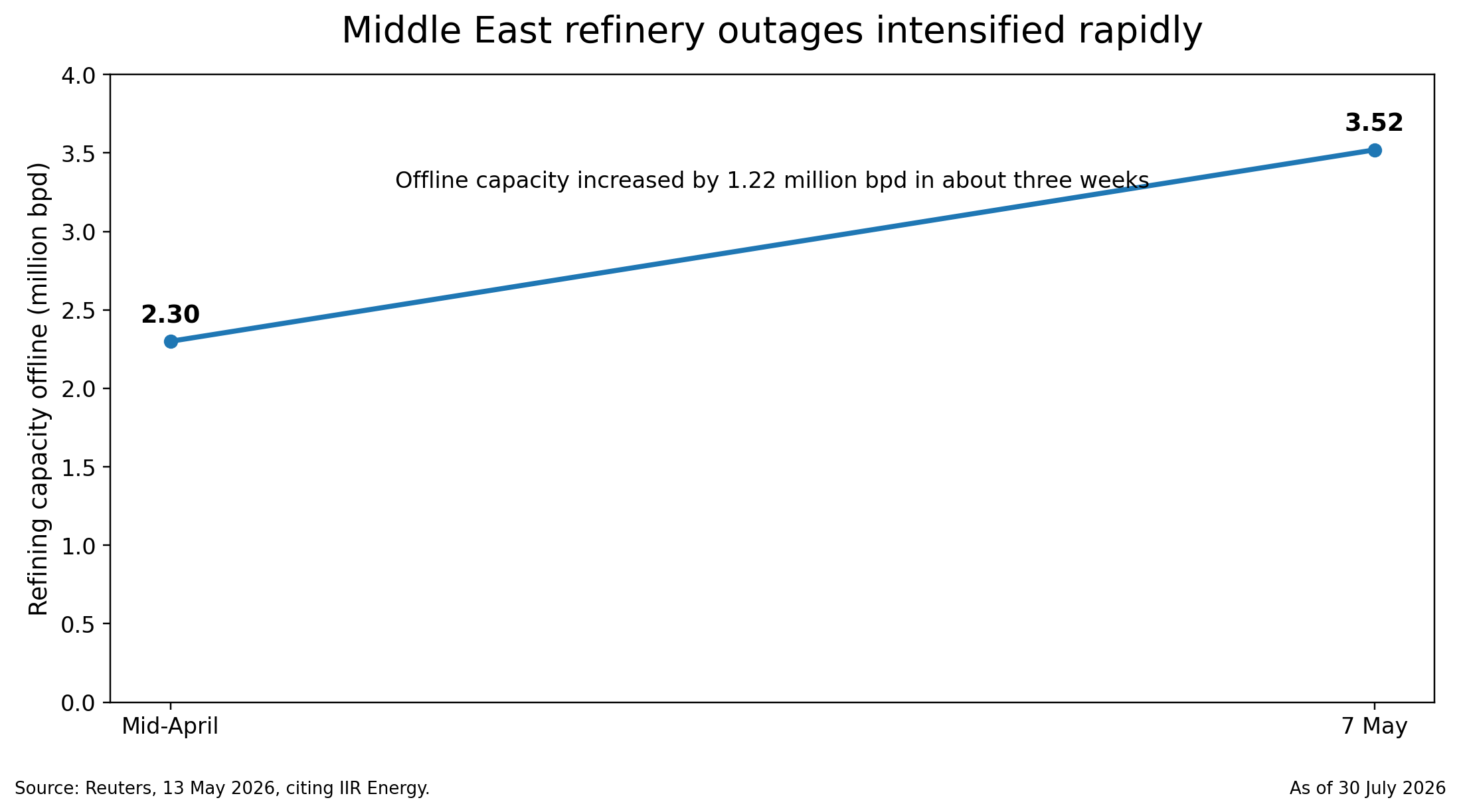
The Middle East remains the largest physical gap. At the peak in early May, the conflict had shut as much as 3.52 million barrels per day of refining capacity, around 3.5% of the global total. Saudi, Bahraini, Kuwaiti and Emirati plants were still partly or fully offline in July. Crude shipments recovered faster than product exports: June Gulf crude flows returned to roughly three-quarters of pre-war levels, while refined-product and LPG exports remained below half. Kpler estimated around 4 million barrels per day of crude exports, compared with only 1 million barrels per day of products—about one-quarter of normal pre-war product flows.
Units closed as a precaution can return within weeks, while damaged hydrocrackers, desulphurisation units, utilities and control systems require longer repairs. One industry estimate suggested Gulf refineries could return to 90% to 95% of capacity within 40 to 60 days after shipping flows normalise. Renewed fighting keeps those dates uncertain, and Gulf cargoes diverted around Africa can take roughly an additional month to reach Asian buyers.
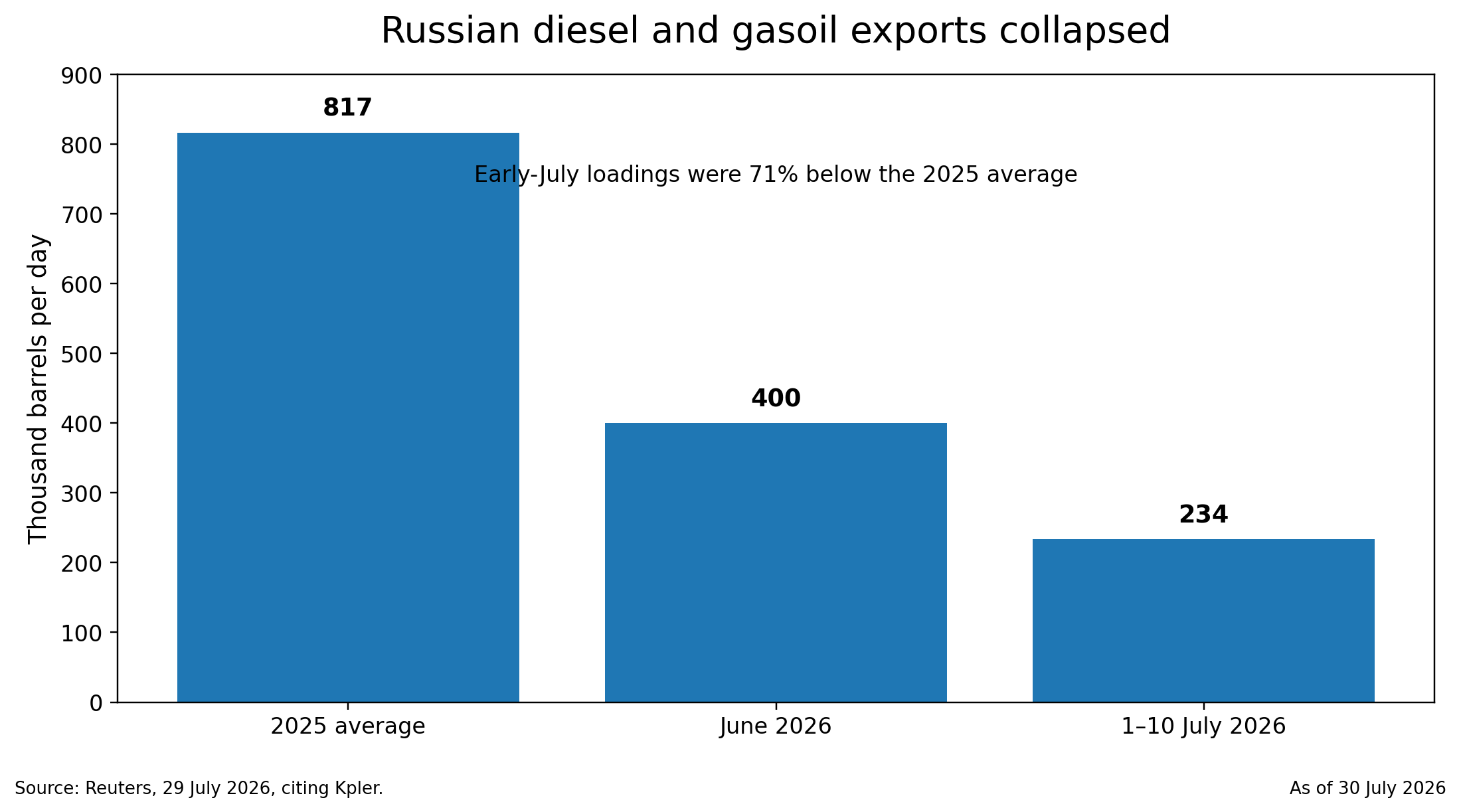
Russia is tightening diesel supply from another direction. It normally ranks as the world’s second-largest diesel exporter after the United States, but diesel and gasoil loadings fell from 817,000 barrels per day in 2025 to 234,000 in early July. The latest figure is 71% below last year’s average. Omsk alone processed about 440,000 barrels per day in 2024; after the July 6 attack, a crude unit representing 38% of capacity was damaged and another representing 37% was halted. Attacks have also affected NORSI, Saratov, Syzran, Salavat, Yaroslavl, Ryazan and Perm, prompting restrictions on diesel, gasoline and jet-fuel exports.
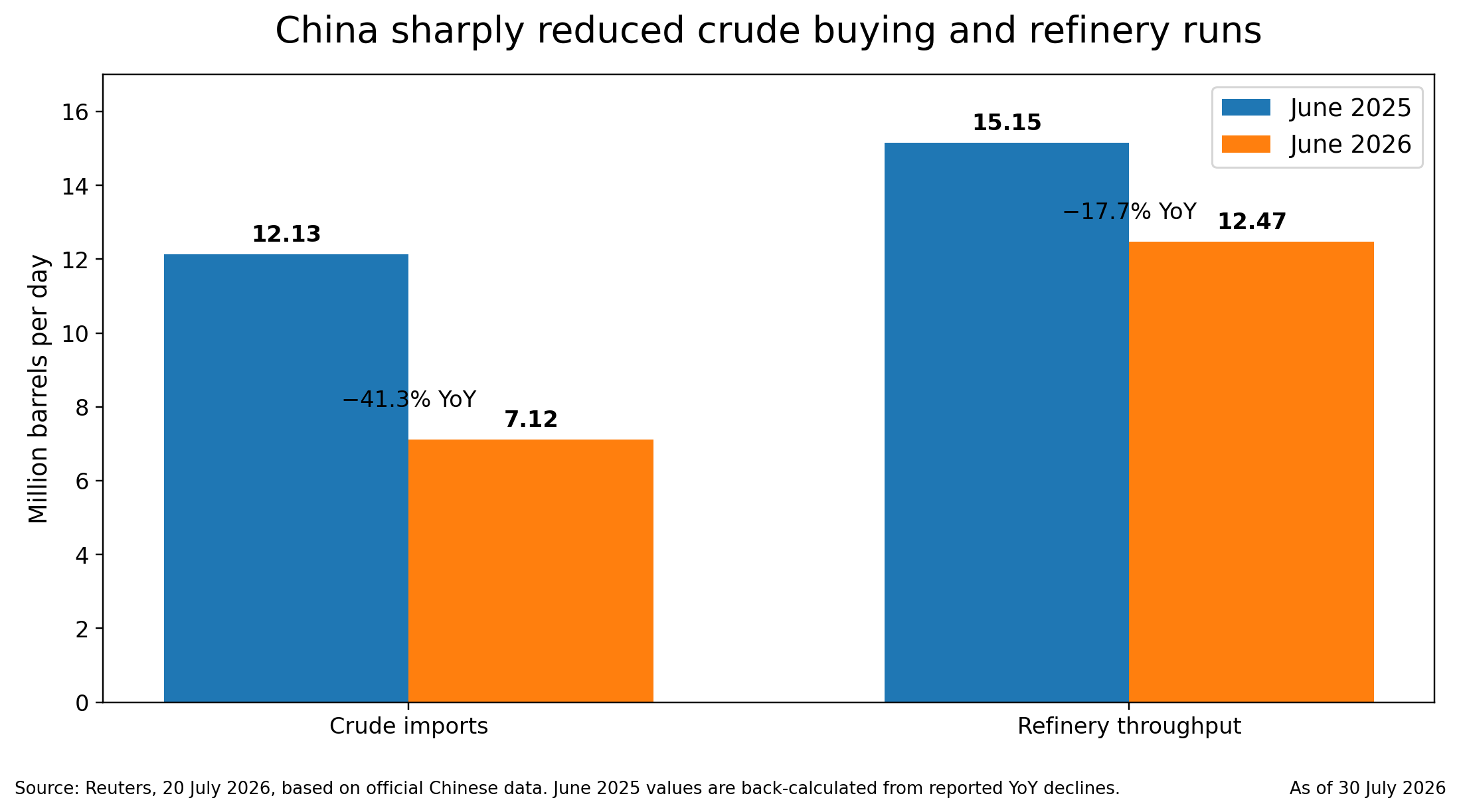
China has the most room to add supply. June throughput fell to 12.47 million barrels per day, down 17.7% year on year and the lowest since March 2020. Crude imports dropped 41.3% to 7.12 million barrels per day, their lowest since October 2016. Chinese plants operated at only about 58% of capacity in June, compared with 93% to 95% of pre-war levels across the rest of Asia. Wood Mackenzie expects Asian throughput to reach 30.37 million barrels per day in August, although Chinese export quotas will determine how much additional fuel reaches regional buyers.
The United States and Europe have much less spare room. U.S. refineries operated at 97.2% of capacity in the week ending July 24. Gasoline stocks were 7% below their five-year seasonal average and distillates were 10% lower. Ampol’s Lytton refinery will shut from August to October, reducing annual output by around 300 million litres, while turnarounds elsewhere will gather pace through September and October.
The immediate impact may be a faster improvement in crude balances than in fuel balances. Planned shutdowns reduce crude demand while supporting diesel, gasoline and jet-fuel margins. Europe will compete harder for U.S. and Asian diesel, freight and industrial costs will remain exposed, and operating refineries will continue capturing unusually strong margins. Through the next two months, Gulf restart rates, Russian repair times, Chinese export policy and the amount of maintenance that operators postpone will shape the market.