







Articles
Oil prices are falling but the war has not ended
By Osama on November 18, 2026 in Free Articles
Oil prices have fallen to their lowest levels since late August, while gasoline prices are experiencing one of their sharpest declines in years. On November 18, West Texas Intermediate (WTI) crude settled at $83.26 per barrel, down 3.2%, while Brent closed at $91.95. Yet the war with Iran continues, attacks on commercial vessels are intensifying, and one of the world's most important oil-export corridors is showing renewed signs of distress. How can prices fall when the risks to supply are increasing? The answer lies partly in the growing disconnect between financial markets, which are anticipating a return to surplus, and the physical oil market, where the recovery remains vulnerable to further disruption. But there are several other fundamentals at work, beginning with the remarkable recovery in Gulf production.
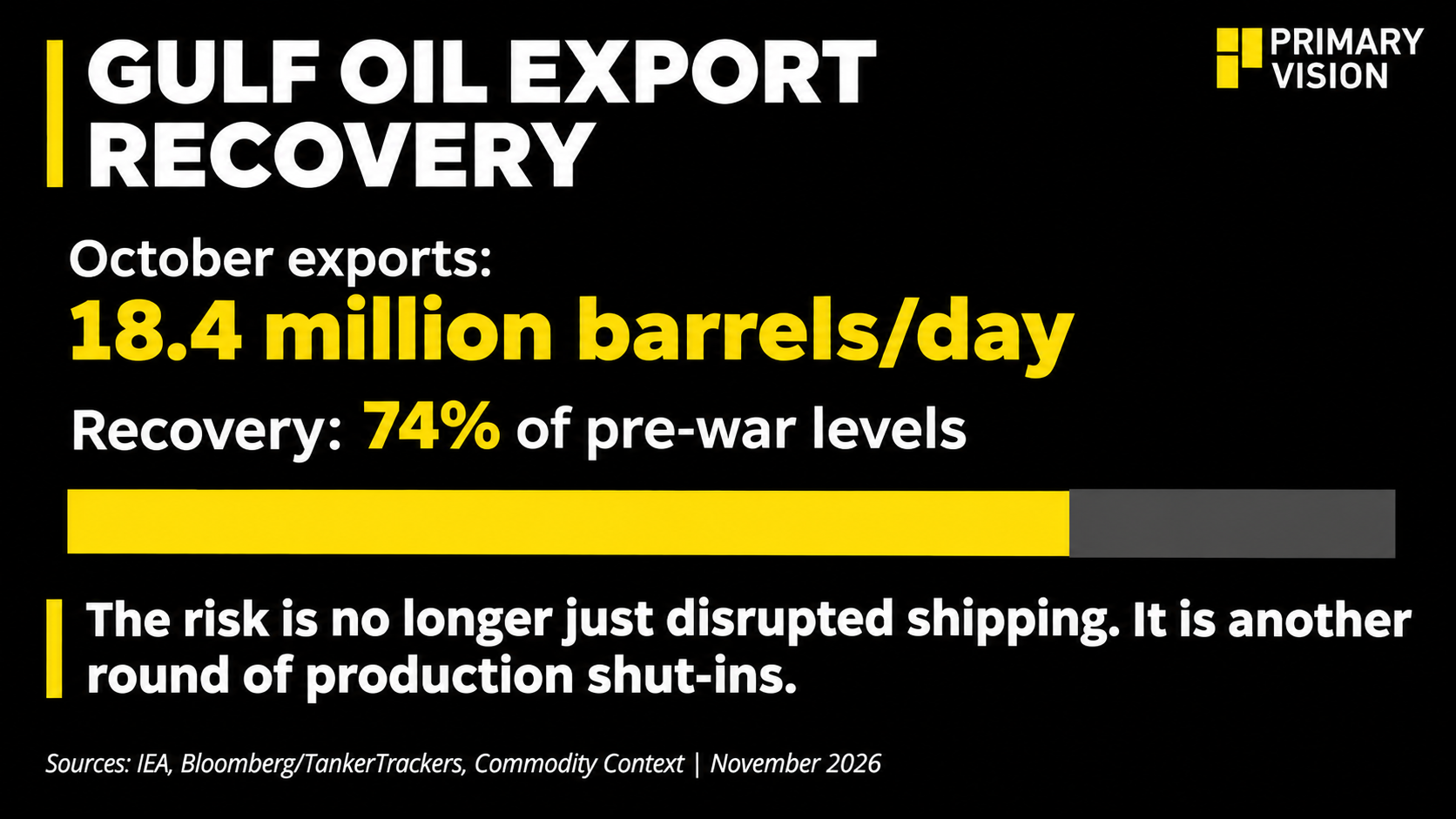
According to the International Energy Agency, global oil supply increased by 5.3 million barrels per day (mb/d) between August and October, reaching 105.4 mb/d. Saudi Arabia increased production from 8.93 mb/d in September to 9.99 mb/d in October, while Iraq's output rose from 4.06 mb/d to 4.6 mb/d. Kuwait also recovered substantially, increasing production from 1.58 mb/d to 2.03 mb/d. This is not simply a market trading on expectations of peace. Actual production has returned despite the continuing conflict. More importantly, the oil has been leaving the Gulf. In October, Gulf exports excluding Oman reached 18.4 mb/d, approximately 74% of pre-war levels. Crude exports recovered to 15 mb/d, equivalent to 82% of pre-war flows. Alternative pipelines, offshore transfers and unconventional shipping arrangements have allowed producers to bypass some of the constraints around Hormuz. The IEA subsequently raised its fourth-quarter global supply estimate by 3.3 mb/d, largely because Gulf exports recovered faster than expected.
At the same time, global oil demand is contracting. The IEA expects consumption to decline by 2.7 mb/d in 2026. China's electrification, improved vehicle efficiency, elevated fuel prices and weaker consumption across emerging economies have reduced the market's ability to absorb recovering production. Consequently, the market is experiencing something that would have appeared unlikely during the earlier stages of the war: rising supply alongside declining demand. This is also visible in inventories. According to the latest weekly petroleum report, U.S. crude stocks increased by 3.4 million barrels during the week ending November 13, while gasoline inventories rose by 5.2 million barrels, more than three times market expectations. However, the global picture is different. Although observed oil inventories rose by 52 million barrels in October, oil held at sea increased by 86 million barrels while onshore stocks continued declining. Demand destruction is easing pressure on prices, but it has not eliminated the supply constraints created by the war.
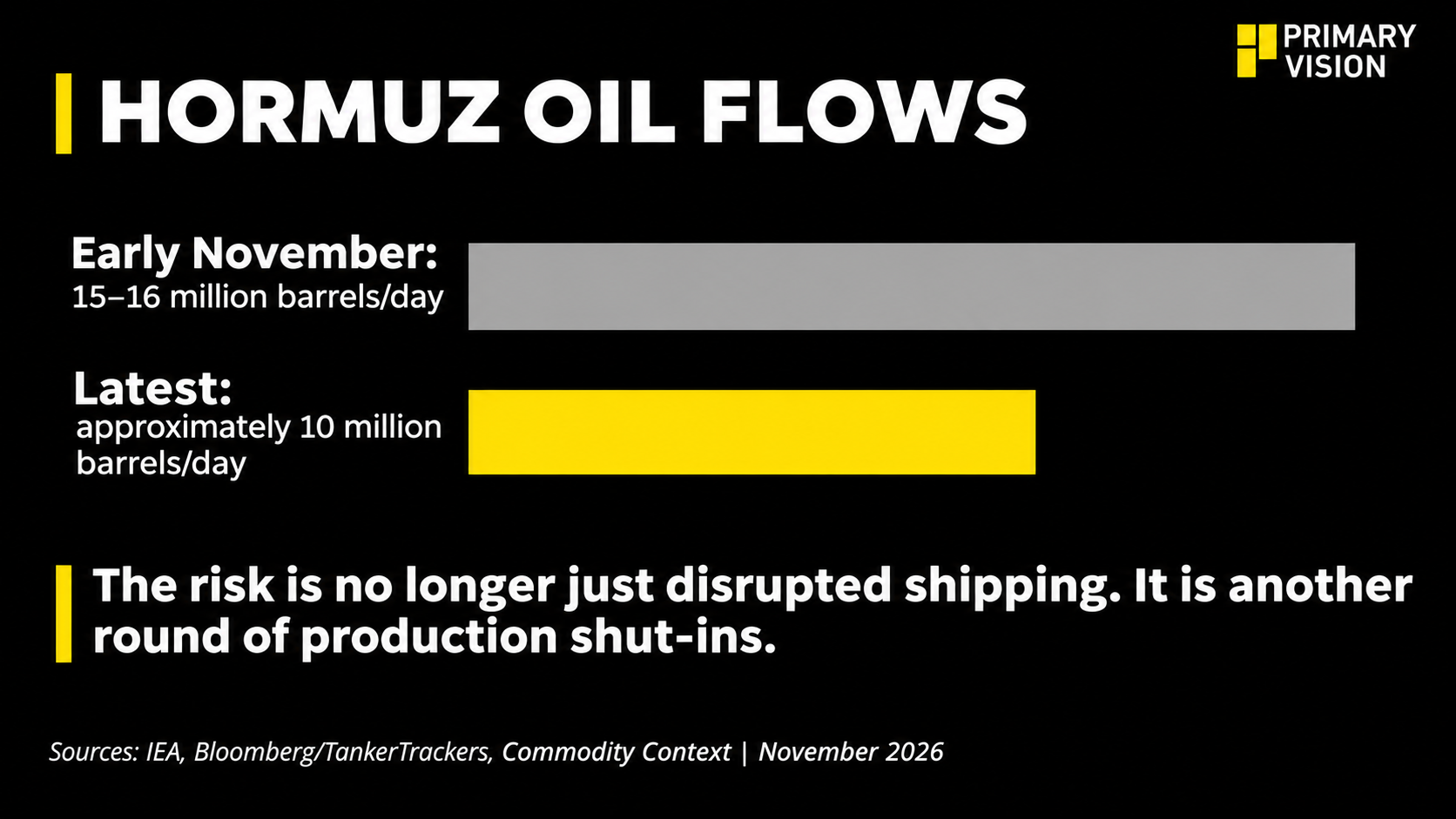
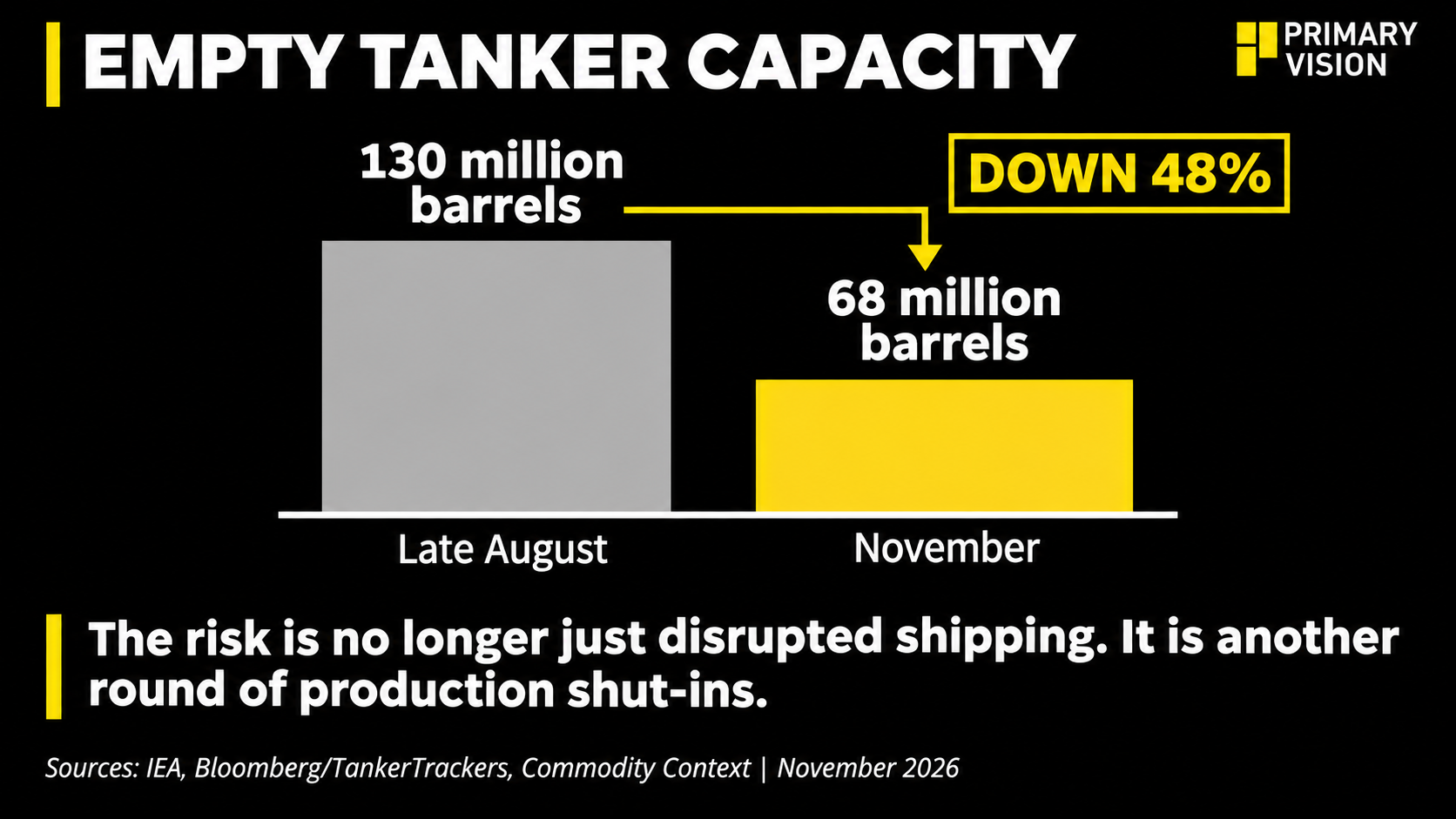
And this brings us to the latest developments in Hormuz. Outbound oil flows through the corridor, including Gulf of Oman ship-to-ship transfers, were running around 15–16 mb/d in the first week of November. The latest seven-day average is closer to 10 mb/d, according to the November 18 Commodity Context data. But the more consequential development may be occurring in the opposite direction. Bloomberg's TankerTrackers data indicate that the combined capacity of empty Very Large Crude Carriers (VLCCs) and Suezmaxes sailing toward the Gulf of Oman has declined from approximately 130 million barrels in late August to 68 million barrels today. That represents a reduction of nearly 48%. These figures measure prospective carrying capacity, not lost oil production. Nevertheless, if fewer vessels return to load crude, today's recovery in exports becomes increasingly difficult to sustain. Oil producers can restart wells and restore processing capacity, but they cannot export indefinitely without sufficient vessels and functioning transport routes. There is also the question of Saudi Arabia's East-West Pipeline, which has been instrumental in keeping Saudi exports moving outside Hormuz. Renewed Houthi attacks against pumping stations introduce another risk to this recovery. On November 17, the Houthis claimed an attack involving five drones against two stations. A prolonged interruption could force Saudi Arabia to reduce exports, divert additional barrels into storage or ultimately curtail production. Restarted production is therefore not necessarily secure production.
All of this complicates the World Bank's October Commodity Markets Outlook. The Bank expects Brent to average $91 per barrel in 2026, declining to $79 in 2027 and $70 in 2028. Its baseline assumes a sustained recovery in Middle Eastern crude shipments, Gulf refinery activity returning to pre-conflict levels by the second quarter of 2027, and improving Russian production. It also anticipates the oil market moving into surplus during the second quarter of 2027. These are reasonable economic assumptions, but they are increasingly demanding geopolitical ones. Consider that the IEA expects Gulf production alone to increase by another 5.3 mb/d in 2027. How much of that recovery remains achievable if shipping conditions continue deteriorating? And what happens if additional production restarts merely fill storage facilities because export capacity cannot keep pace? The World Bank itself acknowledges the vulnerability. In its adverse market scenario, further Gulf production losses of approximately 5 mb/d, alongside constrained Russian exports, would push average Brent prices to $105 in 2027, roughly 33% above its baseline.
My assessment is that this war is unlikely to end soon. However, a prolonged conflict does not automatically guarantee rising prices. Oil can remain under pressure if demand contracts faster than supply or if alternative routes continue functioning effectively. The more immediate question is whether the recovery that has driven prices lower can survive another sustained deterioration in maritime security. There is also a distinction between crude oil and refined products. The IEA reports that Gulf refined-product and liquefied petroleum gas exports remain at roughly half their pre-war levels. Diesel prices in Europe, despite falling from their peaks, were still approximately 77% above pre-war levels in its November assessment. Crude prices can therefore decline while important parts of the energy system remain severely constrained.
The market is currently responding to genuine improvements in production, weakening demand, inventory builds and expectations of further supply recovery. These are powerful bearish forces, and they should not be dismissed simply because the war continues. But the World Bank's projected surplus requires a recovery in physical flows, not merely production capacity. It requires vessels, pipelines, refineries and export terminals to remain operational despite an increasingly dangerous security environment. The oil market is pricing the recovery already achieved. The shipping market is beginning to question whether that recovery can last. If the war continues, as I expect it will, the sustainability of Gulf exports may ultimately matter considerably more than the latest weekly inventory build.