







Articles
- BLOG / Articles / View
- Articles
Market Sentiment Tracker: Everything Outside the Data Centre
By Osama on November 4, 2026 in Market Sentiment
The last week of October carried three central bank decisions, two advance GDP readings and a full round of October sentiment surveys, and across all of it the same division keeps appearing. One narrow set of activity, the construction and equipping of computing capacity, is expanding fast enough to carry headline growth in both the United States and China. Everything adjacent to it is flat or shrinking, and in Europe, where that investment leg barely exists, the contraction has nothing to hide behind. Below are the three regions read against that split, and against the energy shock that is taxing all of them at different points in the chain.
United States
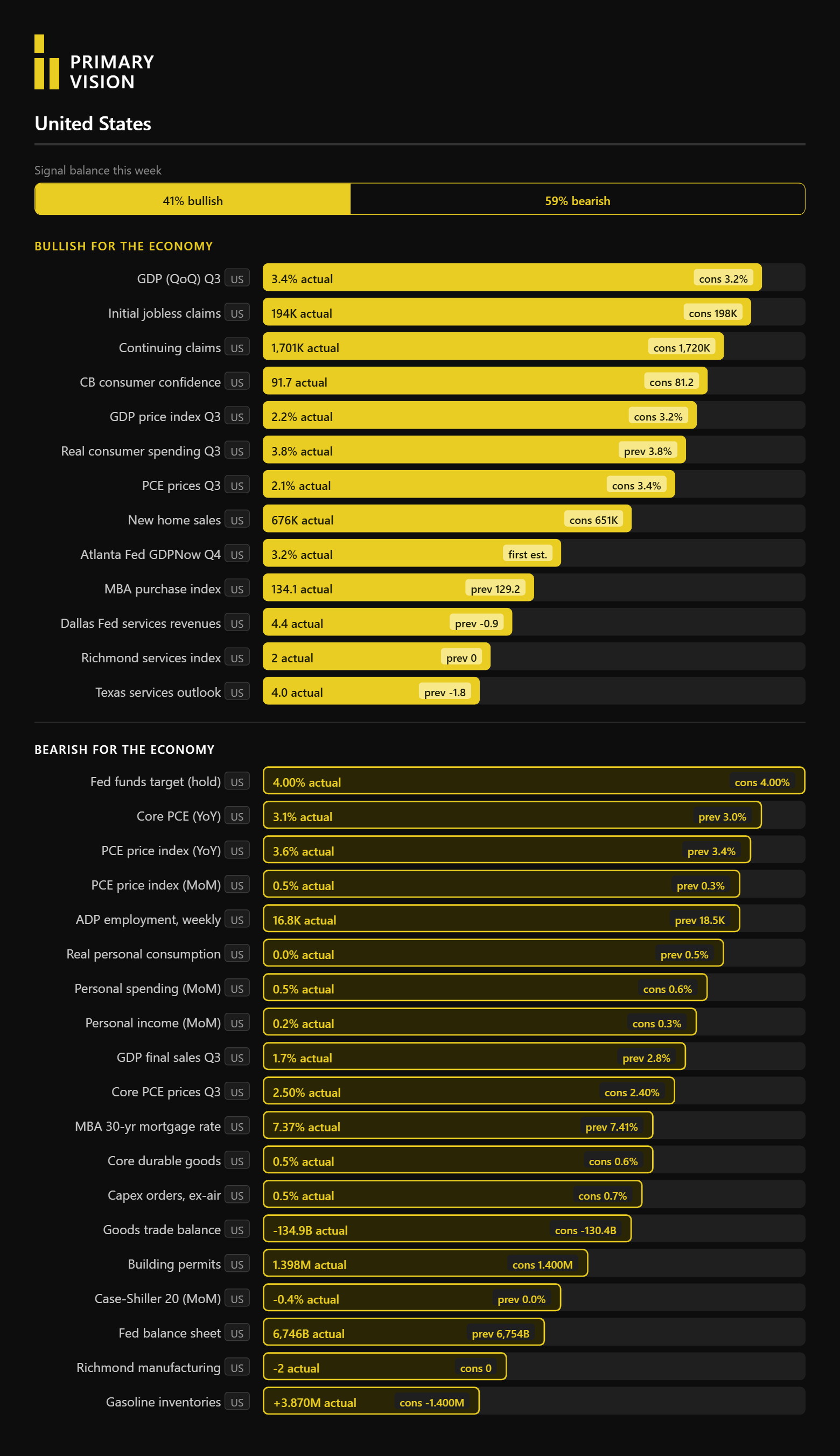
The quarter’s growth was manufactured by a single industry buying equipment from itself. Strip out the 20.9% rise in equipment spending and what remains is a household sector funding its consumption out of savings, with income growth running below outlays for a second month. That is sustainable only while the balance sheet lasts, and the labour market offers no relief, because a construction and semiconductor boom absorbs very few workers relative to the capital it absorbs. Hence the peculiar combination of 29,000 payrolls and claims near historic lows: nobody is being let go, and almost nobody is being taken on, which is what happens when the expanding part of the economy is capital-intensive and the hiring parts of it have stopped growing. Retail looks healthy only in nominal terms, with the chain-store series advancing on price while real consumption registers nothing. The financing side is now hostage to the Gulf, since last week’s entire move in Treasury yields tracked a single day’s reversal in crude rather than any domestic release. The stall in the consumer is either a September artefact or the start of something, and the 6 November payrolls decide which.
Europe
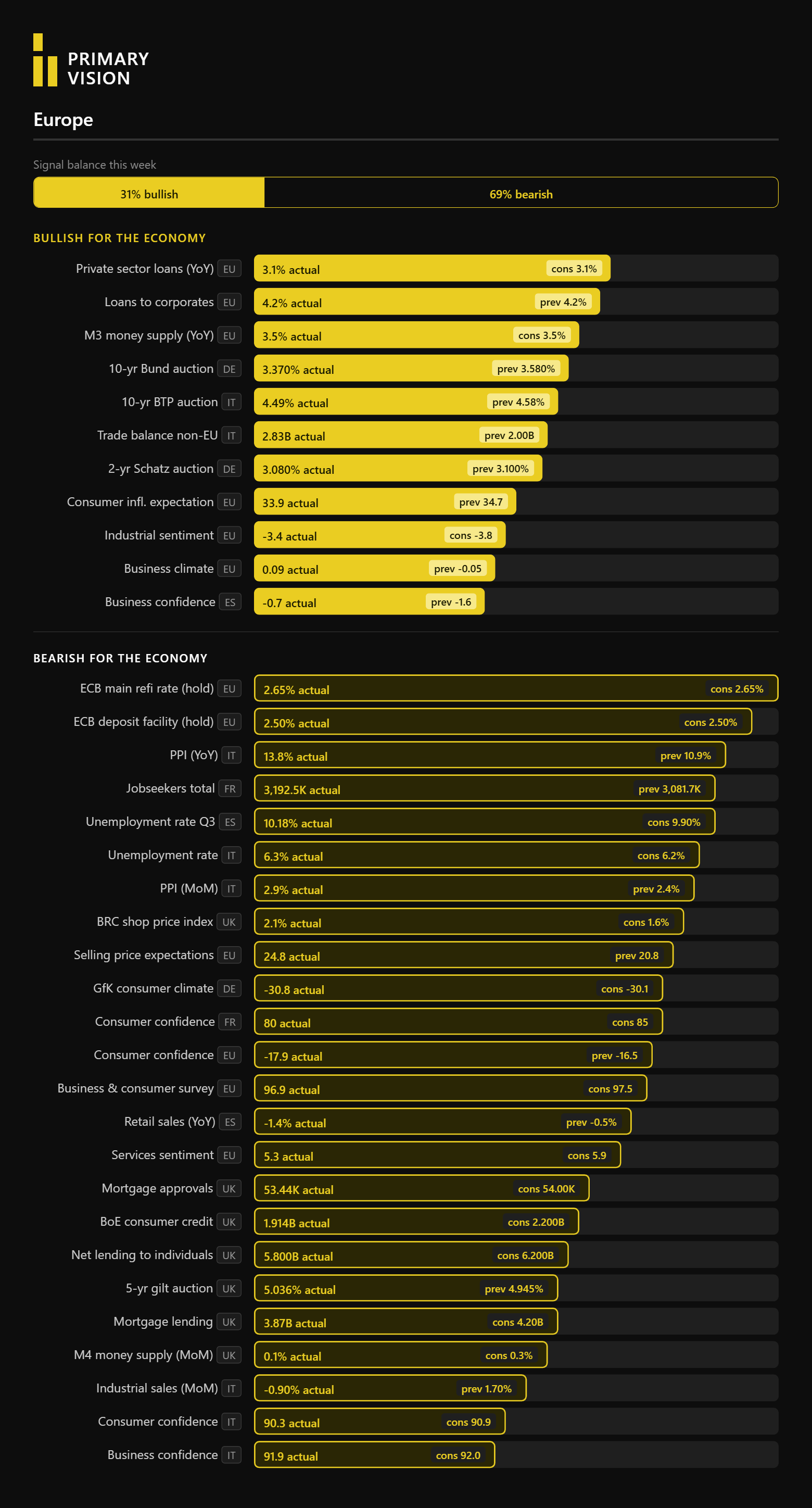
Europe is running the same demand failure without the investment cycle that masks it elsewhere, which is why its surveys are splitting into two incompatible stories. Companies report improving conditions while volumes fall, because the improvement is pricing power rather than orders, and Italian producers raising prices at a double-digit annual pace while their sales volumes decline is the clearest version of that. Households are not confused: confidence is deteriorating, French unemployment rolls grew by more than a hundred thousand in a month, and nobody inside the bloc is behaving as though conditions are improving. The inflation forcing the tightening was not generated in Europe at all. Roughly 1.7 points of the headline comes from an energy component worth 9.03% of the basket, and Germany’s apparent moderation is a temporary tax measure that will unwind. So the ECB is tightening into a demand shortfall to counter a price shock it cannot influence, and doing so while French borrowing costs sit at their widest spread over Germany since 2011. The October flash on 4 November determines whether the December move happens before or after France votes on its budget.
China
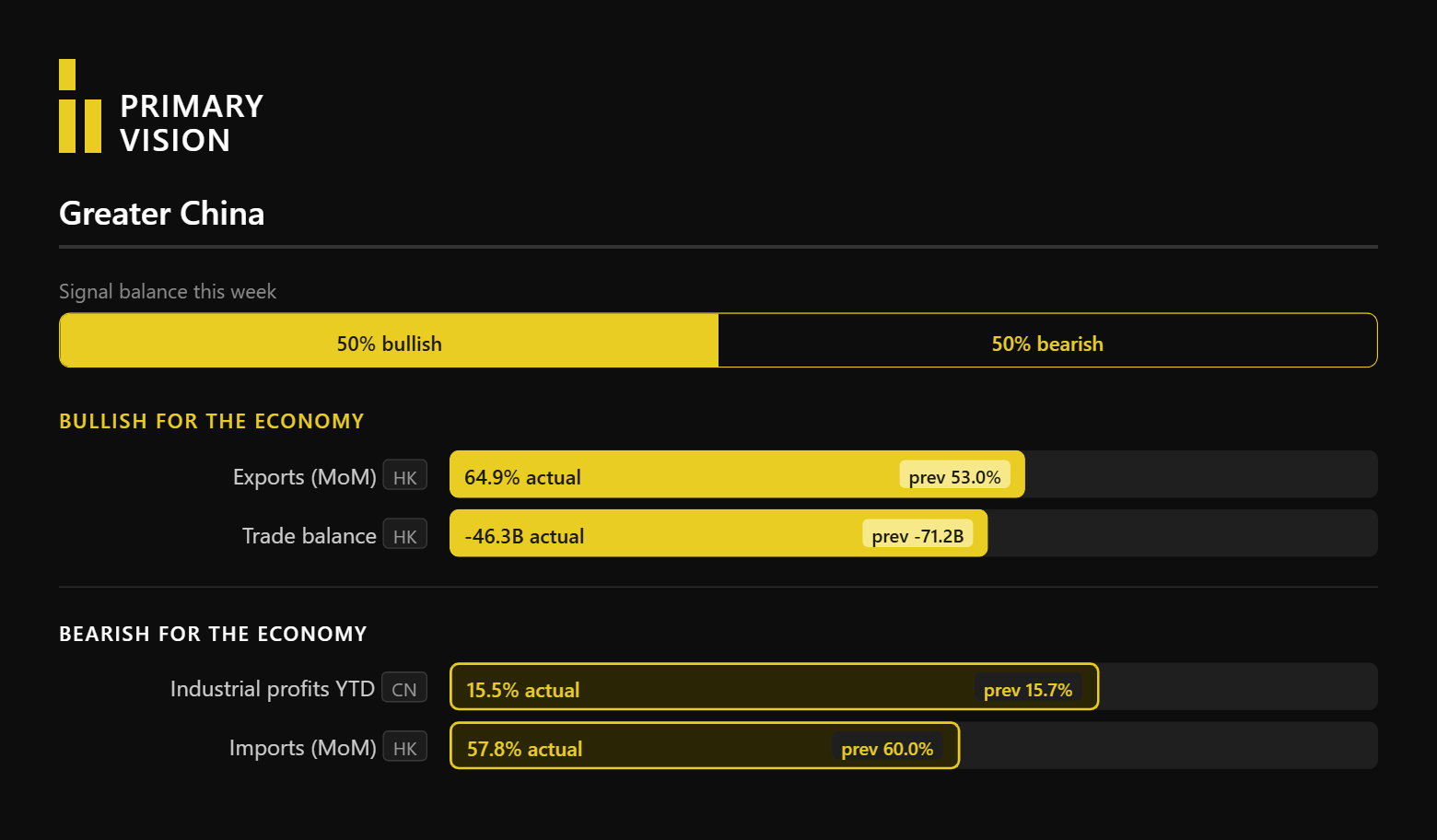
China’s industrial data has stopped describing an industrial base and started describing a supply chain. Profits grew strongly in September on the strength of electronics earnings more than doubling, while traditional manufacturing lost money outright, and the surveys confirm the split rather than contradict it: high-technology manufacturing expanded while the official gauge fell into contraction, large enterprises held above water and small ones did not. The mechanism separating them is the gap between factory-gate and consumer prices, which is where the energy shock lands. Producers are absorbing roughly four points of input inflation they cannot pass on, and only the firms with pricing power from AI demand can carry it. This matters beyond China, because the West has spent three years importing Chinese goods deflation as a quiet offset to its own services inflation, and factory-gate prices at a four-year high withdraw that offset precisely when energy prices made it most valuable. The electronics boom in China and the equipment line in the US accounts are two ends of one order book. October CPI and PPI on 9 November show whether the squeeze has reached the firms that cannot absorb it.
Permission denied
Upgrade to Pro Today and get…
• This article — plus dozens more each month, all within our full Research Module
• Frac Hits — our National-Level Frac Spread Count and Frac Job Count, updated weekly
• Frac Operator Monitor — detailed FSC & FJC by operator
• And so much more, designed to help you track, forecast, and outperform