Market Sentiment Tracker: Look at the 30 YR Treasury Yield
By
Osama
on July 21, 2026
in
Market Sentiment
Right now if you fill up in most of the US, you're paying close to $4 a gallon again — the number ticked back up the same week Centcom confirmed a tenth straight night of strikes on Iran. That's the number that actually explains the recent uptick in bond market.
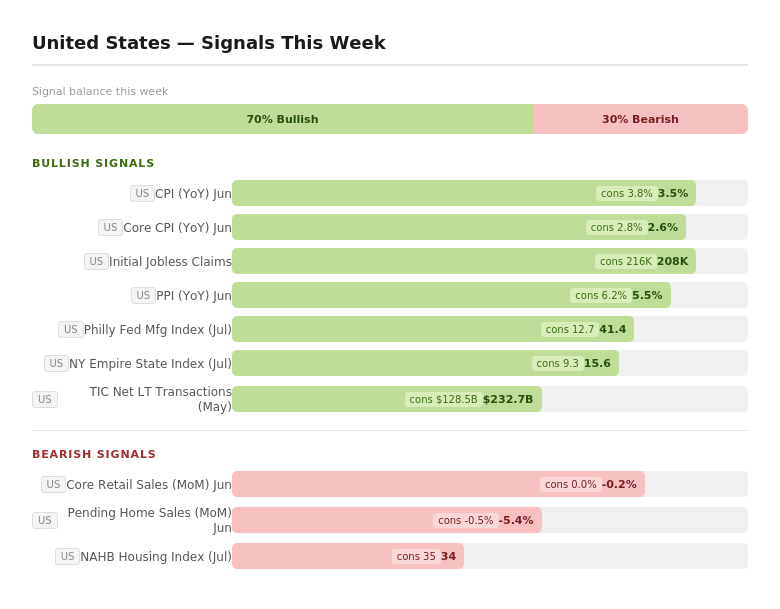
Because here's the paradox nobody's reconciling: June's headline CPI came in soft, core CPI was flat, and yet the 30-year Treasury yield has spent the summer sitting above 5%, a level it hasn't touched since 2007. If inflation is cooling, why won't the long end come down? The answer is that CPI is a rearview mirror and gasoline is a windshield. June's basket was collected before this month's re-escalation pushed pump prices back toward $4. The bond market isn't pricing what already happened but rather what will happen in the future as. That's why the 30-year has become, functionally, a real-time war gauge rather than a Fed-policy instrument.
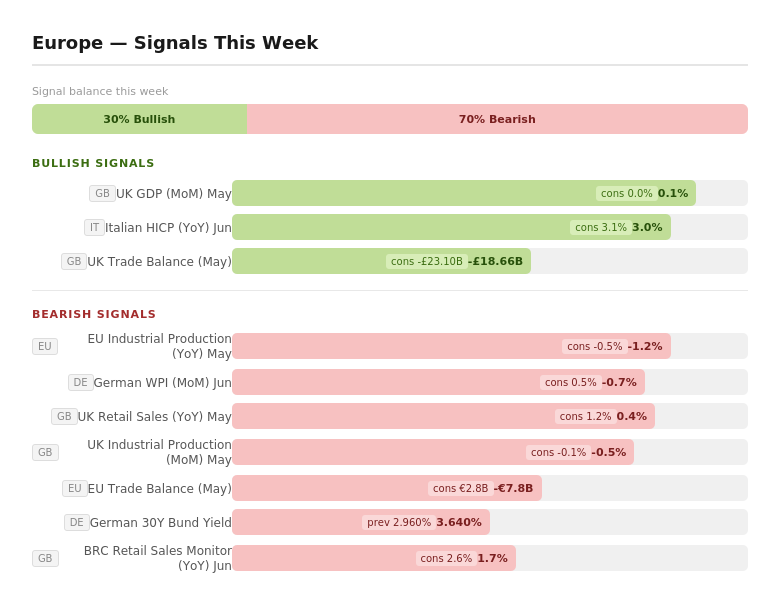
Europe is where you can see the transmission belt most clearly, because Europe doesn't produce its own oil. When the strait gets contested, Germany doesn't get a CPI problem first — it gets a factory-gate problem. German producer prices fell 0.7% month-on-month in June, against expectations for a rise of 0.5%. This is happening because energy input costs are eating the margin before the price hits the shelf. Pair that with the eurozone's trade balance flipping to a €7.8 billion deficit when a €2.8 billion surplus was expected, and you're watching a continent's import bill get reshaped in real time by a chokepoint six thousand miles away. Industrial production across the bloc is down 1.2% year-on-year. This is not happening because of low demand (well partially of course) but that is mainly an energy-cost issue.
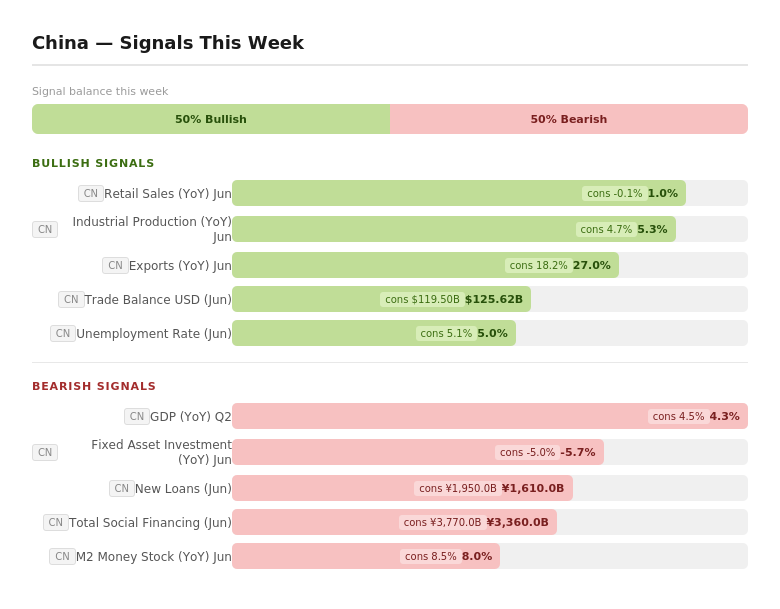
China is the outlier, and the outlier is the interesting part. While Europe's trade balance is bleeding, China's import growth came in at 36% year-on-year against a 24% consensus — a beat so large it looks less like organic demand and more like stockpiling. That's the pattern you'd expect from a country that still has sanctioned tanker routes moving discounted Iranian and Russian crude and every incentive to lock in barrels before Hormuz risk prices them higher. Exports beat too, at 27% against 18%, which reads as Chinese manufacturers front-loading shipments while they can still price competitively. But new loans missed badly — 1.61 trillion yuan against 1.95 trillion expected — which tells you Beijing's central bank is quietly tightening the credit spigot even as trade data looks hot, because it knows imported energy inflation is coming and doesn't want a credit boom colliding with it.
Put the three together and the picture isn't three separate regional stories — it's one story at three different stages. China is buying and stockpiling ahead of the shock. Europe is already living inside it, watching factory prices and trade balances absorb the hit with no oil production of its own to cushion it. And the US, sitting in between, is watching a war that keeps almost-ending reset and re-ignite the same fear every few weeks, which is exactly why the 30-year won't come down even as the June CPI cooled. Until the Strait of Hormuz stops being a variable and becomes a settled fact — open or closed, not oscillating — long-duration debt everywhere is going to keep pricing the war, not the data.
Upgrade to Pro Today and get…
• This article — plus dozens more each month, all within our full Research Module
• Frac Hits — our National-Level Frac Spread Count and Frac Job Count, updated weekly
• Frac Operator Monitor — detailed FSC & FJC by operator
• And so much more, designed to help you track, forecast, and outperform