Market Sentiment Tracker: The Economy Blinked This Week
By
Osama
on April 14, 2026
in
Market Sentiment
United States
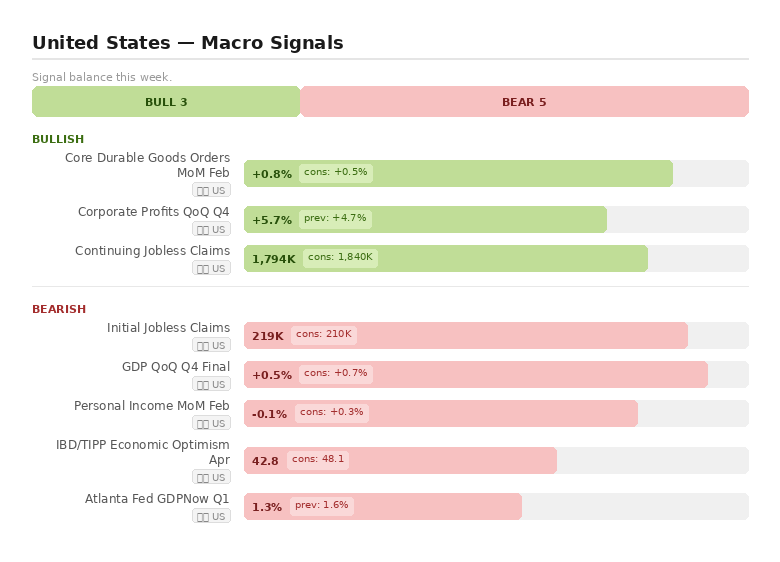
The U.S. economy is sending a split signal that matters: companies are making more money even as the people who work for them are making less. Corporate profits grew 5.7% in Q4, faster than the prior quarter. But personal income fell 0.1% in February when it was supposed to rise 0.3%. That gap cannot hold for long — consumer spending eventually follows income, not the other way around. The GDP number confirms something is already slowing. The Q4 final read came in at 0.5% annualized. That is not a recession, but it is a sharp drop from 4.4% the quarter before. And the Atlanta Fed's live Q1 tracker sits at 1.3%, revised down from 1.6%. The economy is losing speed in real time.
The jobs market looks fine on the surface — workers who lose jobs are still finding new ones. But 219K new unemployment claims came in above the 210K forecast, a small miss that fits the broader pattern of gradual deterioration. The number that cuts through the noise is the IBD/TIPP optimism index: 42.8, against an expected 48.1. Consumers are much more worried than economists thought. When sentiment falls that far below forecast, it usually shows up in spending data within a quarter or two.
Europe
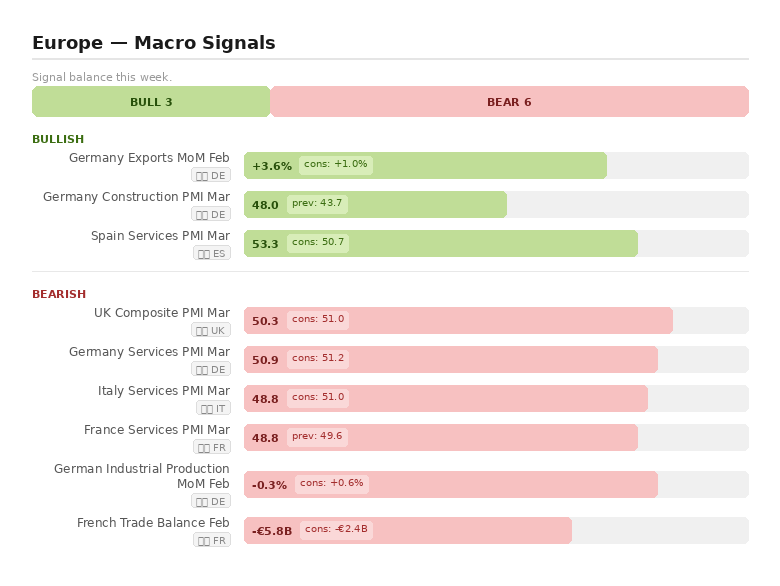
Europe's problem this week is that the one engine still running — services — is now sputtering in almost every major economy. Italy's services PMI collapsed to 48.8, a full 2.2 points below forecast. France sat at 48.8. Both are below 50, which means contraction. Germany held just above 50 at 50.9, but that was down from 53.5 the month before. The UK composite landed at 50.3 against a 51.0 expectation and a 53.7 prior. The direction is the same everywhere: down, and faster than expected. Germany's export surprise — up 3.6% against a 1.0% forecast — looks good on paper. But industrial production fell 0.3% when it was supposed to rise 0.6%. You can read those two prints together as a country that is shipping out what it already made, not ramping up new production. That is a very different story than genuine recovery.
France's trade deficit blowing out to −€5.8B against a −€2.4B forecast is the sharpest data point of the week for Europe. France is importing more and exporting less at the same time, a combination that drains growth. Spain at 53.3 services PMI remains the exception, but one strong outlier does not change the direction of the bloc.
China
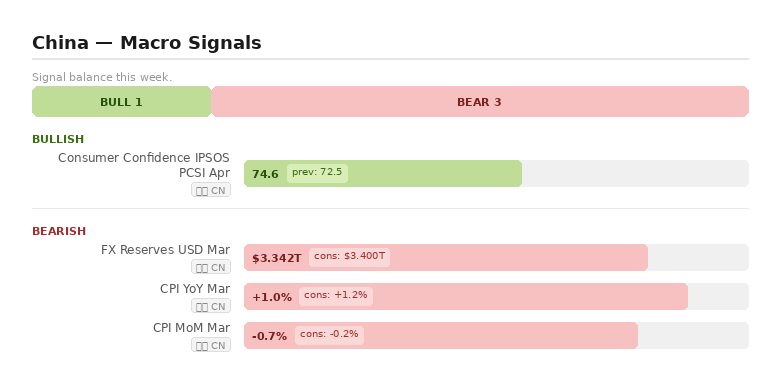
China's data this week tells a single clear story: prices are falling, and the government is running out of reserves trying to stop the currency from falling with them. CPI came in at +1.0% year-on-year in March, below the 1.2% forecast. The monthly number was −0.7%, much worse than the −0.2% expected. When prices fall month after month, businesses delay investment and consumers delay purchases — both waiting for things to get cheaper. That cycle is hard to break. The FX reserve number is the one to watch. China's reserves fell to $3.342 trillion against a $3.400 trillion forecast and a $3.428 trillion prior. That $86 billion miss versus expectations in a single month points to capital leaving the country, the PBOC spending reserves to prop up the renminbi, or both. Neither is good. A country burning through reserves to defend its currency is a country under pressure it cannot fully acknowledge publicly.
The one positive — consumer confidence ticking up to 74.6 from 72.5 — is real but thin. Sentiment can improve while the underlying economy weakens, especially if the stock market is having a decent run. It does not change the deflationary dynamic that the price data is describing.
Upgrade to Pro Today and get…
• This article — plus dozens more each month, all within our full Research Module
• Frac Hits — our National-Level Frac Spread Count and Frac Job Count, updated weekly
• Frac Operator Monitor — detailed FSC & FJC by operator
• And so much more, designed to help you track, forecast, and outperform