Market Sentiment Tracker: Who Is Paying for the AI Boom’s Insurance Policy
By
Osama
on October 20, 2026
in
Market Sentiment
The IMF kept global growth at 3.1% this year despite seven months of war and oil above $100, and the reason is that AI capital spending has roughly cancelled the energy shock. The cancellation works at the world level and nowhere below it. In April, 54 economies produced 95% of global growth. In October it is 32. The offset goes to whoever sits in the chip supply chain, and the bill goes to everyone who buys diesel. Each region this week comes down to which side of that line it is on, and what it is giving up to stay there.
United States
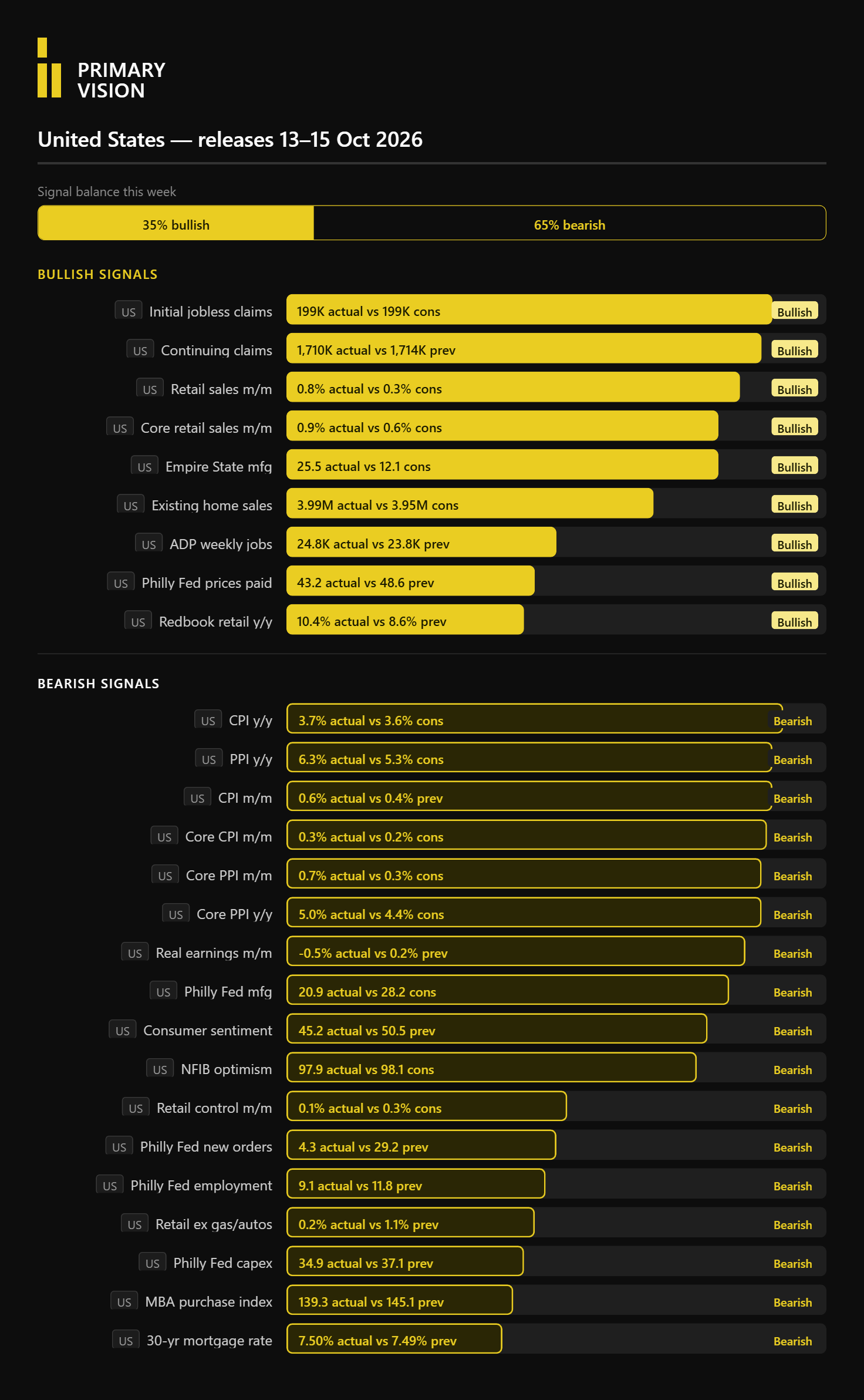
America sits on both sides at once, which is why its data looks incoherent. Empire State came in at 25.5 and Philadelphia new orders at 4.3 in the same week. Both are accurate, and they describe two different economies that get averaged into one figure. The hyperscalers are funding their data centres from their own profits rather than from borrowing, so interest rates barely touch that spending. When the Fed raises rates against an oil shock it has no control over, the pressure therefore falls entirely on the part of the economy that is already weak. Roughly a quarter of American capital spending now behaves this way, which means the Fed has to tighten harder than it used to for the same effect, and small firms and housing absorb the difference. Small business confidence at 97.9 and mortgage applications at 139.3 are the first signs of it. The labour market has nothing in reserve: 29,000 jobs in September, very few people quitting, claims at 199K.
Europe
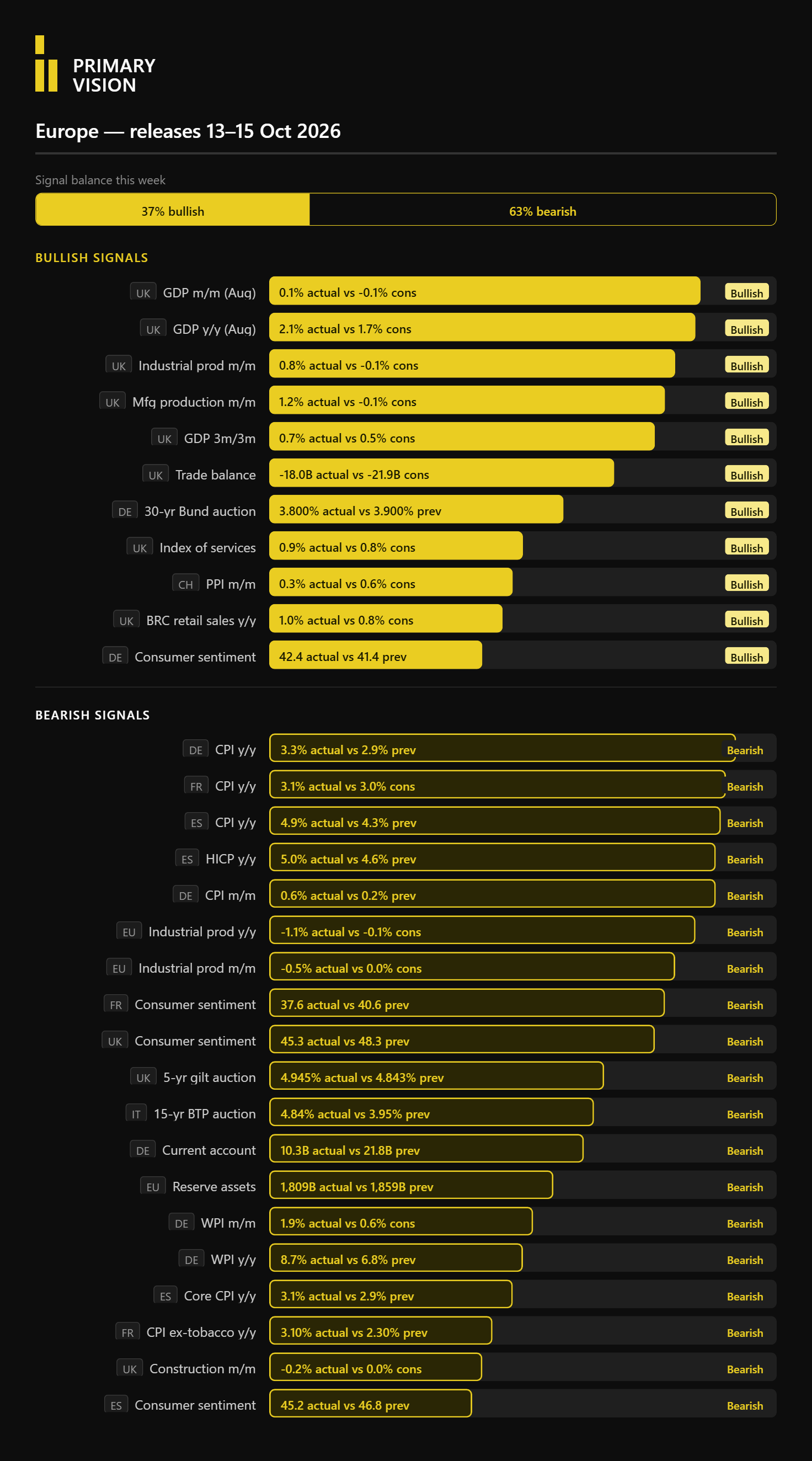
Europe sells equipment into the boom and buys everything else from outside it, so the benefit arrives as orders while the cost arrives as prices. Capital goods output is up 3.0% over the year against non-durable consumer goods down 9.1%, which is not two sectors moving independently but the same households funding the second while the first is paid for abroad. The awkward part is what holds core inflation at 2.5%. Chinese goods are cheap because Chinese industry is absorbing the energy shock rather than pricing it, and Brussels is now preparing measures against the €60bn a month that arrives on those terms. Restricting it would lift core inflation while growth slows to 0.9%, which is the one trade-off nobody at the ECB has had to defend in public yet. Meanwhile a single deposit rate is being asked to cover borrowers moving apart: Italy paid 89 basis points more for 15-year money this week, Germany paid less than last time. The gap widens on its own from here, because Italy’s debt service rises with every auction while Germany’s falls. Healey has the same arithmetic alone on 28 October.
China
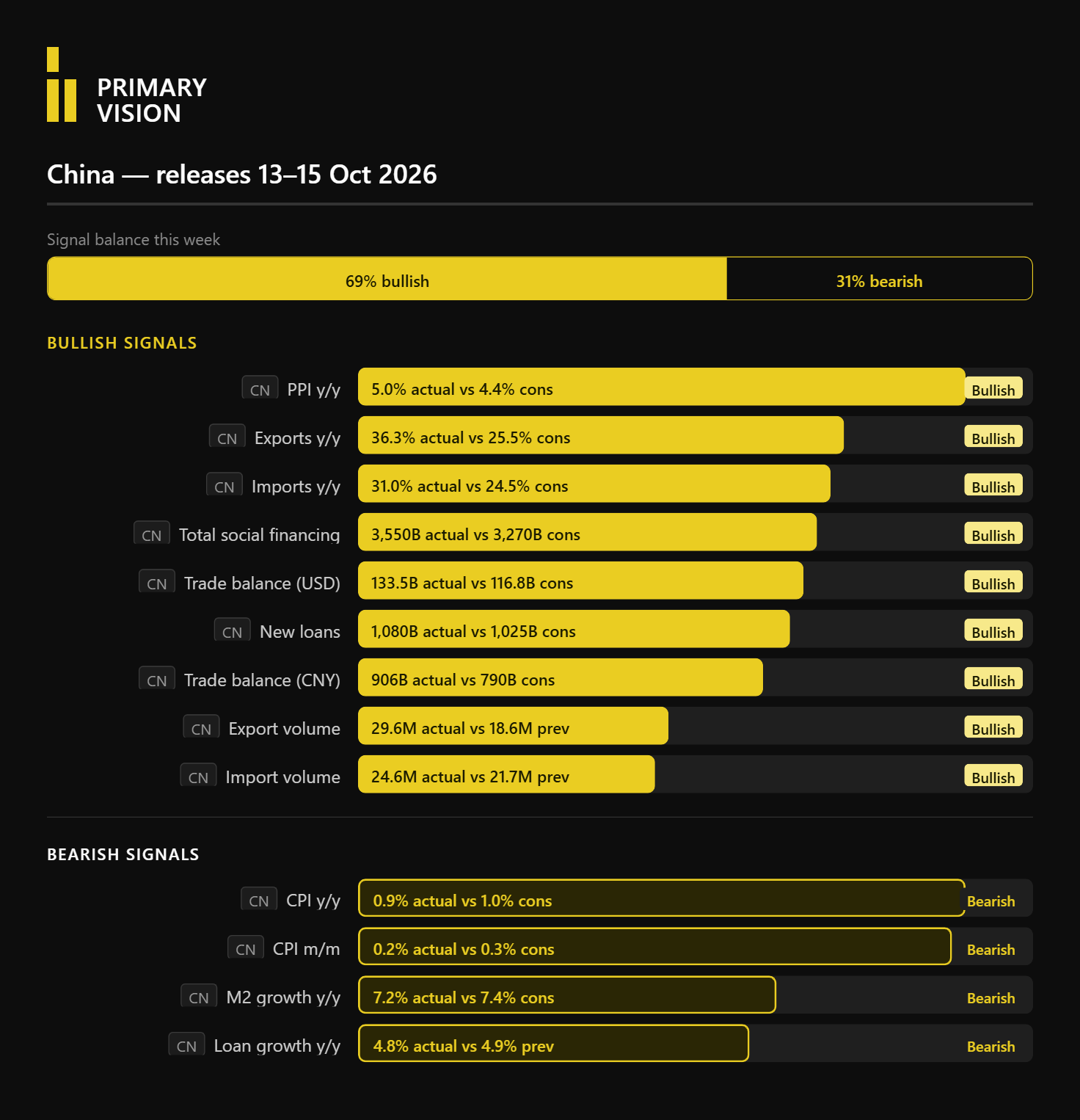
China is winning the volumes and losing the terms, and the gap between producer prices at 5.0% and consumer prices at 0.9% is where that shows up. Four points of cost increase are sitting inside Chinese manufacturers rather than on any invoice, which is the actual machinery behind the IMF’s global offset. Cheap AI hardware reaches the rest of the world because someone upstream is paying $110 for the oil and not charging for it. Beijing has chosen to deepen the subsidy, fixing the yuan at its strongest since February 2023 to cheapen imported crude at the cost of export competitiveness, which works only while volumes stay near 36%. Underneath, the domestic economy is not participating: fixed investment down 7.2% over nine months, bank lending growth slipping to 4.8%, and the September credit expansion came mostly from government bonds rather than borrowers. The export machine is therefore carrying a stalled economy on compressed margins. It has also been running oil stocks down for six months with import volumes 21.5% lower, which is part of the buffer the IMF says the world has drawn on. The restocking is the moment the offset stops being free.
Upgrade to Pro Today and get…
• This article — plus dozens more each month, all within our full Research Module
• Frac Hits — our National-Level Frac Spread Count and Frac Job Count, updated weekly
• Frac Operator Monitor — detailed FSC & FJC by operator
• And so much more, designed to help you track, forecast, and outperform