






Articles
- BLOG / Articles / View
- Articles
Market Sentiment Tracker: Who’s Paying for AI?
By Osama on November 17, 2026 in Market Sentiment
Underneath this week’s calendar sits a single physical construction project, and it is consuming electricity, semiconductors, networking hardware, rare earth magnets and long-dated capital at a scale that is starting to surface inside price indices as something that resembles inflation but behaves far more like scarcity. America finances it and bills the cost to households through the regulated rate base, China manufactures the inputs and absorbs the margin compression that comes with them, and Europe sells the equipment into both while refusing to let the thing be built on its own territory. That last position is the most awkward of the three, and the October data makes all of them legible.
U.S.
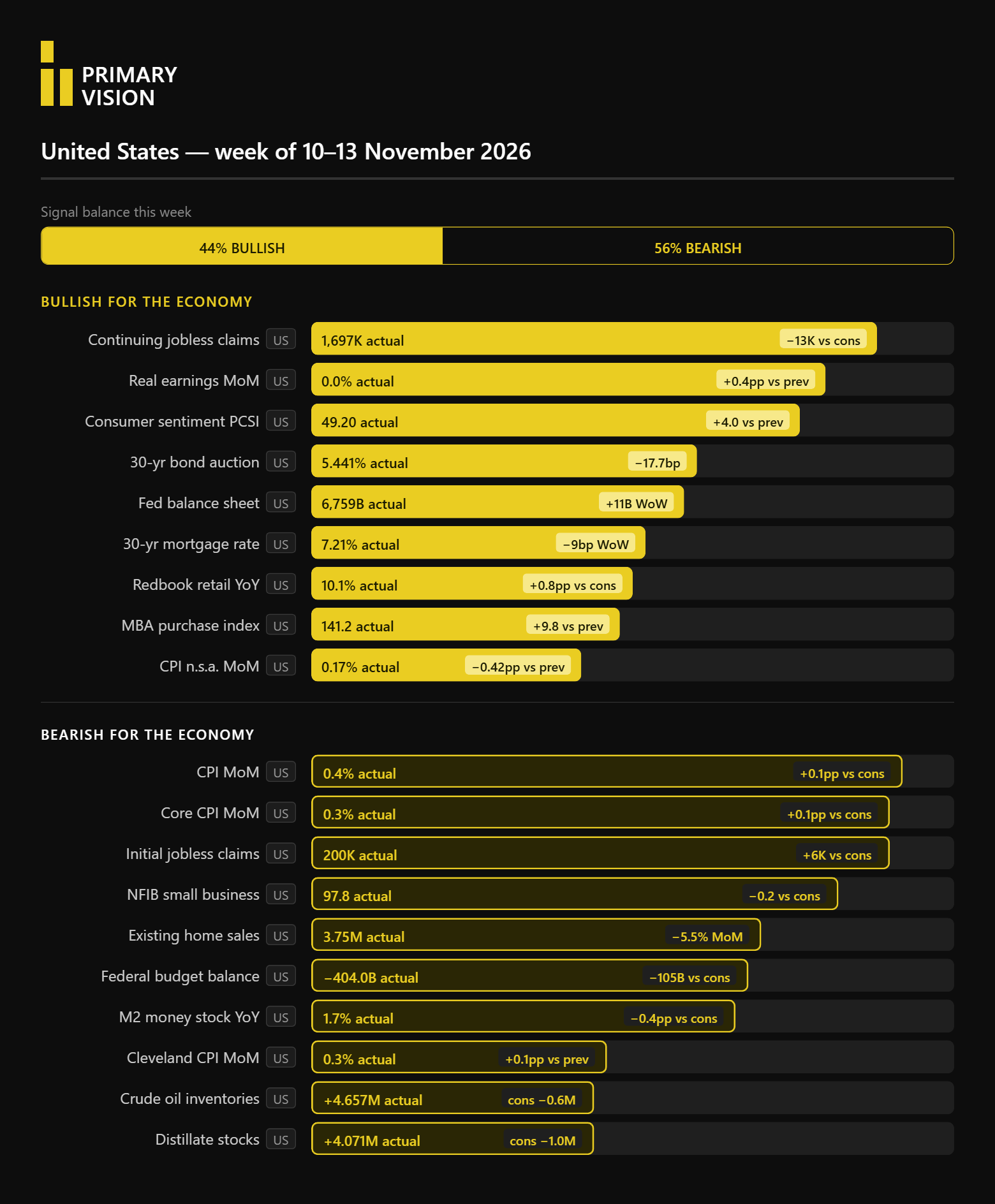
The split inside October’s energy line is the whole story, because electricity rose 0.9% on the month while utility natural gas fell 0.8%, and a divergence that wide between a fuel and the thing made from it is a load problem rather than a cost problem. The reason it reaches consumers is structural: investor-owned utilities have committed roughly $1.4trn of capital spending through 2030 with 2026 capex up 27%, and because that spending enters the rate base, the EIA expects residential electricity prices to rise 5.1% this year on top of a cumulative 40% since 2021. The same buildout is competing for duration at the same time, with AI-related bond issuance reaching $250bn in the first half alone, $218bn of it investment grade, which is the mechanism putting a 30-year government bond at 5.441% and a mortgage at 7.21% in the same week that applications still rose 6.2%. Household energy carries a 3.432% relative importance and is now being priced by server farms, while professional and business services added 70,000 jobs inside a 165,000 total against a 59,000 consensus. Existing home sales fell 5.5% to 3.75m in the same month, so the household is losing both contests at once.
Europe
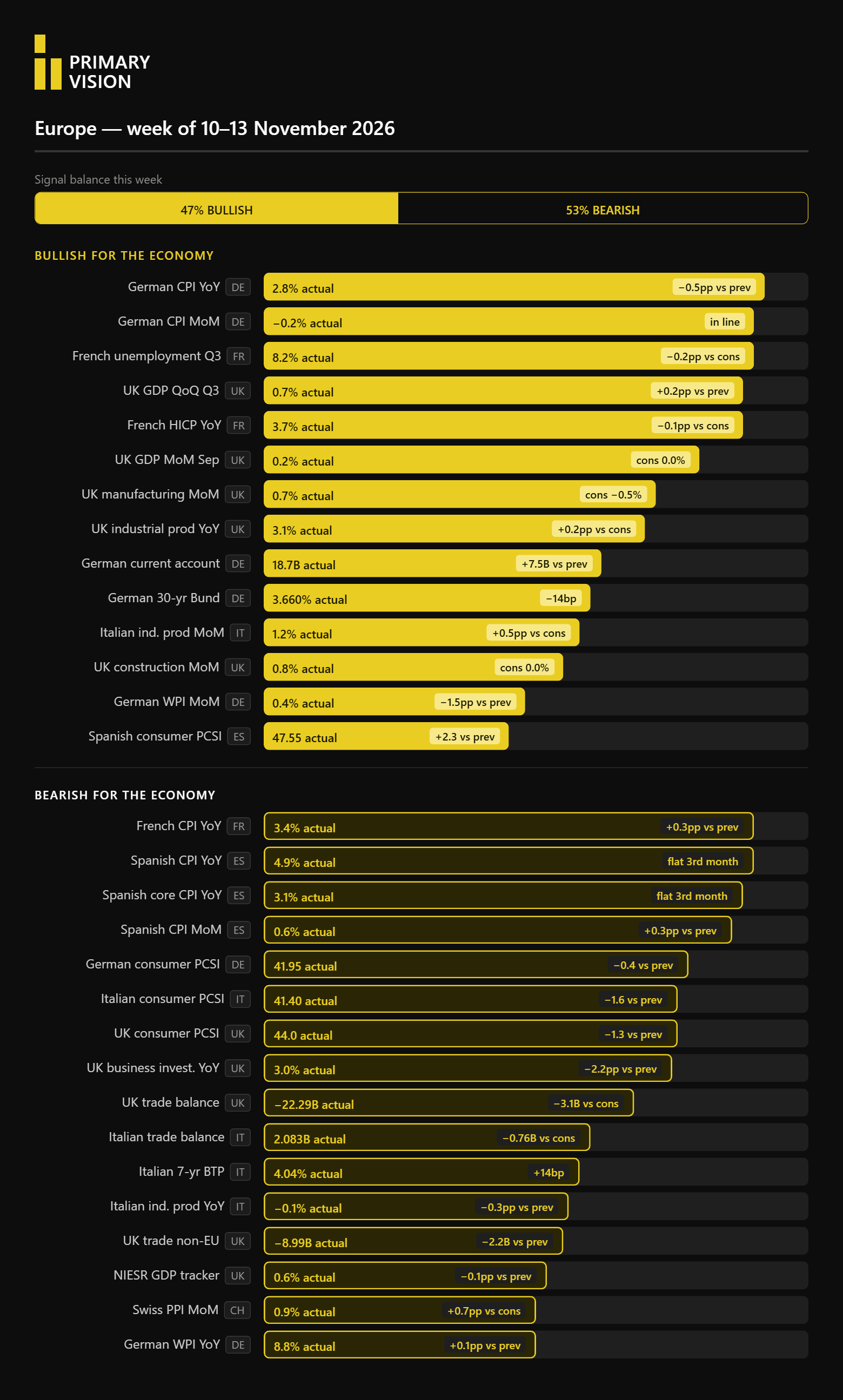
Europe is the supplier of this boom and refuses to be the site of it, which is why its corporate earnings and its investment data now point in opposite directions. Schneider Electric generated roughly €10bn of data centre revenue last year, about a quarter of group sales, and Siemens booked over €3bn in nine months at around 50% growth, while ASML’s chief executive describes sustained positive momentum in AI investment — none of which lands as European capital formation, because more than 70 projects across the continent were blocked, rejected or heavily restricted in the first four months of 2026, affecting an estimated $42bn, with Denmark passing emergency legislation to push data centre applications to the back of the grid-connection queue. The domestic consequence shows in the calendar, where UK business investment decelerated to 3.0% year-on-year from 5.2% and to 0.4% on the quarter from 1.8%, even as manufacturing output beat at 0.7% against a −0.5% consensus and construction rose 0.8% against a flat forecast, which is the profile of an economy running installed capacity harder because new capacity cannot get connected. Energy inflation of 20.8% and German wholesale prices of 8.8% are the input costs of competing for the same electricity, and household sentiment fell to 41.95 in Germany, 41.40 in Italy and 37.90 in France.
China
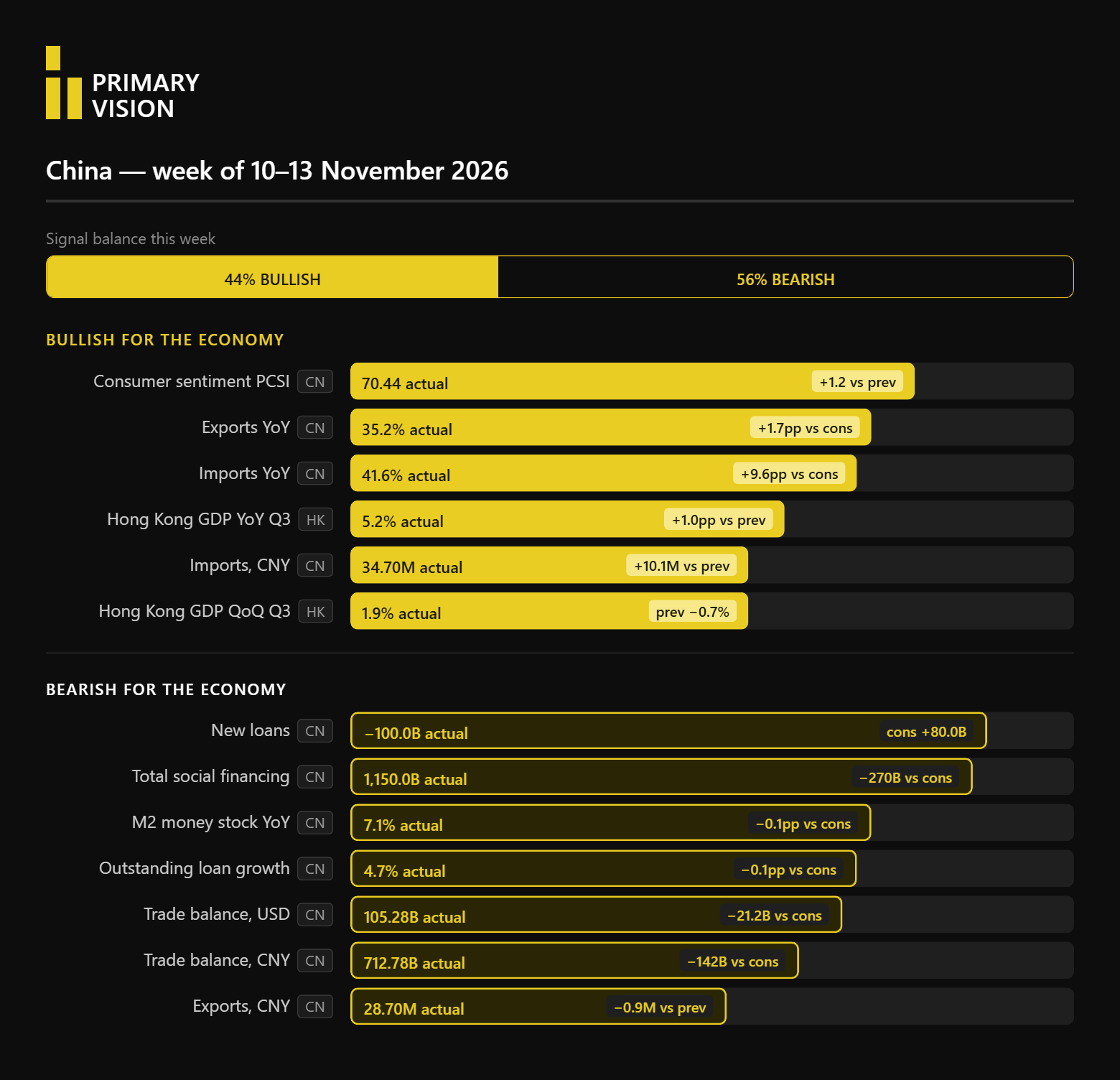
China’s October producer prices contain the buildout and the consumer economy moving in opposite directions inside a single index, with prices for means of production rising 7.4% and supplying 5.77 of the 5.7 headline points while consumer-goods producer prices fell 0.1%, food within them down 1.6% and clothing down 1.3%. The export data identifies the buyer, since shipments grew 35.2% on semiconductors, data-centre servers and networking equipment and imports grew 41.6% on the components feeding that assembly, producing a cumulative surplus of $1.043trn through October, and the physical bottleneck is visible in rare earths, where January-to-October export volumes fell 8.7% while export value rose 46.4% to $584.3m, where Shin-Etsu has stopped accepting orders for certain dysprosium magnets and TDK calls procurement extremely difficult, and where Capital Economics reads October’s volume rebound as Beijing relaxing enforcement under American pressure after Busan. The gains stop at the factory gate: purchase prices ran 7.9% against factory-gate prices of 5.7%, leaving Chinese manufacturers carrying 2.2 points of the world’s construction costs, while households repaid ¥430bn in October and ten-month lending ran ¥3.55trn below last year. Industrial profits, due at the end of November, measure how much of that absorption the sector can still afford.
Tags:
Permission denied
Upgrade to Pro Today and get…
• This article — plus dozens more each month, all within our full Research Module
• Frac Hits — our National-Level Frac Spread Count and Frac Job Count, updated weekly
• Frac Operator Monitor — detailed FSC & FJC by operator
• And so much more, designed to help you track, forecast, and outperform