Market Sentiment Tracker: Why Is the Fed Hiking Into 29,000 Jobs?
By
Osama
on October 13, 2026
in
Market Sentiment
One energy shock, three policy responses. The Fed raised rates into a stalling labour market. The ECB is tightening against inflation its own staff call supply-driven. China is the only major economy that entered the Hormuz disruption in deflation. This week’s data shows what each position costs.
United States
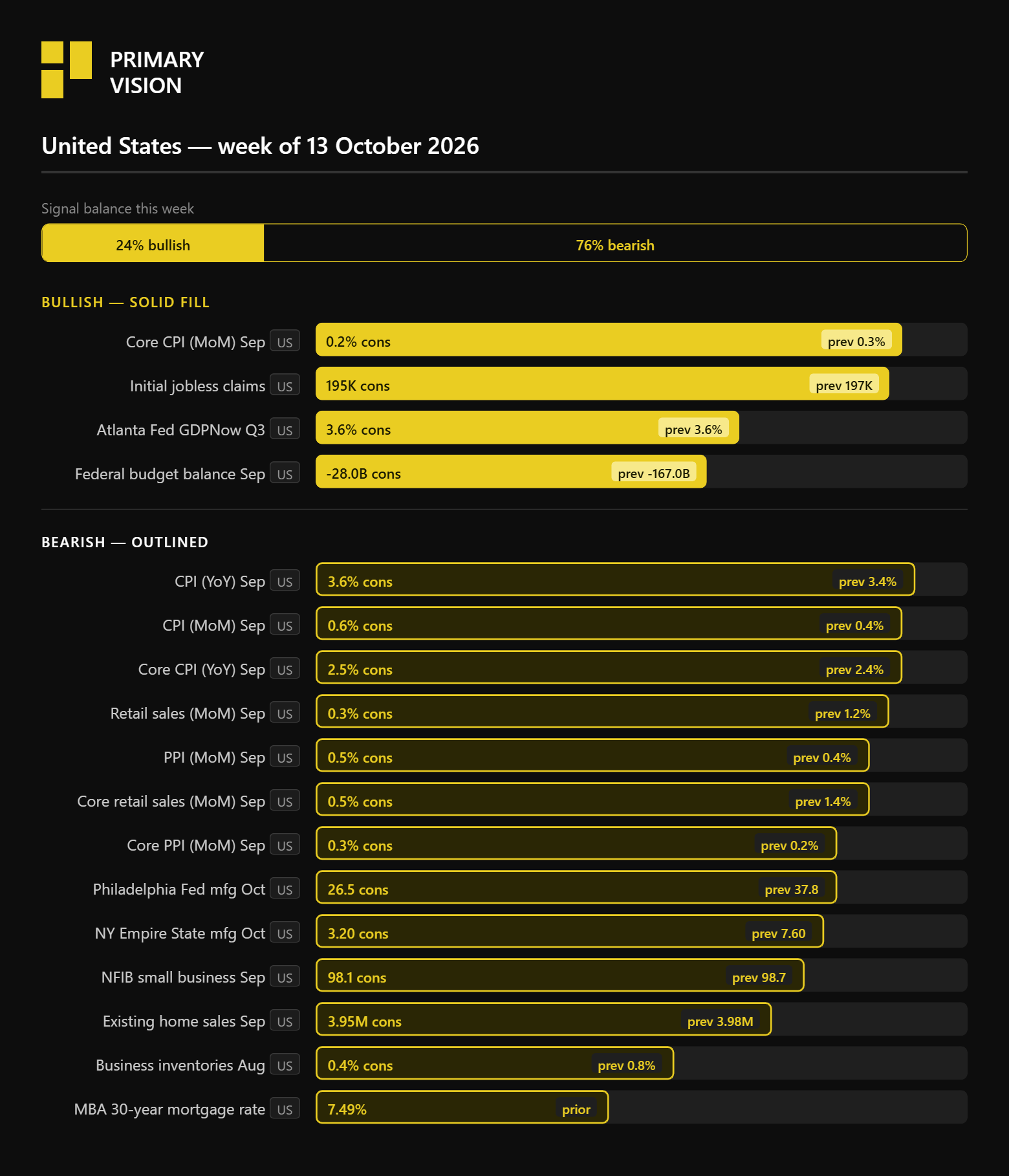
One-year consumer inflation expectations jumped to 3.90% in September from 3.60%. That is the number behind the Fed's 16 September hike to 3.75%-4.00%, delivered in the same month the economy created 29,000 jobs. Warsh is not responding to realised inflation. He is responding to the risk that a second oil shock inside eighteen months converts into wage behaviour, and he is willing to buy that insurance with the labour market. The Cleveland Fed has Q4 headline CPI tracking 4.39% annualised against 1.57% in Q3. Core over the same span moves from 2.16% to 2.56%. The headline swing is nine times the core swing, which is the signature of pump prices rather than demand.
Watch what that does to volumes. Nominal retail sales of 0.3% under a 0.6% CPI means Americans bought less in September than August, and August's 1.2% was partly fuel purchased at rising prices. Claims at 195K alongside 29,000 payrolls describe an economy where nobody is being fired and nobody is being hired.
October 28 is priced at roughly one in four. A 0.3% core tomorrow moves that to a coin flip and takes the long end with it.
Europe
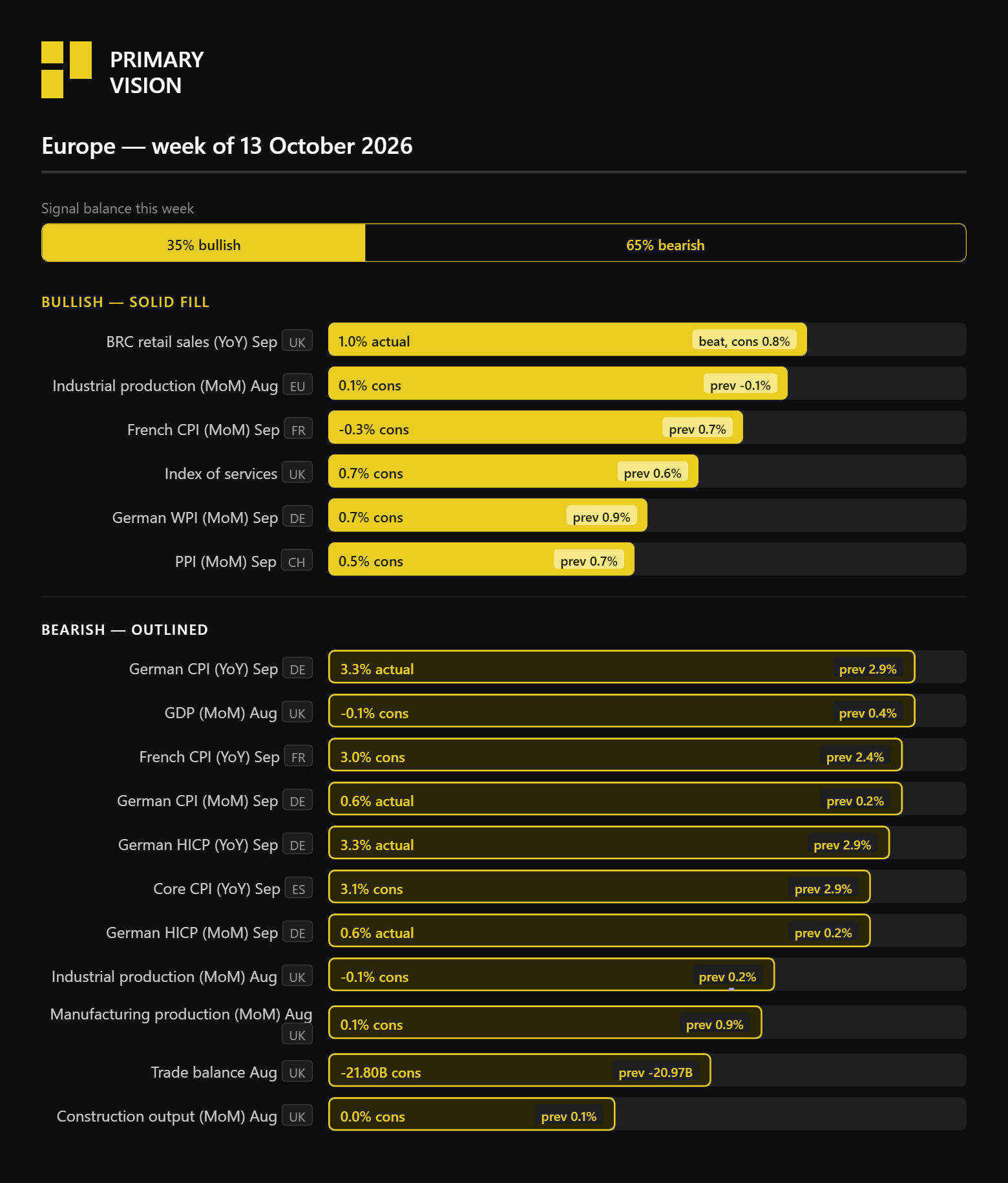
Energy carries 9.03% of the euro-area basket and rose 18.8% in September. That contributes about 1.7 points of the 3.8% headline. Back it out and the bloc sits near 2.1%, effectively at target. Destatis puts German inflation excluding energy at exactly 2.1%, with core unmoved at 2.4% for a third consecutive month. The ECB has raised rates twice regardless, to 2.65%, and meets again on 29 October. Lagarde appears twice this week.
The constraint nobody is pricing is dispersion. Spain is at 5.0%, Italy 4.1%, France 3.4%, Germany 3.3%. A 170 basis point spread across the four largest economies cannot be managed with one policy rate, and the spread maps directly onto energy intensity and import dependence. Every further hike tightens hardest where inflation is lowest.
Britain shows where this ends when fiscal space is gone. August GDP contracting 0.1%, ten-year gilts near 5.07%, thirty-year above 5.80%, debt at 95.1% of GDP, and a Budget on 28 October that has already frozen corporate behaviour. The BoE is stuck at 3.75% in both directions.
China
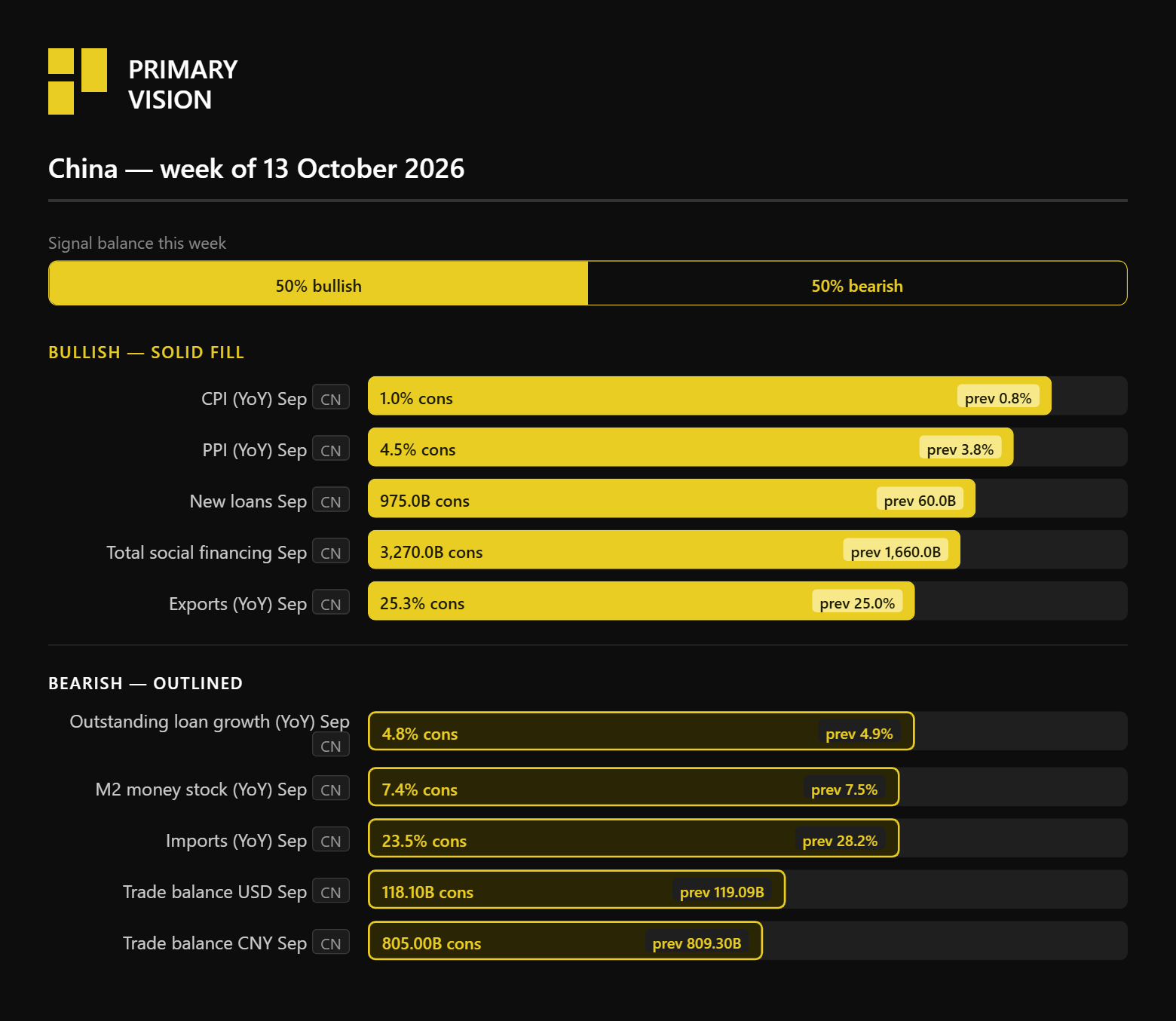
Robin Xing's framing is the one to hold: China handles this shock better than its peers because of energy fungibility and a low starting point for inflation. Everyone else entered the Hormuz disruption with inflation above target. China entered it in deflation. So the expected 4.5% PPI, clearing June's 4.1% high, reads differently depending on where you stand. Domestically it compresses margins, because raw-material and fuel input prices are rising faster than factory-gate prices. Externally it hands Chinese exporters a widening cost advantage over German and American manufacturers absorbing 18.8% energy inflation. Exports holding at 25.3% while global demand softens is share capture, not cyclical strength.
The domestic economy is not participating. Household borrowing fell 1.03 trillion yuan between January and August. M1 at 4.1% against M2 at 7.5% means deposits are accumulating rather than circulating. September's credit expansion runs through net government bond issuance, which accelerated markedly.
Imports decelerating to 23.5% while priced in the same inflated oil means real import volumes are contracting faster than 23.5% suggests. The 20 October loan prime rate decision is now the only lever that addresses any of it.
Upgrade to Pro Today and get…
• This article — plus dozens more each month, all within our full Research Module
• Frac Hits — our National-Level Frac Spread Count and Frac Job Count, updated weekly
• Frac Operator Monitor — detailed FSC & FJC by operator
• And so much more, designed to help you track, forecast, and outperform