






Articles
- BLOG / Articles / View
- Articles
Forecasting Propane: A Look at Supply, Demand and the Winter Ahead
By Osama on October 20, 2026 in Market Sentiment
American propane exports reached a record 2.1 million barrels per day in April 2026, and averaged 2 million barrels per day during the first six months of the year, an 11% increase over the same period in 2025. These figures, published by the U.S. Energy Information Administration (EIA) on October 1, tell us something important about the changing geography of global energy trade. The United States is supplying more propane to international markets even as trade tensions reshape its traditional export destinations, while the petrochemical industry and winter heating demand continue to influence consumption. With another heating season approaching, the more interesting question is how closely production can keep pace with these shifting requirements, and how far ahead those changes can be anticipated. This is precisely where Primary Vision's NGL Monitor becomes particularly useful.
The expansion of American shale production has transformed the United States into a major supplier of natural gas liquids (NGLs), linking production decisions in American basins with industrial activity thousands of miles away. Propane, in particular, occupies an interesting position in this relationship. Beyond residential heating and agricultural applications, it is an important feedstock for producing propylene, a building block for plastics and other industrial materials. The demand picture is therefore shaped as much by petrochemical activity in Asia as by seasonal temperatures in North America.
Recent trade developments illustrate this relationship. According to the EIA's October analysis, U.S. propane exports to China declined 19% during the first half of 2026 compared with the corresponding period in 2025, following tariffs and changing commercial relationships. At the same time, India and other South Asian markets have become increasingly important destinations for American cargoes, partly because buyers have sought alternatives to disrupted Middle Eastern supplies. Export infrastructure is also expanding, with an additional 300,000 barrels per day of capacity expected from Enterprise's Houston Ship Channel and Nederland projects. These developments have implications for freight rates, domestic inventories, processing economics and the price relationships between American and international markets.
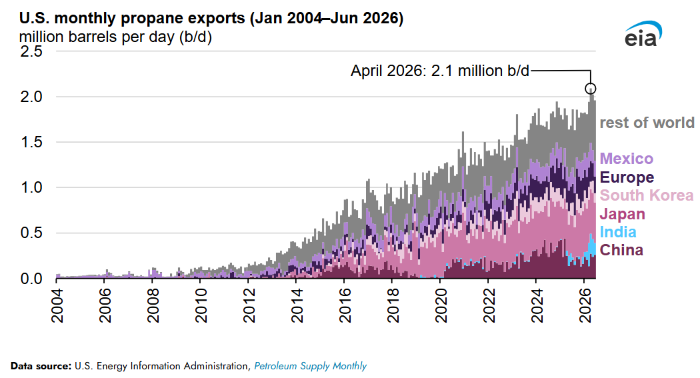
They also raise an important forecasting question. How accurately can we anticipate propane supply when production depends on natural gas processing, crude oil output and infrastructure capacity, while demand responds to seasonal heating, petrochemical consumption and international trade? The challenge becomes particularly apparent during winter, when consumption can increase considerably even as production changes relatively little.
Let's have a look at Primary Vision's NGL Monitor inside EFRACS and see what is happening there. The platform tracks supply and demand across individual hydrocarbons, including ethane, propane, butane and iso-butane, while providing historical observations and forward-looking projections. What caught my attention was the performance of its historical propane forecasts. In comparisons against January 2025 actuals, forecasts produced between April and December 2024 achieved accuracy levels ranging from 98.18% to 99.99% for propane supply. Even the April 2024 projection, made more than nine months before the target period, was within approximately 1.8% of the subsequently reported actual. Propane demand forecasting accuracy across those same comparisons remained above 92%.\
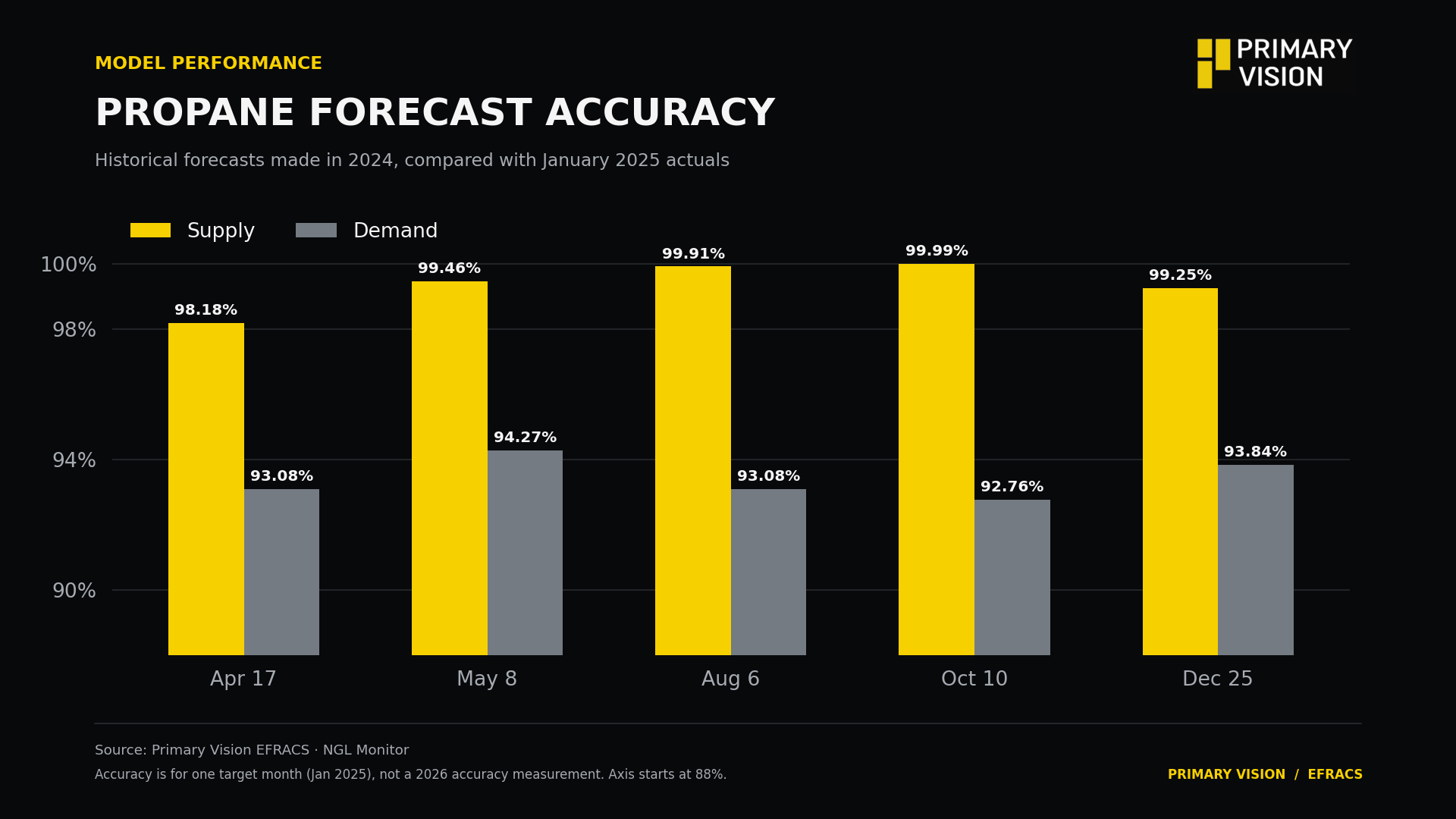
These are historical results for a particular target month, rather than a claim about forecasting accuracy across every period. Nevertheless, they offer a useful indication of how closely the model anticipated realized propane volumes, particularly over longer forecasting horizons.
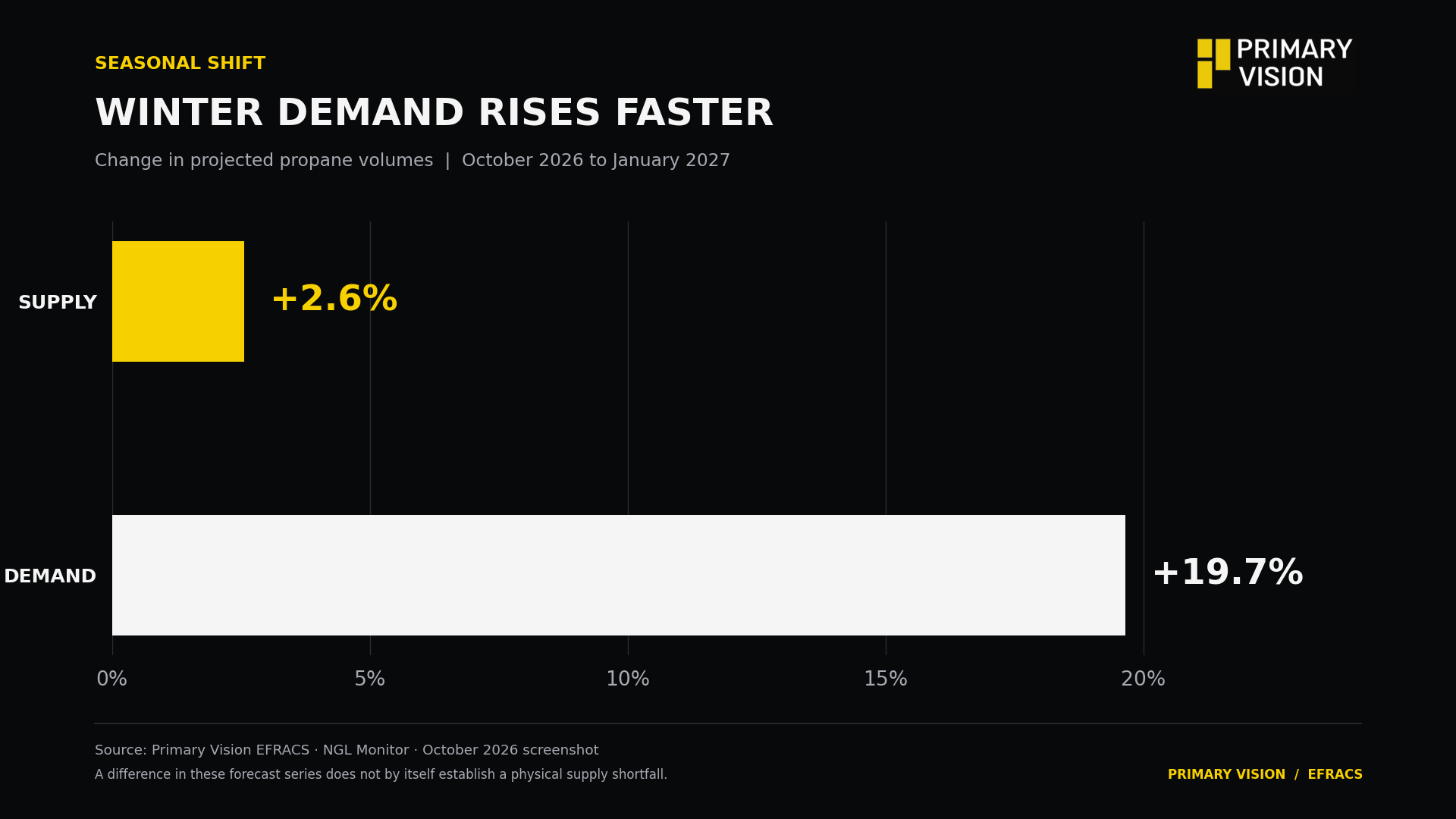
The latest projections offer another perspective as the market approaches winter 2026–27. The NGL Monitor currently shows propane supply increasing only modestly between October 2026 and January 2027, by approximately 2.6%. Over the same period, projected demand rises by almost 20%, reflecting a pronounced seasonal increase. Looking further ahead, the model anticipates demand moderating during the spring, while supply remains comparatively stable through July 2027.
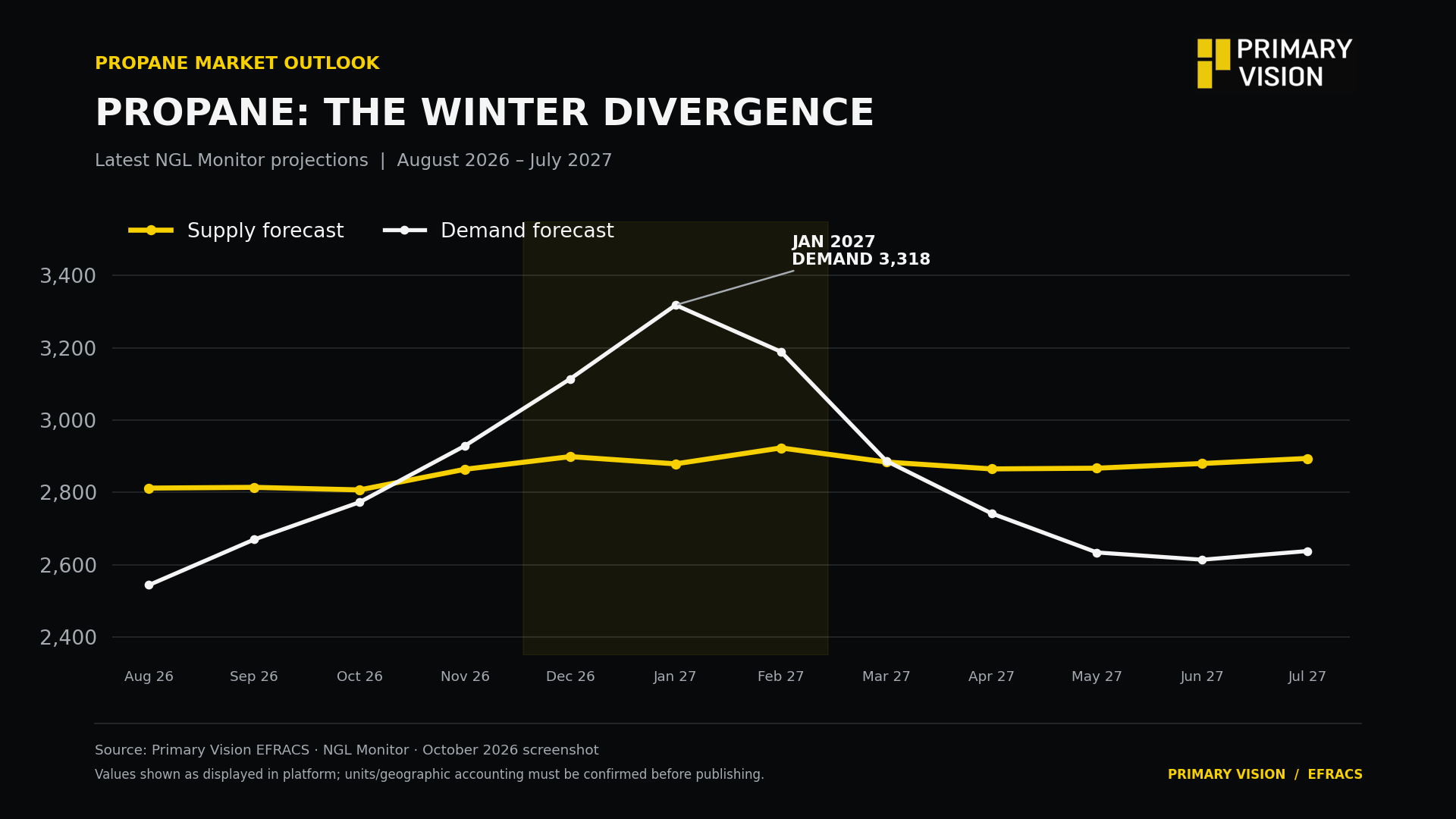
This seasonal divergence deserves attention, although it should not automatically be interpreted as a physical shortage. Inventory withdrawals, imports, exports and regional distribution all influence how propane markets balance. The EIA's Winter Fuels Outlook, published on October 6, offers additional context on the approaching heating season and the influence of prices and weather on consumption. The important question is therefore how production, storage and trade flows interact as demand moves through its annual cycle.
For producers, traders, petrochemical companies and infrastructure operators, these relationships have practical consequences. An accurate supply forecast can inform export planning and processing capacity decisions, while demand projections help identify periods when inventory management and logistical flexibility become particularly important. With U.S. propane increasingly connected to Asian industrial demand and geopolitical developments affecting established trading routes, understanding these movements several months in advance is becoming more valuable.
The propane market offers a useful reminder that changes in global energy trade are not confined to the commodities dominating daily headlines. Some of the more consequential developments are taking place further along the hydrocarbon value chain, where production, processing, transportation and consumption meet.
Tags:
Permission denied
Upgrade to Pro Today and get…
• This article — plus dozens more each month, all within our full Research Module
• Frac Hits — our National-Level Frac Spread Count and Frac Job Count, updated weekly
• Frac Operator Monitor — detailed FSC & FJC by operator
• And so much more, designed to help you track, forecast, and outperform