






Articles
Hormuz is Open. Why Is Diesel Still So Expensive?
By Osama on October 5, 2026 in Free Articles
The diesel market is telling a different story from the crude market. Middle East crude exports have recovered sharply, and latest shipping data reported that regional crude exports averaged about 18.5 million barrels per day by October 1, slightly above the roughly 18 million bpd average seen before the war. That suggests the world is no longer dealing with the same crude shortage it faced earlier in the conflict. Yet diesel prices remain exceptionally high. The reason is simple: reopening a shipping lane does not rebuild a refinery, restore an export program or refill depleted product tanks.
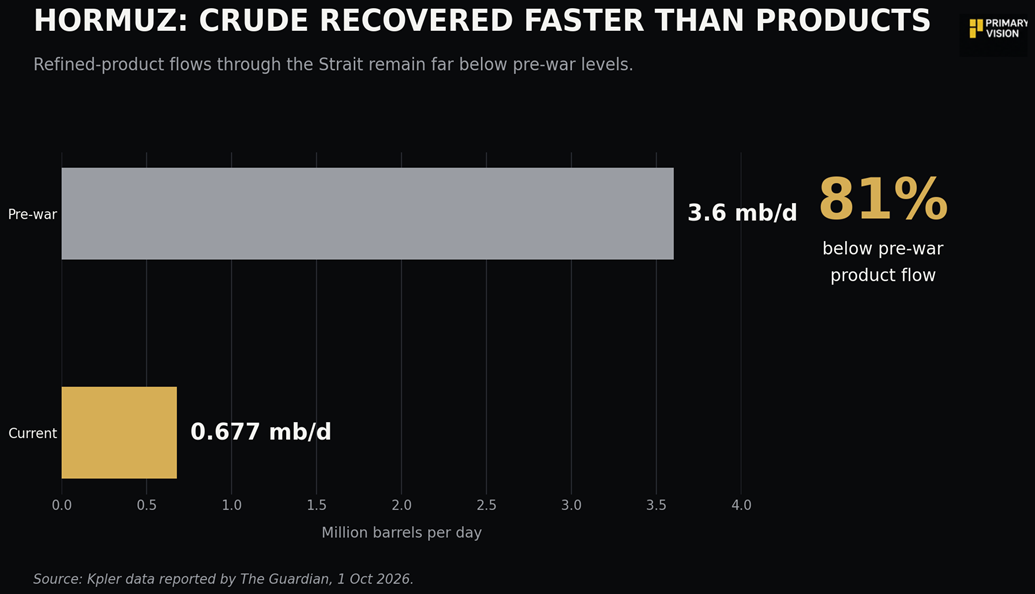
The clearest evidence is in the product flow itself. Kpler data showed refined-product shipments through the Strait of Hormuz at only about 677,000 bpd, compared with 3.6 million bpd before the war. That is an 81% shortfall even as crude flows have recovered toward normal levels. The bottleneck has shifted downstream: the market has more access to crude molecules than to the refining capacity and logistics required to turn them into diesel, jet fuel and other products. Russia compounds that problem. As per recent calculations half of the country’s six largest diesel-producing refineries had either sharply reduced runs or halted operations after drone attacks. Exports from Russia and the Gulf had removed roughly 1.6 million bpd of diesel from the international market since February. Russia was the world’s second-largest diesel exporter last year, so the loss is not a marginal disruption that can be replaced overnight.
China is also not providing the usual relief. Chinese refiners suspended most October fuel exports as Beijing prioritized domestic inventories. That removes another potential source of balancing barrels at precisely the moment when Europe and the United States are looking for additional diesel.
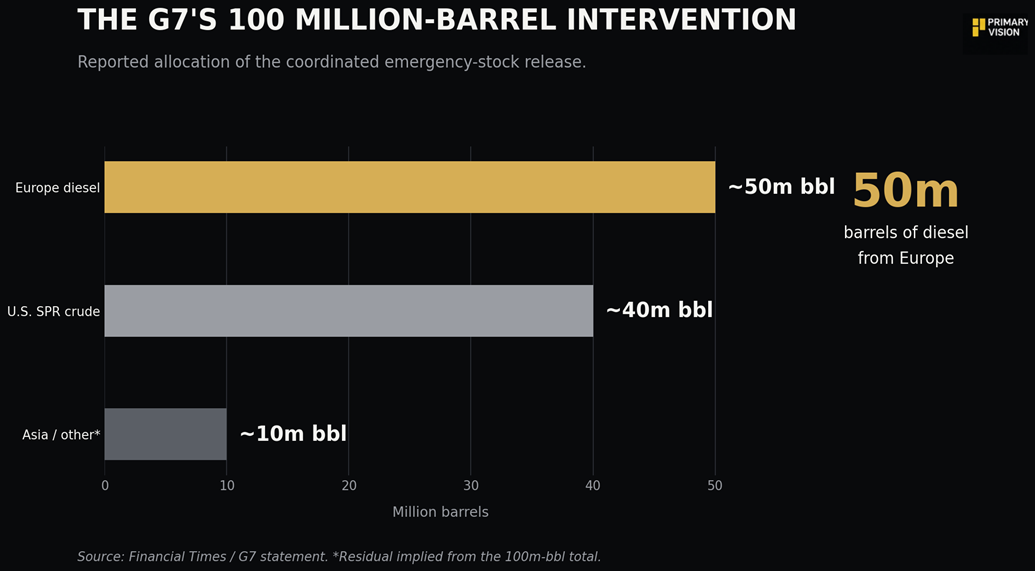
This is why governments have moved from crude releases to product intervention. G7 announced a coordinated 100 million-barrel emergency release over four months, with a substantial diesel component front-loaded into the first 20 days. U.S. contribution would be about 40 million barrels of crude from the Strategic Petroleum Reserve, while Europe would release roughly 50 million barrels of diesel, with Asian members providing the balance. If you look at the composition you find out that policymakers are no longer treating this as simply a crude-supply problem.
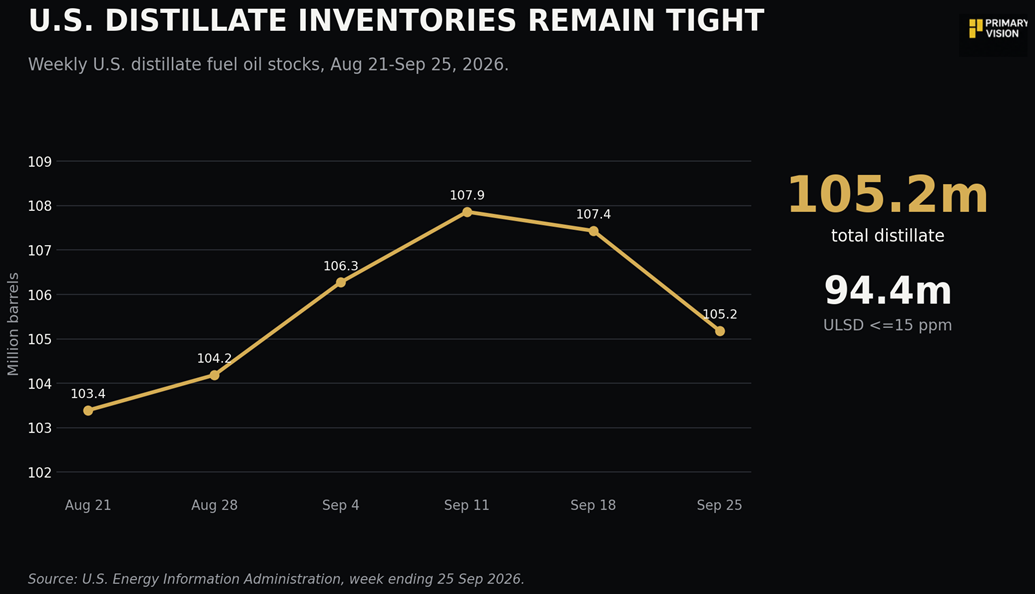
The U.S. cushion is not especially comfortable either. EIA data for the week ending September 25 put total distillate inventories at 105.2 million barrels, including 94.4 million barrels of ultra-low-sulfur distillate. The EIA’s September Short-Term Energy Outlook warned that distillate stocks had fallen below the five-year range in April and were expected to remain unusually low through the end of 2026 and much of 2027. The agency explicitly linked that tightness to reduced international refinery production and strong U.S. exports into a short global market.
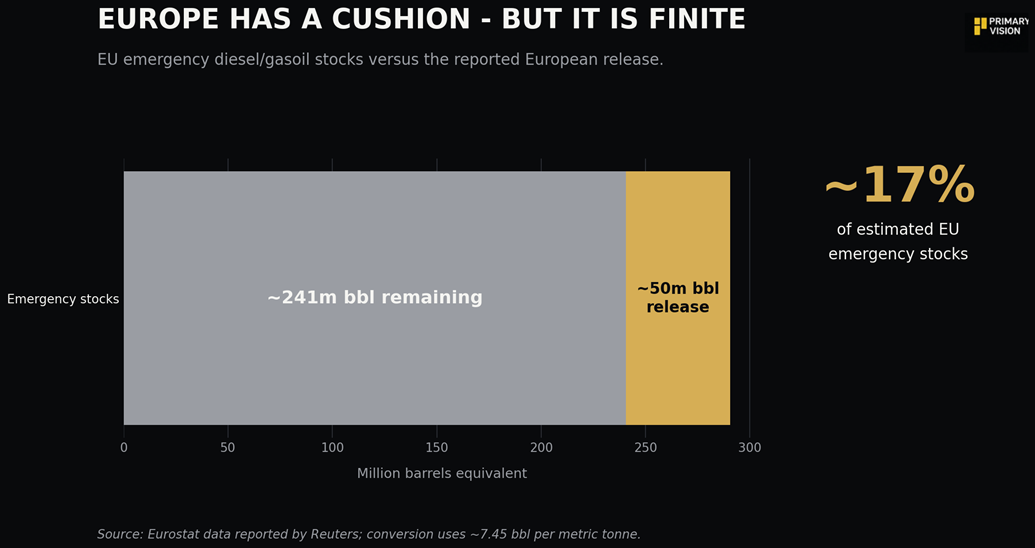
Europe has a larger strategic cushion, but it is finite. There is around 39 million metric tons of emergency diesel and gasoil stocks across EU states. At a rough diesel conversion of 7.45 barrels per metric ton, that is about 291 million barrels. A 50 million-barrel European release would therefore amount to roughly 17% of that emergency pool. Germany and France alone hold 35% of the bloc’s reserve. The stock draw can suppress prompt prices and buy time, but it cannot manufacture the missing refining capacity.
Nor can lower crude prices immediately solve the logistics problem. Tanker rates on some Middle East-to-Asia routes had surged from roughly $30,000 per day to as much as $1.2 million per day. Ship-to-ship transfers, military escorts, longer routes and insurance premiums all increase the delivered cost of the barrel. Even when crude can move, the system moving and refining it is more expensive and less efficient than it was before the conflict.
That leaves the diesel market with a very different recovery path from crude. Crude flows can rebound in days once shipping routes become usable. Refineries cannot be rebuilt in days, export bans do not disappear automatically, and inventories cannot be replenished while the market is still drawing them down. The G7’s intervention may soften the immediate squeeze, but it is a bridge, not a repair.
Hormuz may be moving crude again. The world is still short the machinery, inventories and logistics needed to move enough diesel.
Tags: