







Articles
Is Diesel Telling Us Something Oil Isn’t?
By Osama on August 27, 2026 in Free Articles
Oil has spent much of the past few weeks giving people two apparently conflicting stories. Crude itself has been volatile but hardly behaving as though the world is about to run out of barrels. Diesel, meanwhile, has been trading at levels that are difficult to ignore. And once you start looking at inventories, refinery runs and the amount of oil actually moving around the world, the gap between those two stories starts making more sense.
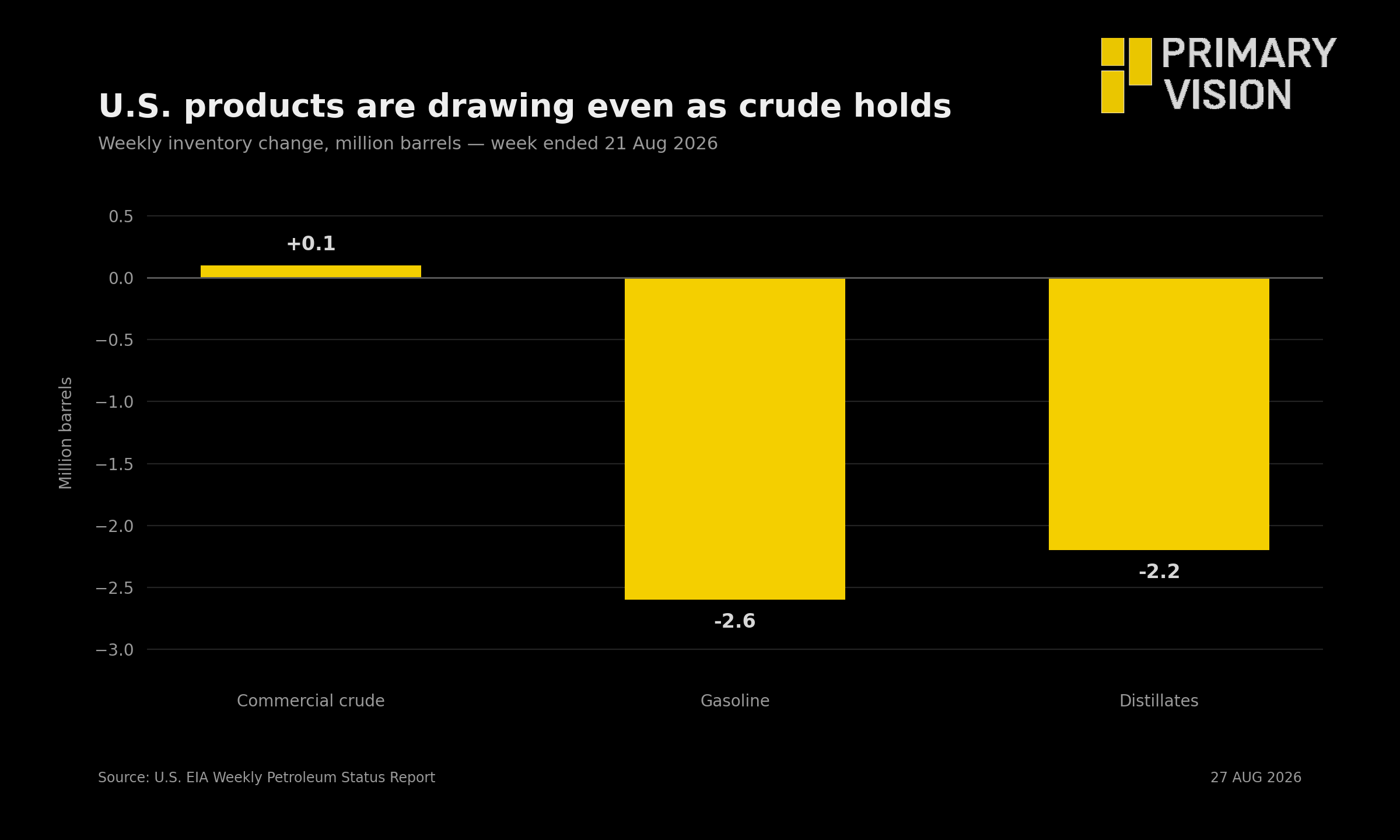
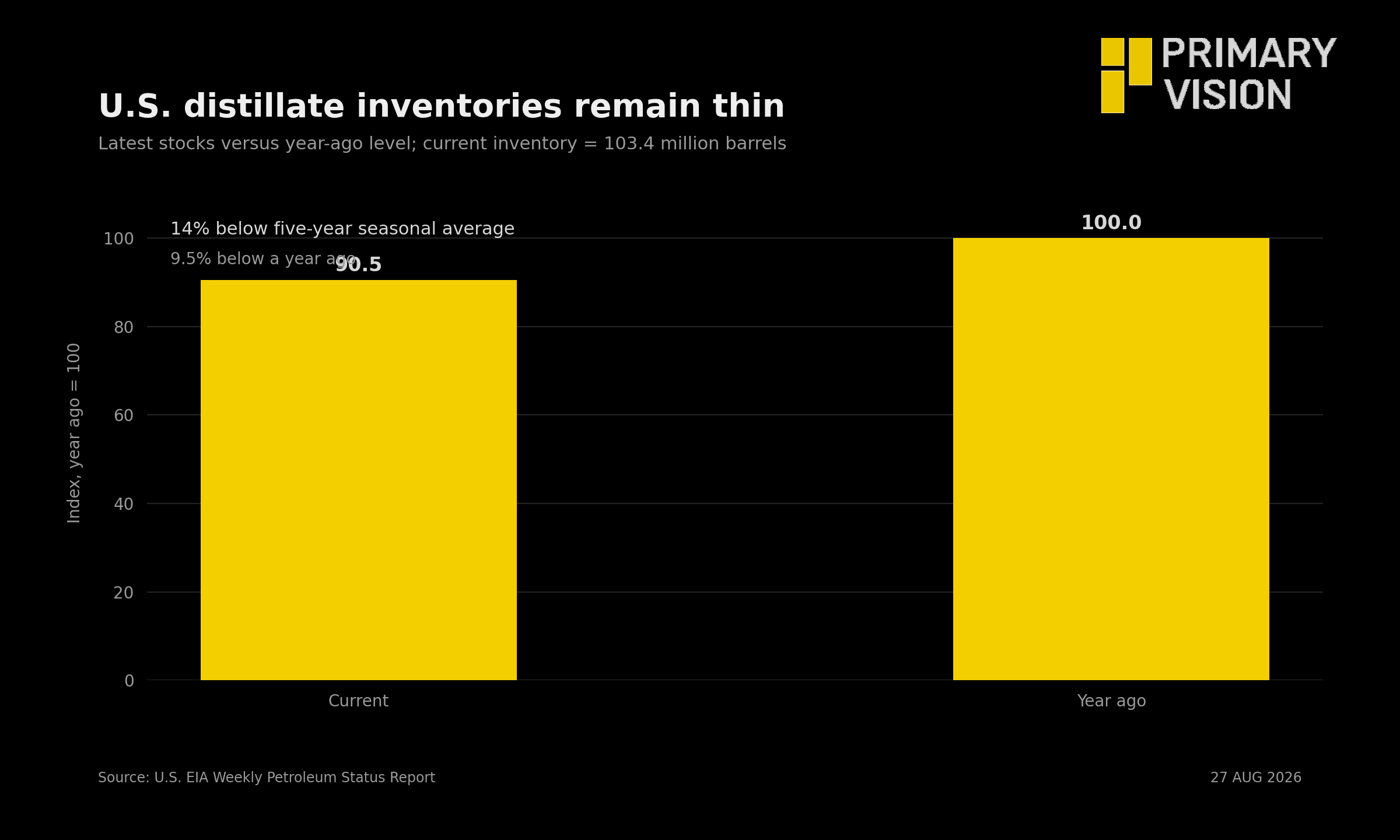
Let’s start with the US, because yesterday’s numbers were interesting. Commercial crude inventories rose by just 0.1 million barrels in the week to August 21, leaving them at 428.9 million barrels. That is actually around 1% above the five-year seasonal average, so I wouldn’t describe US crude stocks themselves as exceptionally low today. The products are another matter. Gasoline inventories fell by 2.6 million barrels, while distillates dropped by another 2.2 million barrels to just 103.4 million. Distillate stocks are now around 14% below the five-year seasonal average and roughly 9.5% below last year. And remember, American refiners are hardly sitting around doing nothing. Refinery utilisation was running at 97.4% last week, with crude inputs at roughly 17.4 million barrels per day. Distillate production averaged about 5.1 million barrels per day.
That is probably the number I would keep coming back to. When refineries are running close to flat-out and the product you need is still disappearing from storage, there simply isn’t much spare refining response left. Normally, high margins encourage refiners to process more crude, make more diesel and eventually rebuild inventories. That mechanism still works, but there is a practical difference between asking a refinery running at 85% utilisation to increase production and asking one already running above 97%.
Once you reach that point, the balancing mechanism increasingly has to come from somewhere else. Imports have to increase. Exports have to fall. Demand has to soften. Or refining capacity somewhere outside the US has to produce the missing barrels. Which brings us to diesel.
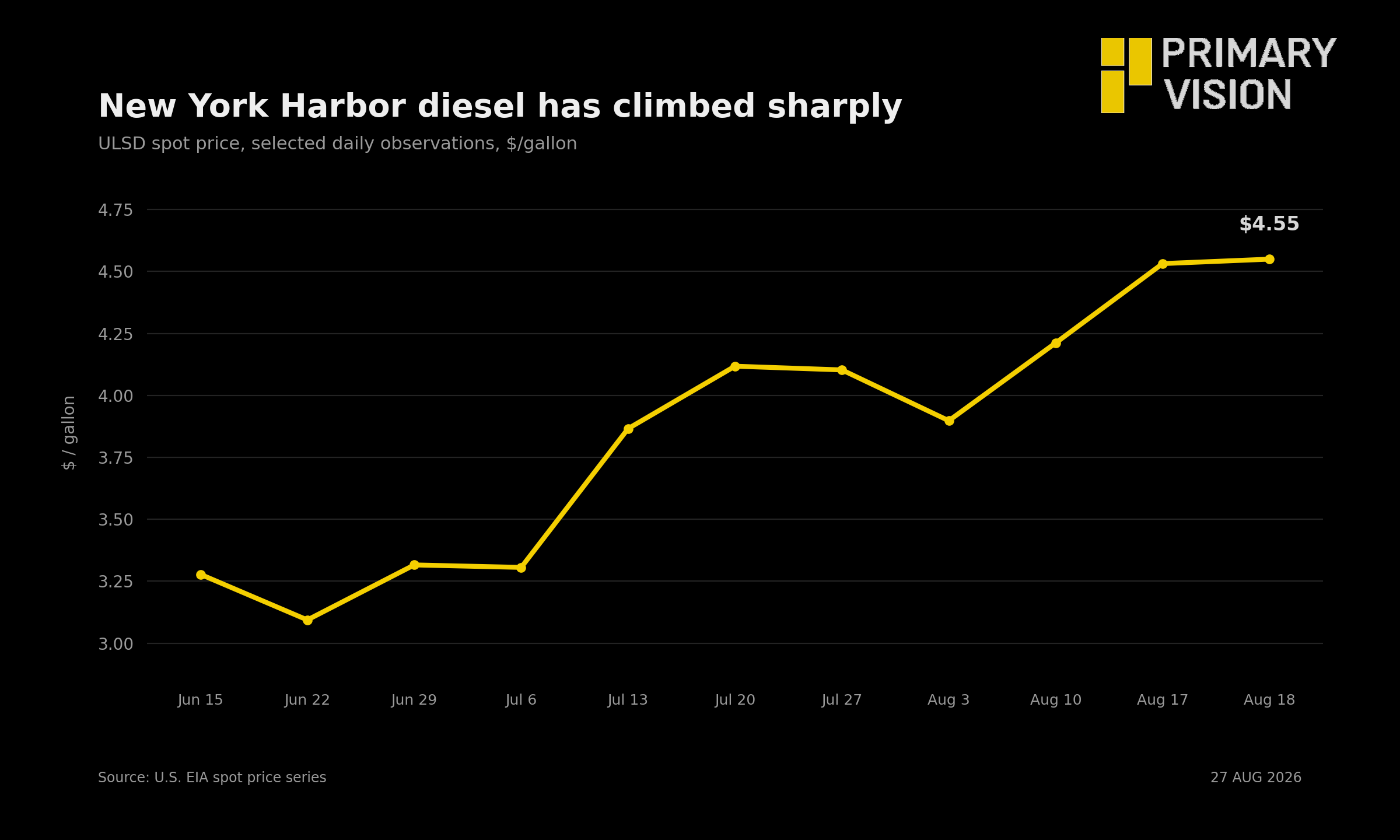
There has been a figure around $183 per barrel circulating heavily on X. Depending on the contract and the day being referenced, that is entirely plausible. The latest weekly EIA average for New York Harbor ultra-low-sulfur diesel was $4.473 per gallon, which works out to roughly $188 per barrel on a simple 42-gallon conversion. Now compare that with WTI trading in the low-to-mid $80s. Of course that difference is not a refinery’s literal profit margin. Refinery yields, operating costs, transport, blending and plenty of other things sit in between. But it gives you a good sense of how strongly the market is valuing diesel relative to the crude barrel going into the refinery. Reuters reported earlier this month that the US diesel crack spread broke $100 per barrel for the first time, reaching a record $102.20. That record diesel crack becomes even more interesting when you put it next to 97.4% refinery utilisation.
Normally, an enormous crack spread does its job. Refiners see the money, run harder and eventually produce enough product to soften the shortage. But what happens when they are already running close to flat-out? You start depending much more heavily on somebody else’s refinery. And somebody else’s refinery is precisely where the global picture gets interesting. The IEA estimates global refinery throughput reached 80.9 million barrels per day in July, but that was still almost 5 million bpd lower than the same month last year. Diesel exports from Russia, the Middle East and Asia were down around 1.3 million barrels per day year-on-year, equivalent to roughly 20% of global seaborne diesel trade. Jet-fuel exports from those regions were down another 670,000 barrels per day. That helps explain why the US can be running refineries at very high utilisation and still losing distillate inventory.
The US is not operating inside a closed system. If Europe, Latin America or other parts of the Atlantic Basin need diesel badly enough, the price signal encourages US barrels to move toward those buyers. High refining margins inside America can therefore coexist with falling American inventories precisely because the shortage is global. In other words, part of the draw in US diesel stocks may actually be telling us more about shortages elsewhere than about American consumption itself. The global inventory picture adds another layer.
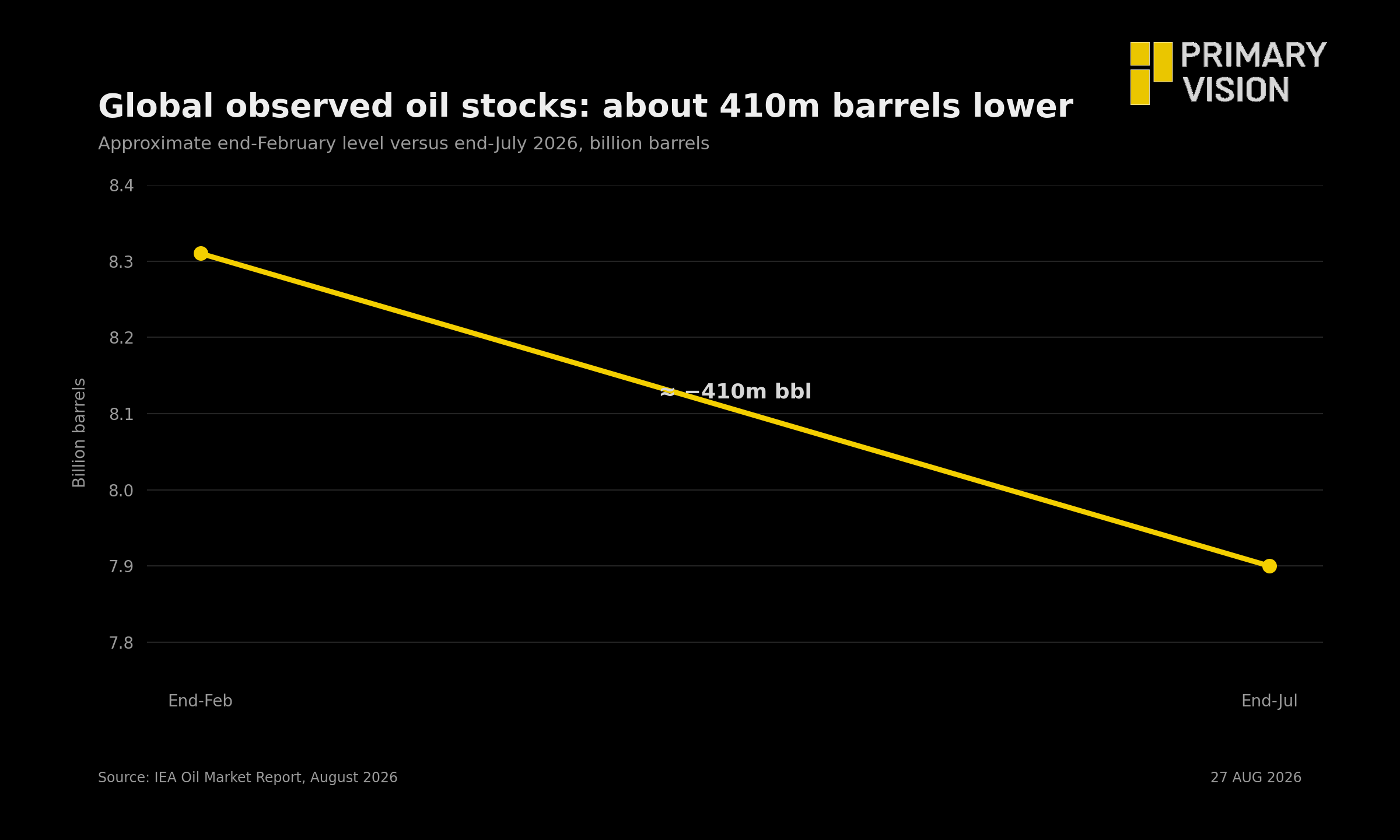
The IEA estimates observed world oil stocks fell by another 69 million barrels in July and ended the month just below 7.9 billion barrels. Since the conflict began, around 410 million barrels have disappeared from observed inventories, equivalent to an average draw of roughly 2.7 million barrels per day. Most of July’s decline came from oil on water rather than tanks on land, which is worth noting. But oil on water is still part of the buffer. If fewer barrels are sitting on ships between producing countries and refineries, buyers have less oil already moving toward them. Lead times become more important. Shipping disruptions matter more. A refinery outage becomes harder to cover. A delay that might normally be annoying starts becoming expensive. That is also why I think the debate over exactly how much crude is moving through Hormuz can sometimes obscure what is happening further downstream.
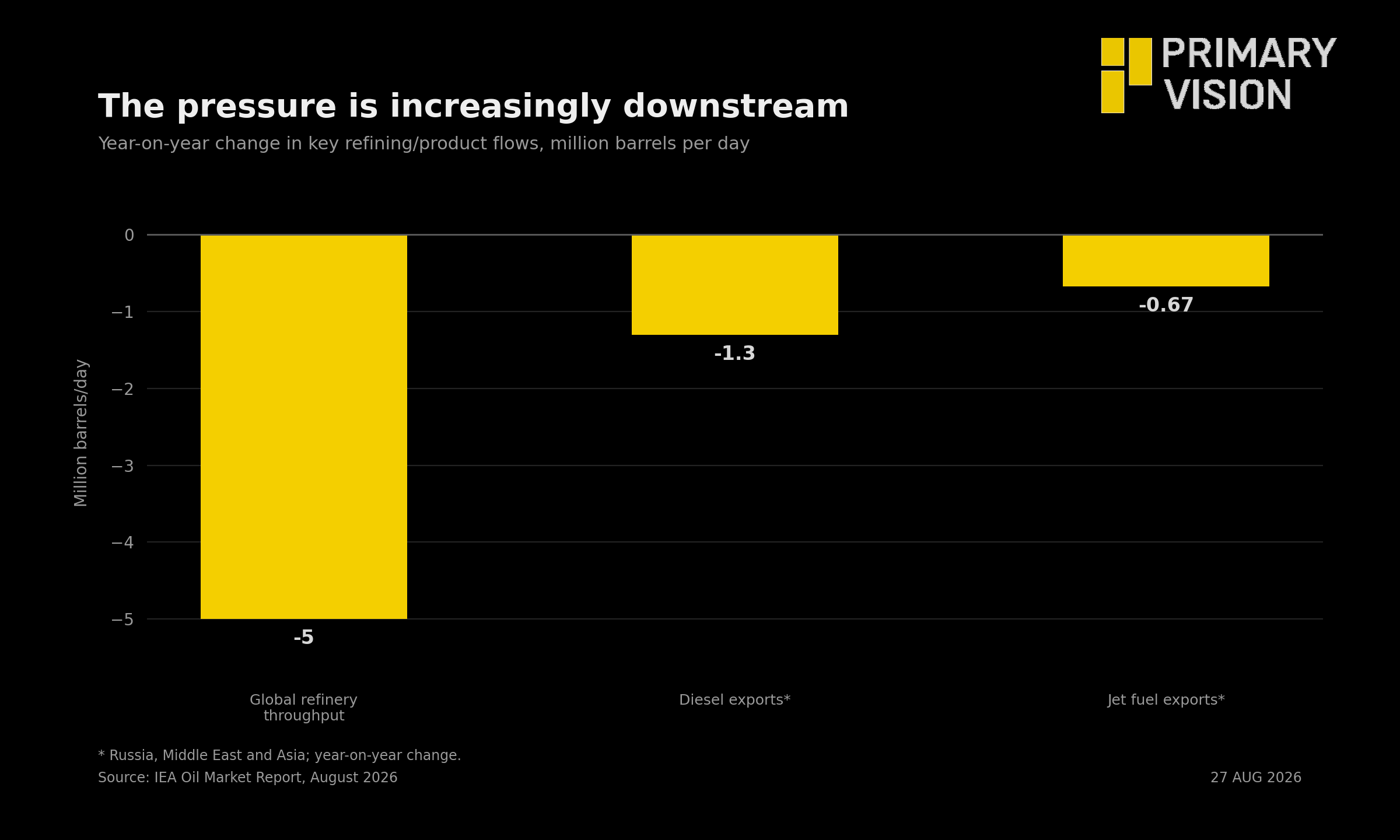
Reuters noted this week that Asian imports of diesel, gasoline and jet fuel were around 21% below pre-conflict levels. Singapore gasoil refining margins were still above $70 per barrel. The crude can exist. It can even be moving. But if the refining system cannot convert enough of it into the products people actually need, the pressure simply shows up somewhere else. There are some early signs worth watching in the other direction. Singapore middle-distillate inventories rose to almost 8.5 million barrels this week, reaching their highest in two weeks. One week does not tell us much by itself, but sustained rebuilding there would matter. And diesel matters because it gets everywhere. Trucks, farms, construction equipment, mines, ships, backup generators. You do not need diesel prices to stay near these levels forever for them to feed gradually into freight bills, agricultural costs, industrial production and eventually consumer prices.
So for the next few weeks I’d probably spend less time asking whether WTI is $82 or $87 and more time watching distillate inventories, refinery utilisation and diesel cracks together. If diesel cracks fall while inventories rebuild, the system is beginning to repair itself. If crude falls but diesel remains extremely expensive and inventories keep drawing, then the crude price is only giving us part of the picture. Crude still gets the television screen. The interesting numbers are increasingly a little further down the barrel.
Tags: