Market Sentiment Tracker: Strongest in Five Years, Growing at 1.5%
By
Osama
on September 29, 2026
in
Market Sentiment
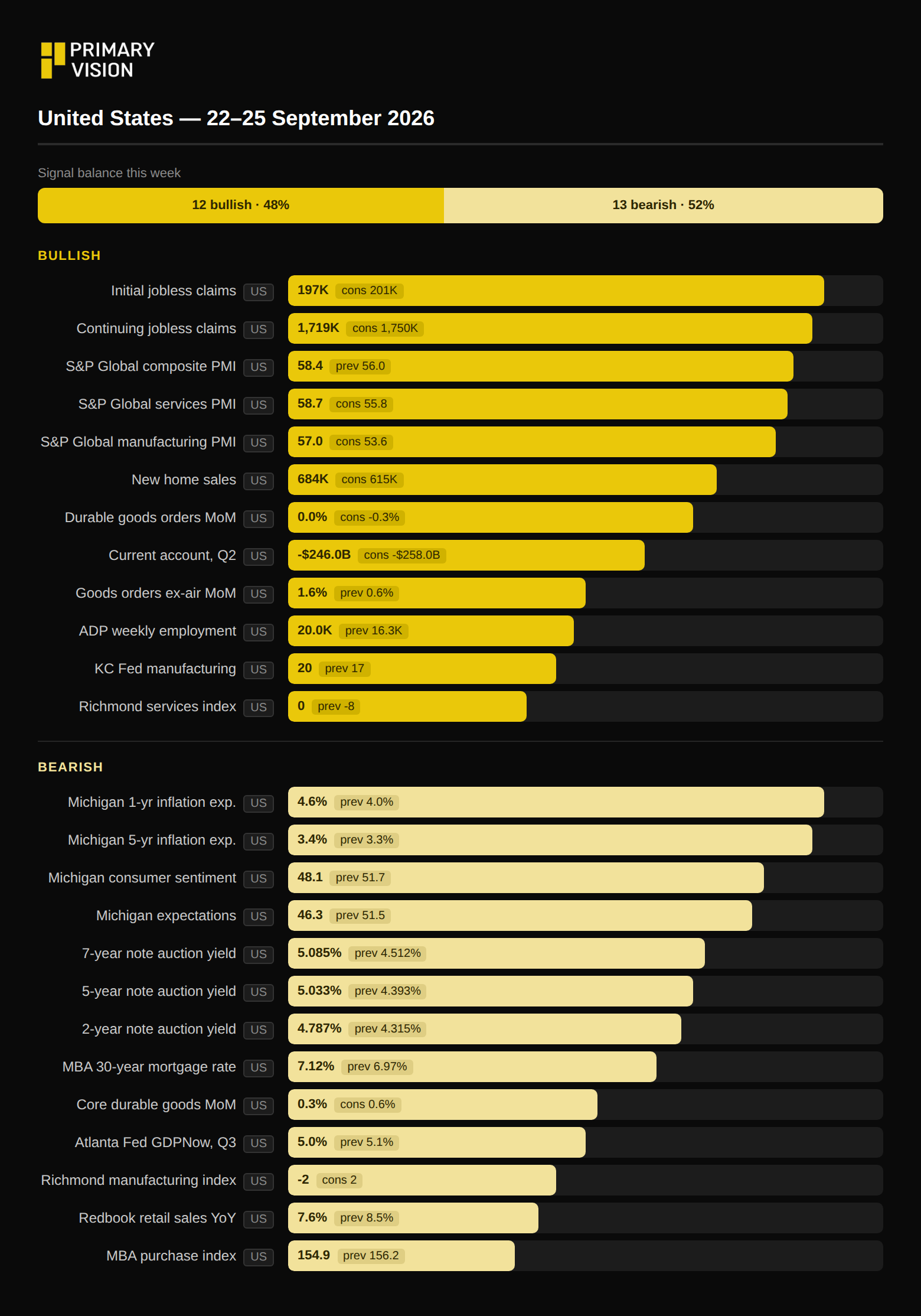
US business surveys came in at their strongest since 2021 this week, which sounds like a boom until you notice the economy grew 1.5% last quarter. Most of the difference is price, not output. Europe below, where last week's call was wrong.
United States
The gap between survey data and hard data is the main thing to resolve this week. Composite output at 58.4 is the strongest since July 2021 and implies roughly 5% annualised growth. Real GDP grew 1.5% in Q2. Part of that gap is timing, but most of it is price. Nominal GDP rose at an 8.0% annual rate in Q2 against a 6.5% deflator. PMIs ask firms whether activity and costs went up, not whether real output did, so in an energy shock they overstate. We read 58.4 as a nominal boom with a thin real core. The year-on-year real rate of 1.5% has historically sat at or below most recession starts. GDPNow's 5.0% for Q3 does not contradict that. Its consumption nowcast is 4.2%, while private domestic investment is running at 18.7%, which is AI capital spending concentrated in a handful of firms. Equipment investment grew 15.2% in Q2.
Our working view is that households are also pulling purchases forward. Michigan reported durables buying conditions improving because people expect to pay more later, and in Q2 goods consumption rose 4.3% while imports surged 12.5%. That fits pre-emptive buying better than underlying strength. It is testable. If we are right, real goods spending should decelerate sharply through Q1 2027 as the pull-forward unwinds. If Q4 real goods PCE holds above 3%, we are wrong and the demand is genuine. On policy, the Fed is at 3.75–4.00% with most of the committee expecting one more move. But the two-year near 4.86%, against a ten-year at 5.24% and a thirty-year back at 2004 levels, says the long end is doing the work, on term premium and deficits rather than the policy path. Households meet that as a 7.12% mortgage. The 684K new home sales print rests on builder buydowns and will not survive it.
Europe
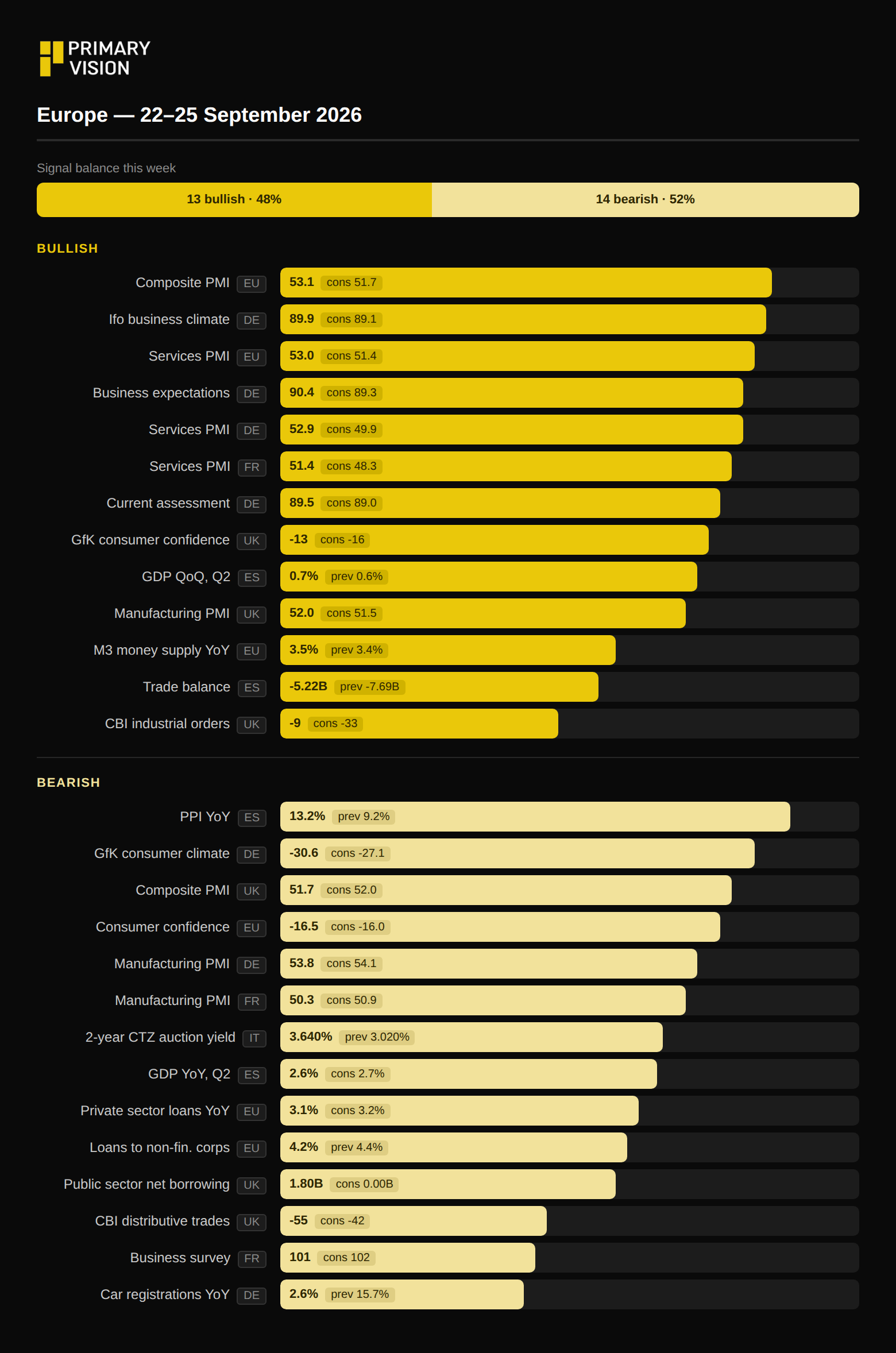
A correction to something we wrote last week. We suggested the eurozone export recovery was American demand pulling Europe along. The trade data does not support it. EU goods exports to the US in Q2 ran roughly a quarter below their Q1 2025 level, and the bilateral surplus has fallen from about €80bn to €29bn since the tariff dispute began. The PMI's second consecutive rise in foreign orders, after fifty-three declines, looks like a rebound off a tariff-depressed floor, helped by a weaker euro. The larger shift is in the terms of trade. The EU's overall goods balance moved from a €51bn surplus in Q1 2025 to a €22bn deficit in Q2 2026, with energy import values doing most of the damage. That is the context for a composite at a forty-month high. Activity is recovering while the income paid out to the rest of the world is rising.
Households notice first. German GfK fell to -30.6 in the same week Ifo improved on all three components. Euro area inflation ran 3.3% in August with energy at 14.3%, and Spanish producer prices at 13.2% suggest the pass-through has further to go. The ECB raised to 2.50% on 10 September and marked up both core inflation for 2027–28 and its growth forecast. Italian two-year paper at 3.64% against 3.02% is the market taking that at face value. What would change our mind is the goods balance. If energy prices ease and the deficit closes by year end, the upswing has a domestic foundation. If it does not, this is a nominal recovery financed by terms-of-trade losses, and the credit numbers, with corporate lending at 4.2% and private-sector loans at 3.1%, suggest the banks are not underwriting it either.
Upgrade to Pro Today and get…
• This article — plus dozens more each month, all within our full Research Module
• Frac Hits — our National-Level Frac Spread Count and Frac Job Count, updated weekly
• Frac Operator Monitor — detailed FSC & FJC by operator
• And so much more, designed to help you track, forecast, and outperform