






Articles
- BLOG / Articles / View
- Articles
Market Sentiment Tracker: The Soft Landing Is Getting Harder to Read
By Osama on October 8, 2026 in Market Sentiment
This week’s data look better at first glance than they do underneath. The U.S. is still generating activity without much new hiring, Europe’s services numbers are holding up while its industrial engine weakens, and China gives us almost no fresh domestic confirmation. The common thread is simple: the headline picture is still standing, but the forward-looking evidence is becoming less comfortable.
United States
The U.S. is starting to look like an economy that can still generate output without generating much new employment. September payroll growth came in at just 29,000 against 89,000 expected, private payrolls were 46,000 versus 85,000, and unemployment moved up to 4.2%. Yet services remain strong: S&P Global Services printed 58.8 and ISM services employment improved to 50.1. That combination suggests something more important than a routine slowdown. Firms appear able to maintain activity without expanding payrolls aggressively, which can happen when productivity improves, management becomes more defensive on costs, or companies no longer trust demand enough to hire ahead of it. That can prolong growth for a while, but it also creates a delayed vulnerability. If hiring stays weak, household income growth eventually slows, and consumption can follow with a lag.
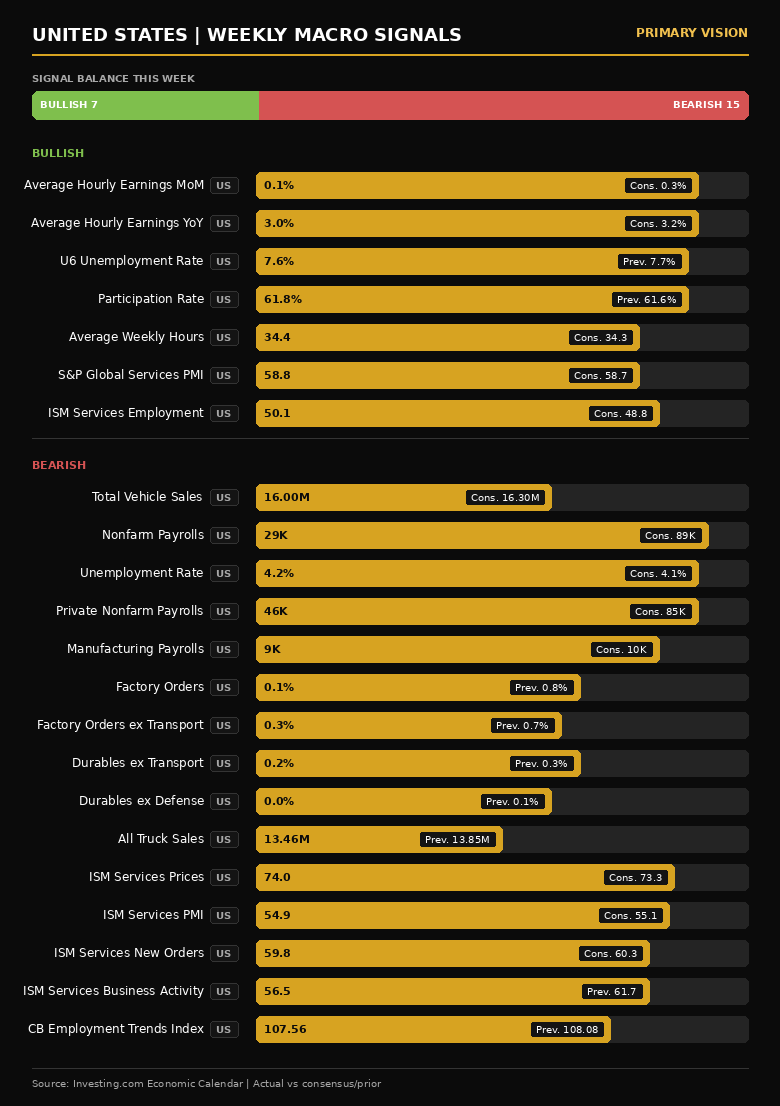
The Fed’s problem is that disinflation is not arriving cleanly either. Hourly earnings growth cooled to 0.1% month-on-month and 3.0% year-on-year, but ISM services prices rose to 74.0. The U.S. therefore looks less like a textbook soft landing and more like a late-cycle economy where labor demand is weakening faster than service-sector inflation.
Europe
Europe’s headline PMIs look reassuring, but the composition is much less so. Spain’s services PMI reached 58.3, Germany’s composite rose to 53.8, and the Eurozone composite climbed to 53.1. The problem is that the sectors doing well today are not necessarily the ones that determine where growth will be six months from now. German factory orders collapsed 10.6% month-on-month against expectations for only a 0.9% decline. French industrial production fell, Spanish industrial-output growth slowed, and Germany’s construction PMI dropped to 43.5. That matters because factory orders feed future production, construction reflects investment appetite, and industrial activity determines whether demand is actually passing through the real economy.
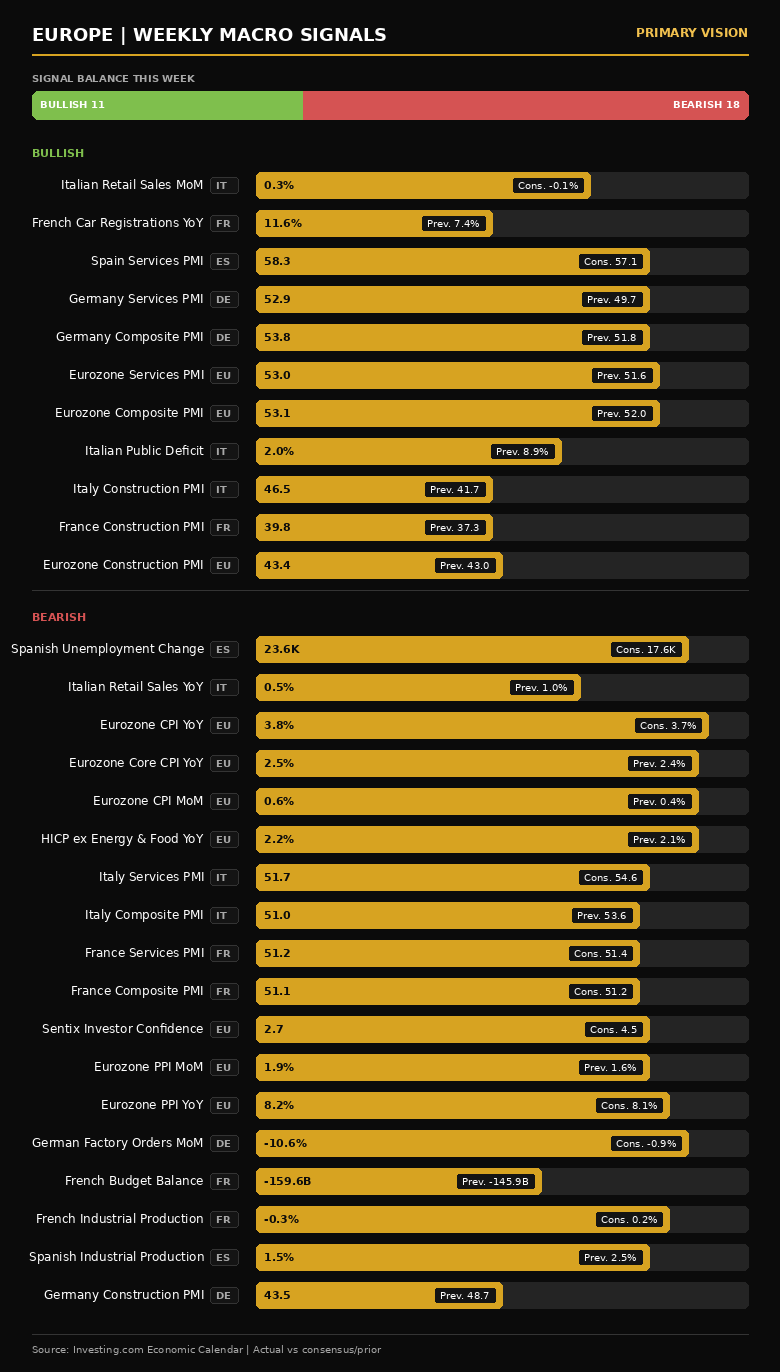
Europe can therefore look healthier in aggregate while its forward pipeline deteriorates. Services can support GDP, but they cannot indefinitely replace weak capital formation, manufacturing demand and industrial employment. The inflation backdrop makes the policy trade-off worse: Eurozone headline inflation rose to 3.8% from 3.2%, while producer-price inflation reached 8.2%. The ECB is being asked to manage weakening investment-sensitive sectors while price pressure remains stubborn. That is a much narrower path than the headline PMIs imply.
China
China is different because the issue this week is not conflicting data but missing confirmation. The National Day holiday leaves no meaningful China-specific release in this calendar with an actual value that can be compared against consensus or prior. That does not make China neutral. It makes the signal unconfirmed. China-sensitive assets can still move on stimulus expectations, policy headlines, commodity positioning or global risk appetite, but without fresh domestic data those moves tell us more about what investors expect than what the economy is actually doing.
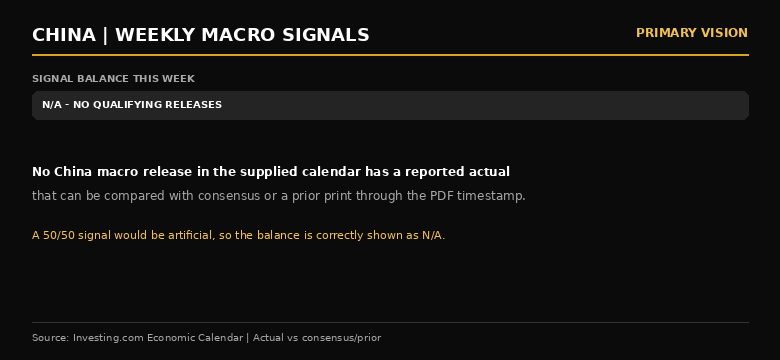
That raises the importance of the next Chinese releases. Strong data would validate expectations that have been building during the information vacuum; weak data would expose how much optimism was driven by positioning rather than activity. Taken together, the three regions point to the same broader issue: the global economy still looks functional, but the evidence underneath the headline story is becoming harder to trust. That gap between current activity and future confirmation is precisely where the next meaningful market repricing could begin.
Permission denied
Upgrade to Pro Today and get…
• This article — plus dozens more each month, all within our full Research Module
• Frac Hits — our National-Level Frac Spread Count and Frac Job Count, updated weekly
• Frac Operator Monitor — detailed FSC & FJC by operator
• And so much more, designed to help you track, forecast, and outperform