






Articles
- BLOG / Articles / View
- Articles
Market Sentiment Tracker: US Duration Shock, Europe’s Winter Risk, China’s Capital Problem
By Osama on August 25, 2026 in Market Sentiment
United States
The most important U.S. macro release last week did not come from the economic calendar. It came from the Treasury market. Thirty-year yields reached 5.327%, the highest since 2007, with the 10-year around 4.74% as oil above $90, heavy sovereign issuance and the Iran conflict pushed the term premium higher. Treasury’s decision to expand long-end buybacks matters because financial conditions are tightening independently of the Fed.
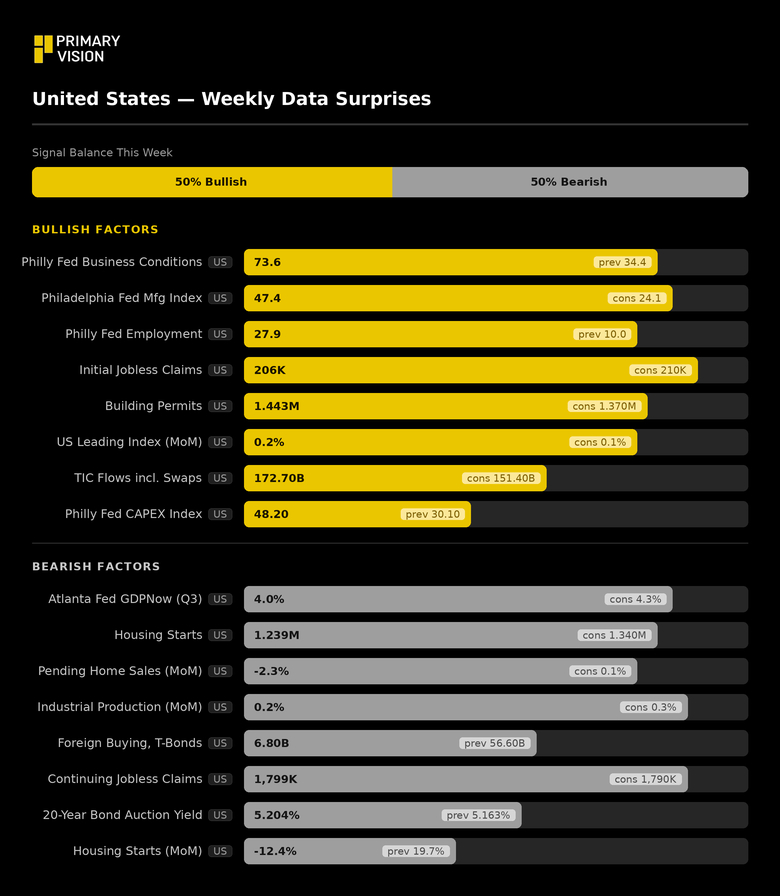
That changes how the week’s housing data should be read. Housing starts at 1.239M against 1.340M expected and pending sales down 2.3% are occurring before the latest long-rate shock has fully passed through mortgage pricing. Building permits at 1.443M provide some pipeline support, but permits measure intentions; starts and transactions measure the financing constraint already hitting households and developers.
The labor numbers are keeping that tightening process alive. Initial claims at 206K remain too low to generate a genuine Fed growth alarm, and the Philly Fed’s 47.4 reading shows firms are hardly behaving as though recession is imminent. Yet industrial production missed at 0.2% and GDPNow slipped to 4.0%.
The complication now is oil. Softer import and export prices would ordinarily strengthen the disinflation case, but Brent around $90–95 introduces a fresh inflation impulse precisely as long yields are already damaging housing and capital expenditure.
The risk has shifted toward a nominal tightening cycle driven by markets: expensive energy raises the price level, expensive duration raises the discount rate, and the Fed gets less freedom to offset either. The next pressure point should be corporate refinancing and investment rather than payrolls. With the long end above 5%, waiting for employment to crack before calling conditions restrictive would be several months too late.
Europe
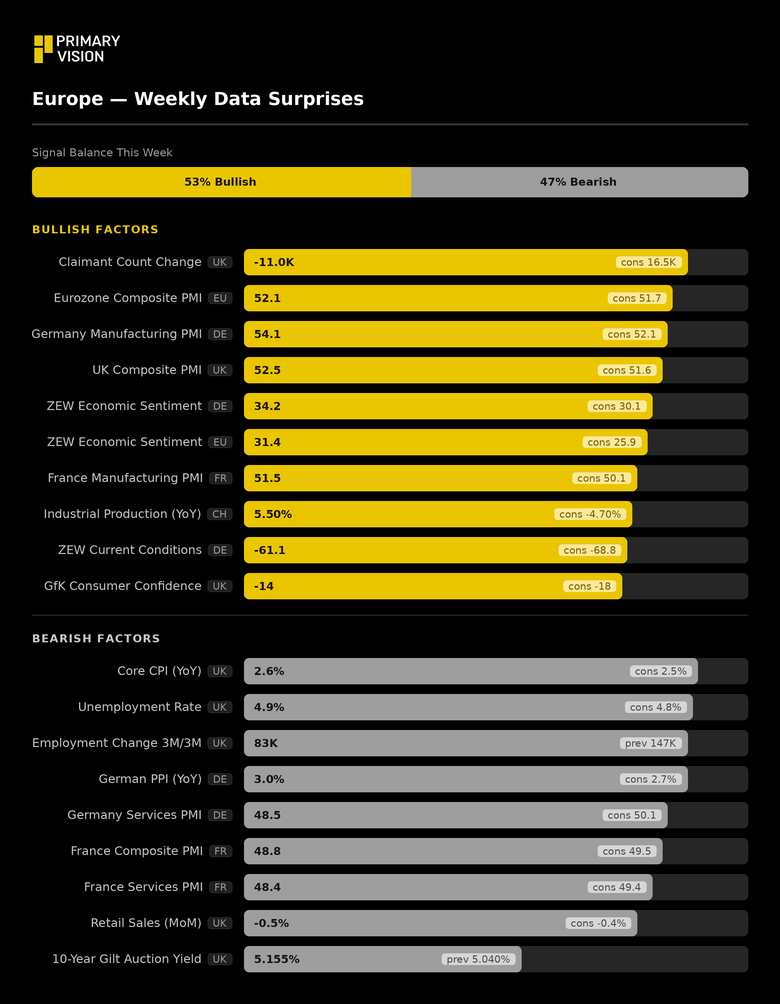
Europe’s PMIs look better at exactly the moment the region’s energy hedge is becoming less comfortable. German manufacturing at 54.1 and Eurozone manufacturing at 52.8 are meaningful because European industry spent much of the previous cycle absorbing an energy and inventory shock. German ZEW sentiment at 34.2 adds evidence that firms are seeing a better order environment. The durability of that rebound now depends heavily on energy.
European gas storage is only around 62%, compared with roughly 74% at this point last year, and remains below the EU’s 80% target for December 1. High current gas prices have themselves discouraged storage purchases. The Iran conflict adds exposure through LNG competition, shipping and the wider oil-products market. That creates an awkward timing problem. Manufacturing is finally improving as Europe heads toward the period when energy inventories matter most. A colder winter or another Gulf supply shock would hit chemicals, metals, fertilizers and other energy-intensive sectors first—the same industrial complex now producing the strongest survey data.
Europe has acquired a winter-dependent industrial recovery. If storage reaches comfortable levels and Gulf energy flows stabilize, manufacturing can finally contribute meaningfully to 2027 growth. If not, margins get squeezed before household demand has recovered enough to take over. That makes European gas inventories one of the highest-value macro indicators to watch over the next ten weeks.
China
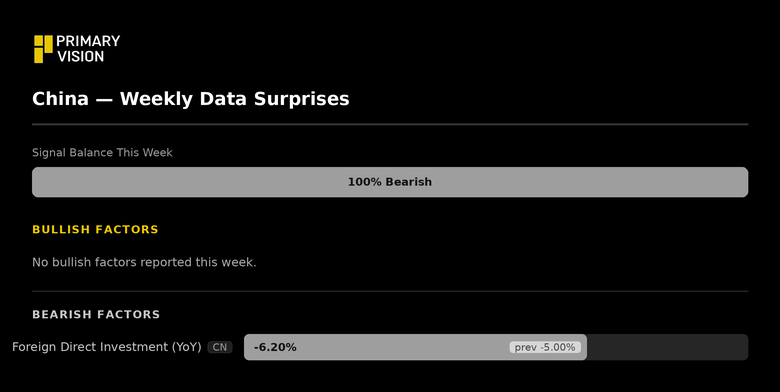
China’s FDI number is more consequential in the present environment than its small weight in the calendar suggests. FDI deteriorated to -6.2% from -5.0%, while the one- and five-year Loan Prime Rates stayed at 3.00% and 3.50%. Meanwhile, fixed-asset investment has fallen 6.7% over the first seven months of the year and Q2 GDP growth slowed to 4.3%. Beijing is now opening an 800 billion yuan policy-financing channel for infrastructure and strategic projects, but implementation delays mean the growth impact is likely to be back-loaded. The important signal is the declining productivity of policy support.
China has funding capacity. What it lacks is a sufficiently large stock of projects and private borrowers willing to deploy it at acceptable returns. The fact that the financing program sat unused during the first half before being activated is revealing: credit supply can be created administratively; commercially attractive investment demand cannot. Property remains central to that problem. Falling home values continue to impair household wealth and weaken the incentive to lever into property, while distressed developers have left construction and land demand structurally lower. Infrastructure can replace some lost fixed investment in GDP accounting, but it does less to repair household balance sheets or restore private-sector animal spirits.
Beijing therefore faces a difficult allocation problem. More stimulus can support headline activity, but commodity inflation from the Gulf raises import costs; further monetary easing risks currency pressure; and infrastructure spending does not automatically revive private investment.
The number to watch is no longer simply the LPR. Watch whether the 800 billion yuan facility actually crowds in private capital. If every yuan of policy capital requires progressively more state direction to generate investment, the weakness in FDI is describing something much broader than foreign sentiment: it is describing the declining return on China’s old growth model.
Tags:
Permission denied
Upgrade to Pro Today and get…
• This article — plus dozens more each month, all within our full Research Module
• Frac Hits — our National-Level Frac Spread Count and Frac Job Count, updated weekly
• Frac Operator Monitor — detailed FSC & FJC by operator
• And so much more, designed to help you track, forecast, and outperform