






Articles
- BLOG / Articles / View
- Articles
Market Sentiment Tracker: When Will China's Oil Imports Recover?
By Osama on July 28, 2026 in Market Sentiment
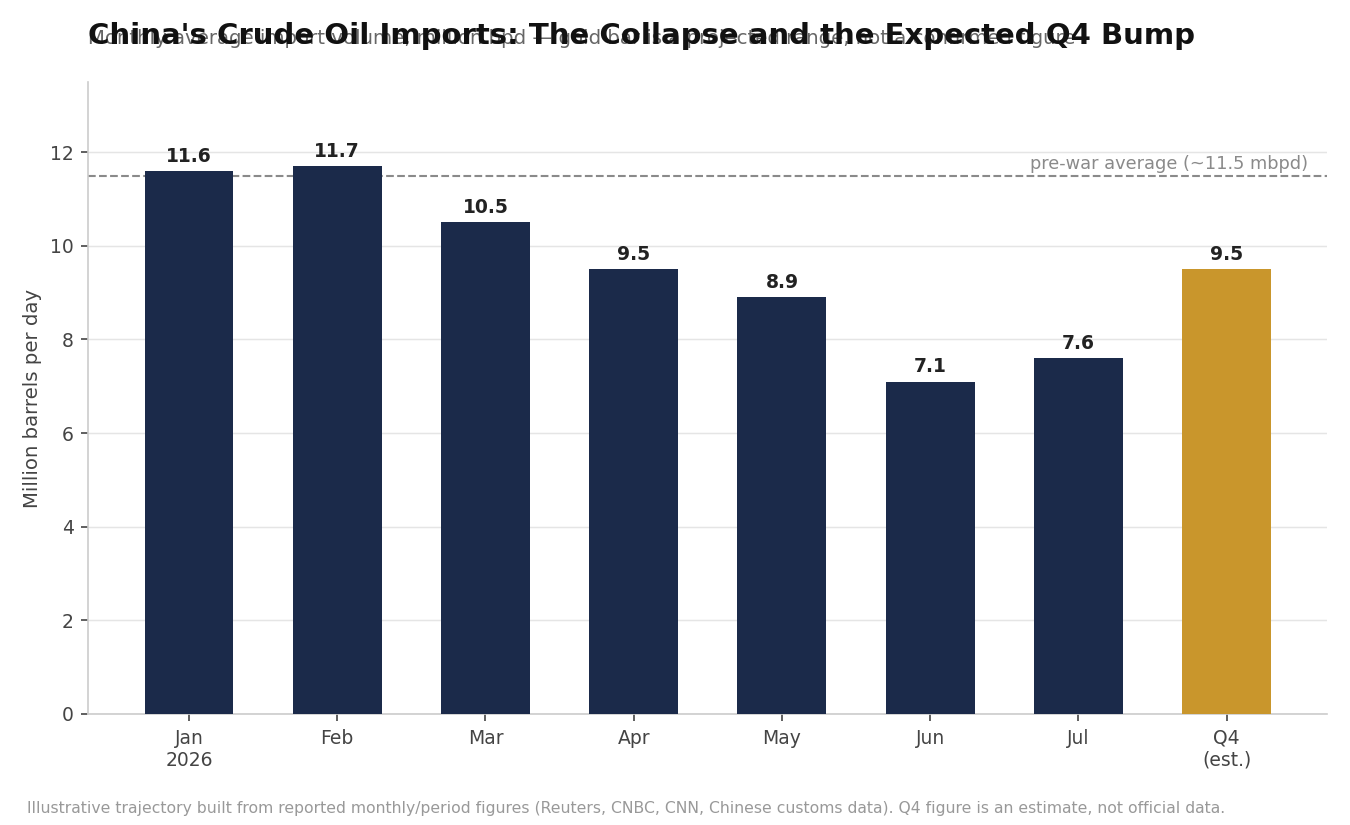
China's crude imports fell from an average of roughly 11.5-11.6 million barrels a day before the Iran war to somewhere between 6 and 8 million bpd by June — the weakest monthly volume since October 2016. That cut accounted for roughly three-quarters of the entire global adjustment in crude imports since the war began, which is the main reason Brent never traded anywhere near the $170-200 range some desks were pricing in when Hormuz first shut. However, what matters now is what China's refiners actually plan to do with crude over the next two to three quarters, and that means going past the headline import number and into the plumbing: quotas, margins, and inventory rules.
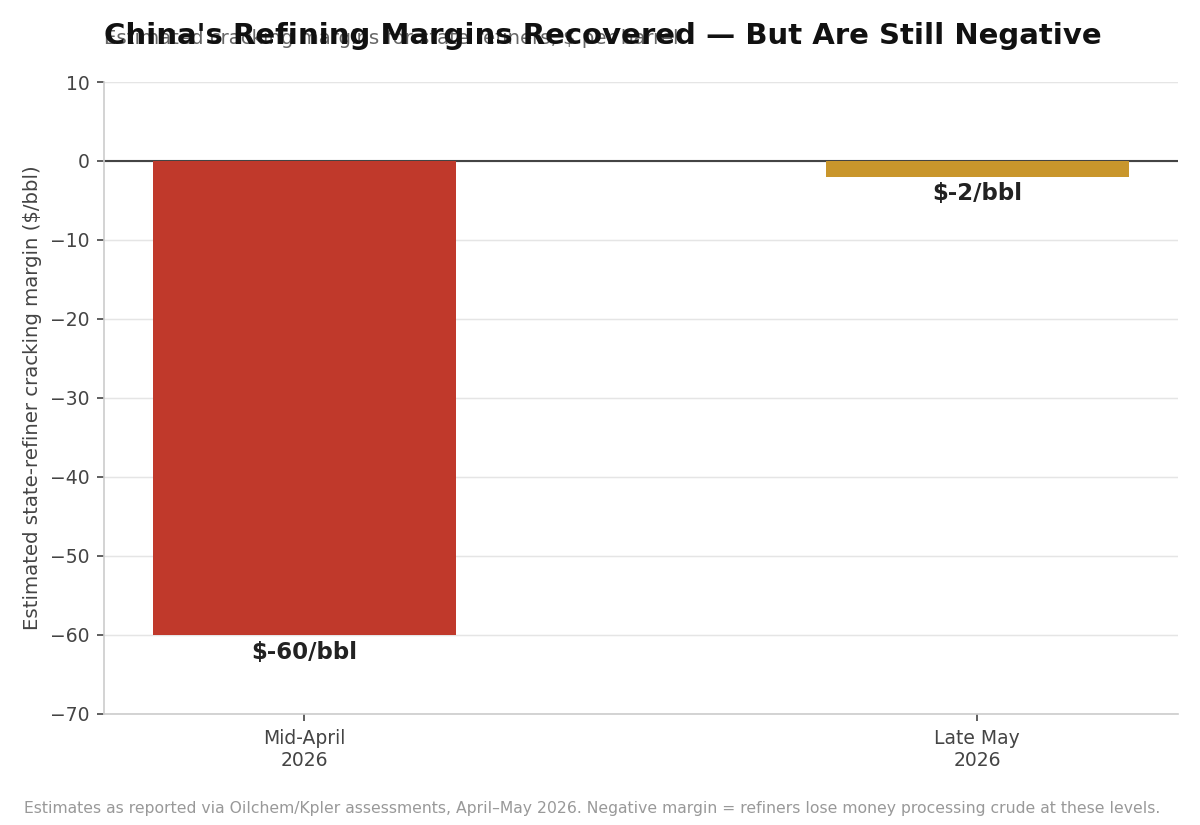
Let's start with the state majors, because they set the floor. Sinopec's own first-half filing shows refinery throughput down 5.6% year-on-year to 113.3 million tonnes, with domestic sales of refined products down 9.2% — gasoline, diesel and jet fuel all falling, alongside double-digit declines in petrochemical feedstock. Their full-year 2026 guidance is roughly 250 million tonnes of throughput — which is flat versus 2025. Separate industry forecasting points to a 5% drop in China's overall refining activity for 2026. The margin data explains why. State-refiner cracking margins collapsed to as low as minus $60 a barrel in mid-April, before recovering to around minus $2 by late May as refiners cut back on expensive feedstock. Still negative. Refiners were missing their own transportation-fuel sales targets through April and May even as run rates fell to multi-year lows, and gasoline and diesel inventories are sitting near two-year highs.
That weakness may not be purely cyclical either. Even before the war, forecasts had already moved up China's oil demand peak to as early as 2027, two years earlier than the prior estimate, citing EV penetration, LNG-fueled trucking, and high-speed rail eating into road and air fuel. Whether the war itself pulled that timeline forward further is still an open question — EV sales and LNG-truck adoption did keep climbing while gasoline and diesel sat above $100-equivalent pricing for months, and it's plausible some of the switching sticks even as crude gets cheaper again. But it's also entirely possible this reverses once prices normalize and gasoline cars look economical again; consumption habits built over a few months of an oil shock aren't necessarily permanent. We'll have a much better read on how much of this year's demand destruction is structural versus temporary once winter fuel-buying season plays out and prices settle.
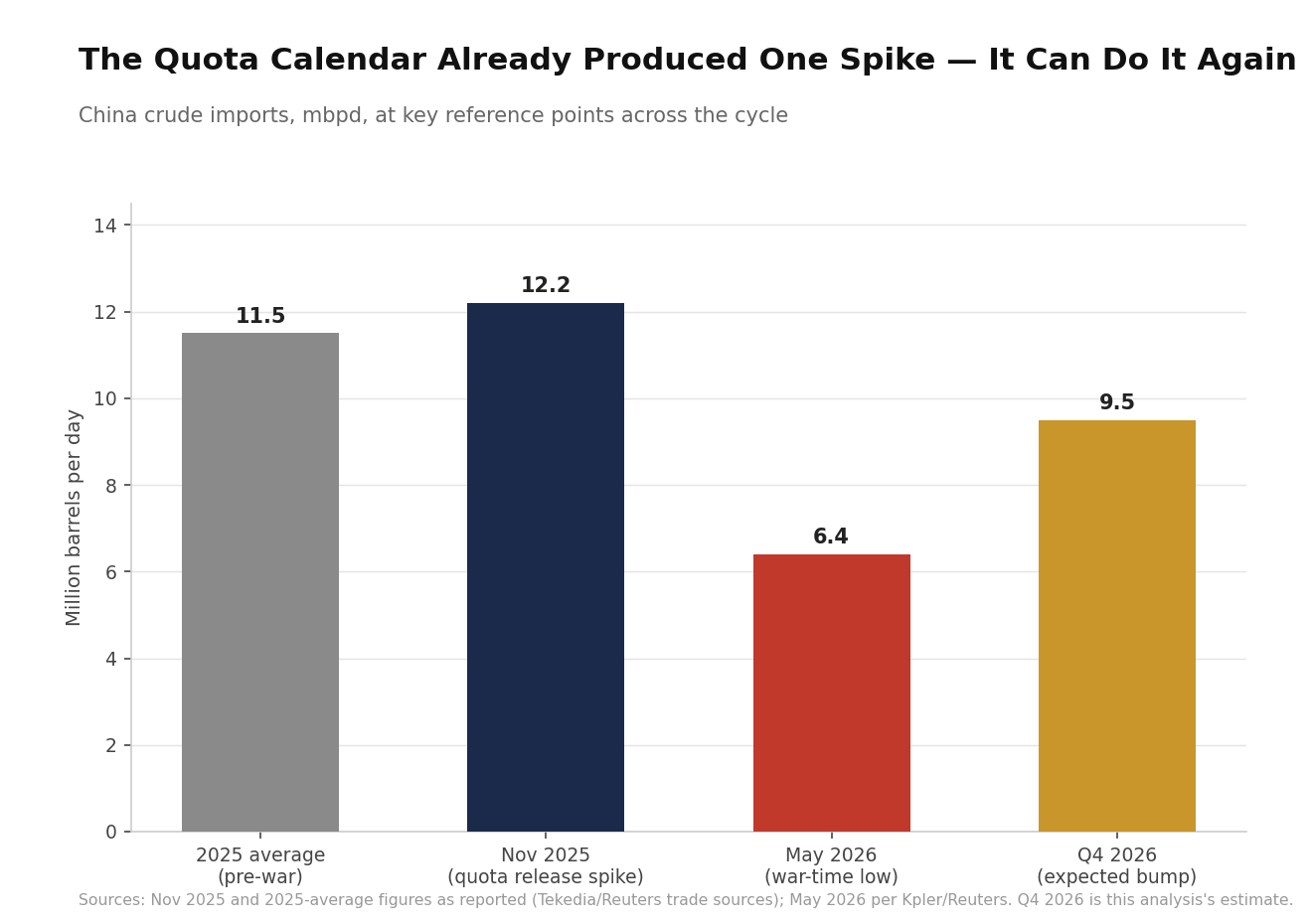
Against that backdrop, we need to look at the quota system to determine whether a near term bounce back is possible or not. Beijing set the 2026 crude import quota for independent refiners at 257 million tonnes, also flat versus 2025. By the start of the year, only 60-70% of that annual allocation had actually been issued across the first two batches. That leaves roughly 80-100 million tonnes of quota — about 1.6-2 million bpd on an annualized basis — still unreleased and due to land later this year. This isn't a guess: the same mechanism pushed November 2025 imports to a 27-month high of 12.2 million bpd after Beijing's year-end quota release, as teapots rushed to use allowances before they expired. Expect a similar pattern around Q4 2026 — the quota calendar works this way most years, war or no war.
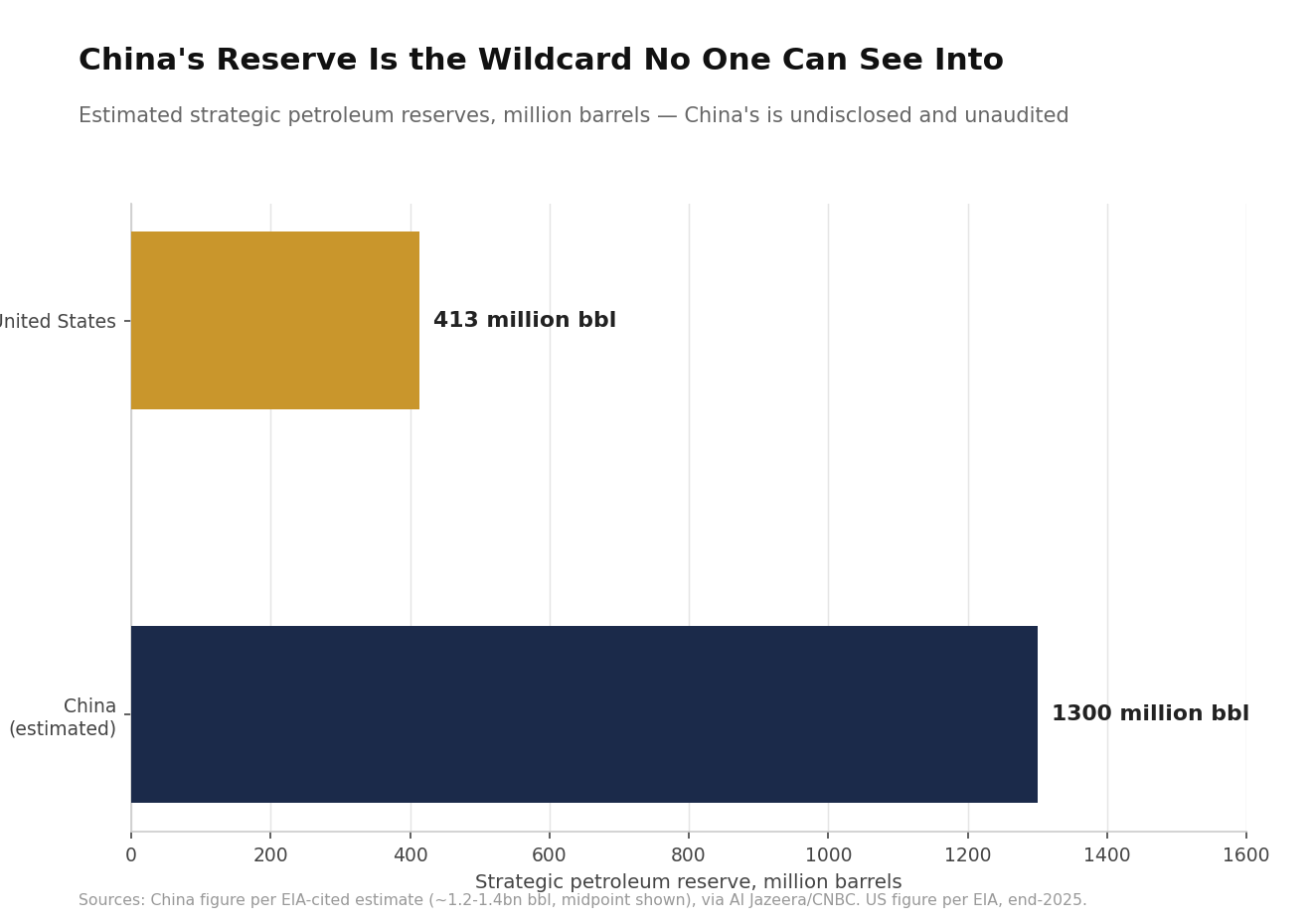
Layered on top of that is fuel-export policy. Beijing raised the state-refiner export ceiling to 800,000 tonnes for July, up from roughly 600,000 in June, and chasing export margins could pull through incremental crude buying rather than relying on domestic sales — with one catch: Beijing requires refiners to hold product stocks above end-February levels, so this can't simply be funded by drawing down inventory. It needs fresh crude. The wildcard nobody can time is the reserve. China holds roughly 1.2-1.4 billion barrels in strategic storage — the largest buffer on earth, built cheap on sanctioned Russian, Iranian and Venezuelan barrels. Premier Li Qiang has pushed for even more tank capacity, but Beijing publishes no reserve targets and no inventory data, so a restocking decision could add a sudden 1-2 million bpd for months with no advance warning in the data.
Teapots spent most of H1 2026 under-buying relative to their allocations — running at the lowest utilization since 2017 while sitting on above-average Shandong stockpiles — which means more of this year's quota is likely to get used later and in a more compressed window than usual, stacked on top of whatever fresh allocation lands in Q4.
The bigger risk to this whole framework is the assumption that Hormuz stays a live constraint through year-end. If the ceasefire holds and insurance premiums keep falling, Middle Eastern grades become cheaper relative to the Russian, Iranian, and Latin American barrels teapots leaned on all year, and refiners have every incentive to switch back into higher-quality Gulf crude faster than the quota calendar dictates — which would front-load some of that Q4 bump into Q3 instead. Conversely, if Iran keeps disrupting transits — as it has done repeatedly even after supposed ceasefires this year — the opportunistic Gulf-crude buying teapots have already started doing gets choked off again, and the recovery becomes entirely dependent on Russian, Iranian and Venezuelan barrels, which come with their own sanctions and shadow-fleet friction. Either way, the direction of travel over the next two quarters is more buying, not less — the real argument is over pace and durability, not whether China restarts.
Tags:
Permission denied
Upgrade to Pro Today and get…
• This article — plus dozens more each month, all within our full Research Module
• Frac Hits — our National-Level Frac Spread Count and Frac Job Count, updated weekly
• Frac Operator Monitor — detailed FSC & FJC by operator
• And so much more, designed to help you track, forecast, and outperform