






Articles
- BLOG / Articles / View
- Articles
Monday Macro View: Has Frac Efficiency Changed the Oil Price Equation?
By Osama on October 19, 2026 in Market Sentiment
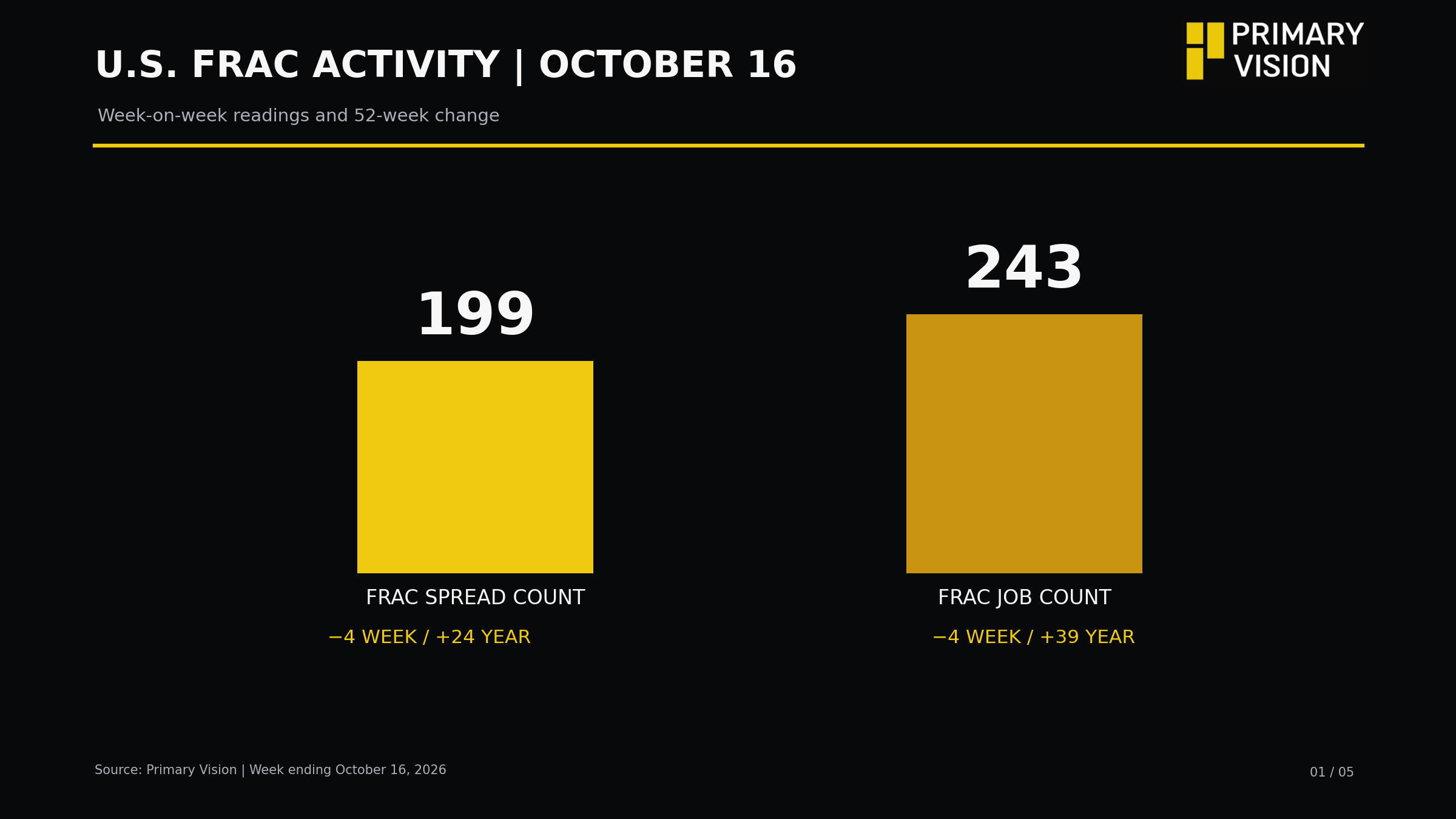
Primary Vision's Frac Spread Count (FSC) declined by four to 199 for the week ending October 16, while the Frac Job Count (FJC) also fell by four to 243. The national rig count remained unchanged at 603. Despite the weekly pullback, active frac spreads are 24 higher than a year ago, while the rig count has increased by 55. These figures arrive as American shale operators prepare their development budgets for 2027, with oil prices, service costs and capital discipline influencing investment decisions. However, improvements in completion efficiency raise an important question about how much additional equipment the industry actually needs to respond to stronger prices. To examine this relationship, Primary Vision recently introduced the Frac Efficiency Index (FEI).
The FEI measures completion jobs relative to the average number of active frac spreads, allowing us to examine changes in the amount of work delivered by the equipment deployed. Our latest findings show that the index has increased approximately 38% since late 2023, reaching 5.4 nationally by June 2026. Interestingly, this improvement continued through the 2024–25 oil-price downturn, when WTI declined approximately 33%. The efficiency gains have therefore persisted under considerably different price conditions, although their effect on future investment decisions remains to be established.
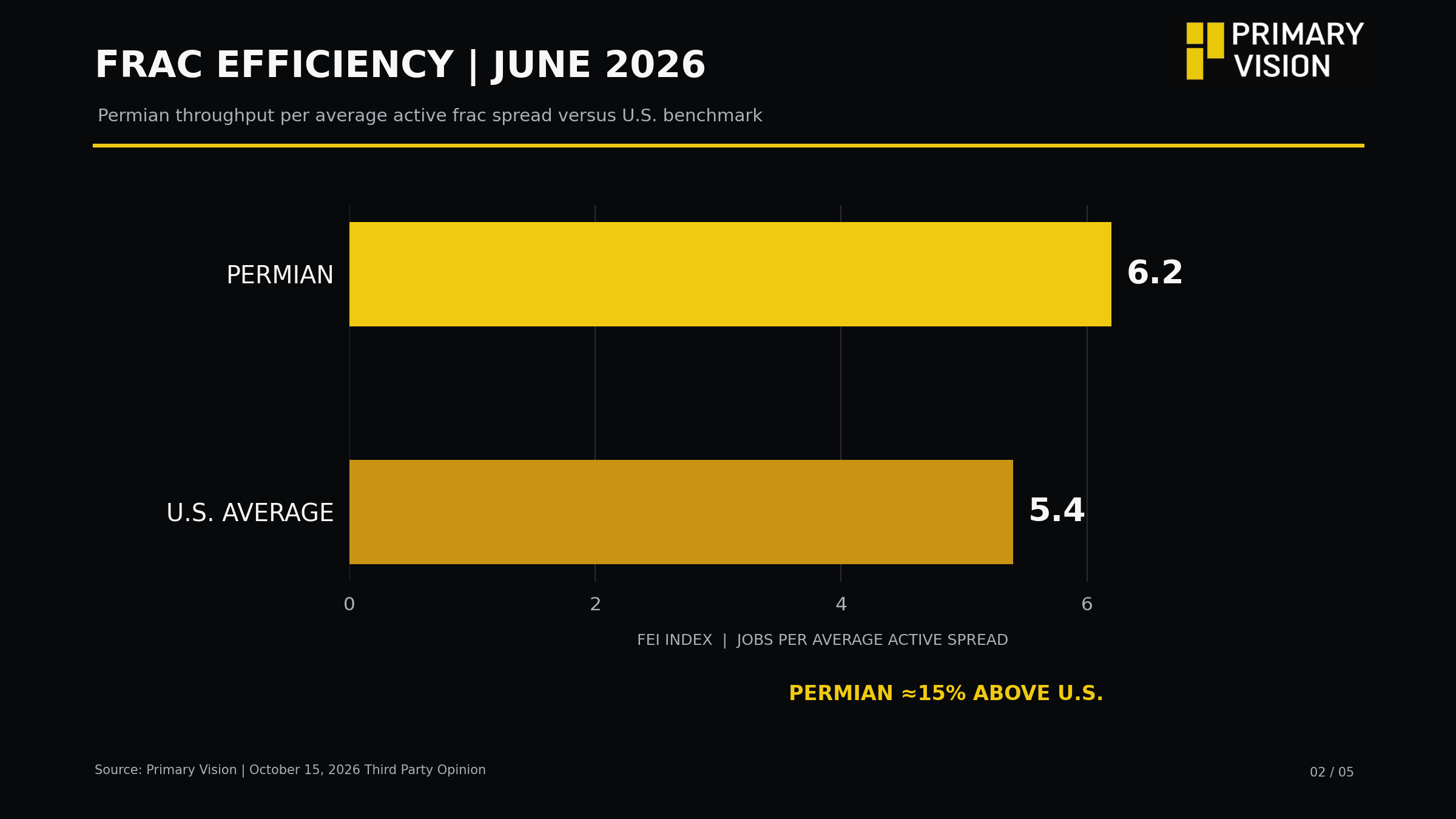
The Permian offers an important perspective on where the industry stands today. Its FEI reached approximately 6.2 by June 2026, compared with the national average of 5.4, giving the basin an advantage of nearly 15%. This difference is particularly relevant because the Permian accounts for such a substantial share of American completion activity. Higher throughput per spread means that the same number of active crews can support a greater volume of completion work, although differences in well design and operating conditions complicate direct comparisons between basins. Another interesting finding comes from the equipment available to the industry.
During the first quarter of 2026, approximately 60% of marketed frac capacity was actively deployed. By the second quarter, utilization had improved to roughly 67%, representing an increase of around 7 percentage points, while marketed fleet capacity remained broadly unchanged. This suggests that the recovery in activity was largely absorbed by existing capacity rather than fleet expansion. Nevertheless, approximately one-third of marketed capacity remained inactive, although not all idle equipment was necessarily available for immediate redeployment.
This distinction becomes important when considering how operators might respond to higher oil prices. Before commissioning additional capacity, producers and service companies have room to increase the utilization of equipment already available. However, the economic viability of reactivation depends on labor availability, maintenance expenditure, pumping capacity and expected contract duration. Higher efficiency may reduce the number of spreads required, but it does not eliminate the costs associated with restarting idle equipment.
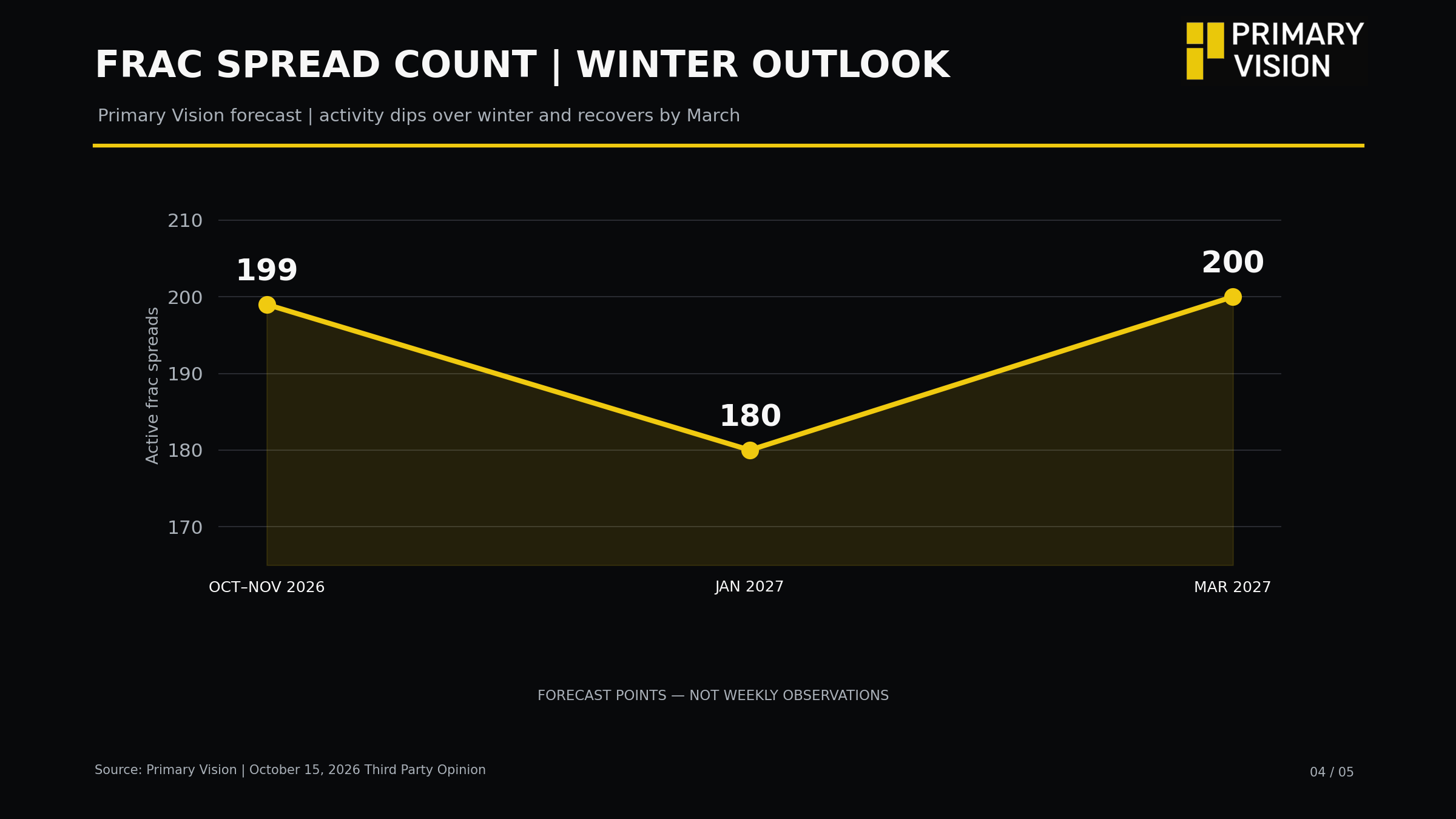
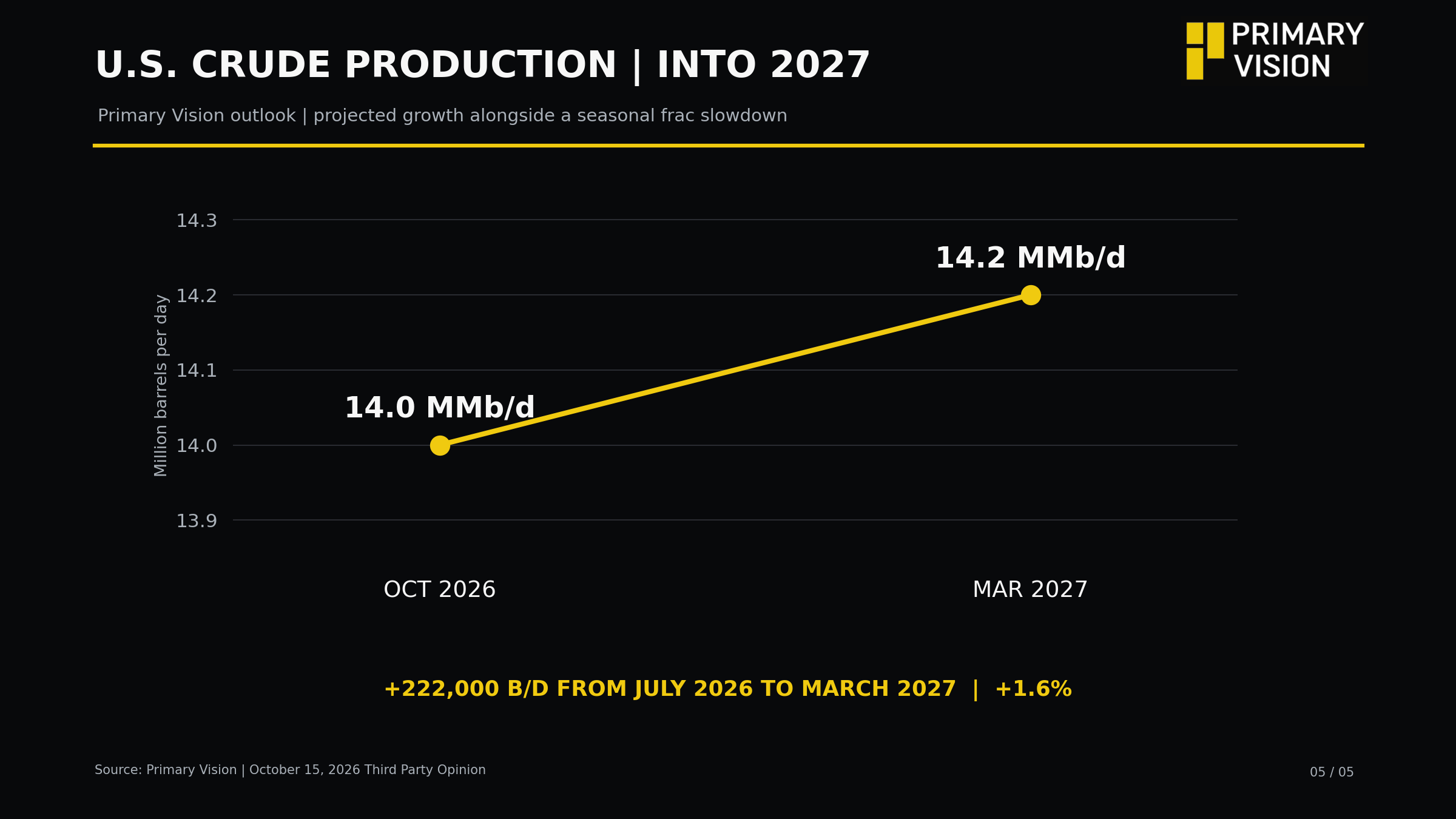
Primary Vision's latest forecast anticipates an average of approximately 199 active spreads between October 16 and November 27, followed by a seasonal decline towards 180 in January. Activity is then projected to recover towards 200 by March 2027. The anticipated winter decline of roughly 11% will be worth monitoring alongside FEI. If completion throughput holds up better than the spread count, it would provide further evidence of the industry's ability to manage seasonal reductions in deployed equipment. Meanwhile, our U.S. crude production outlook projects an increase of approximately 222,000 barrels per day between July 2026 and March 2027, taking production towards 14.2 million barrels per day. This projected growth overlaps with a period of relatively stable frac activity and a temporary winter slowdown. The explanation partly lies in the lag between completing wells and realizing their production, although well productivity and decline rates remain equally important.
The coming months will provide a useful test of how completion efficiency influences the industry's response to oil prices. With active spreads near 200, substantial marketed capacity still undeployed and production projected to increase, the more relevant question for 2027 is how much additional completion activity operators can generate from the equipment already available before further fleet expansion becomes necessary.
Tags:
Permission denied
Upgrade to Pro Today and get…
• This article — plus dozens more each month, all within our full Research Module
• Frac Hits — our National-Level Frac Spread Count and Frac Job Count, updated weekly
• Frac Operator Monitor — detailed FSC & FJC by operator
• And so much more, designed to help you track, forecast, and outperform