Monday Macro View: How Are Longer Laterals Changing the Frac Math?
By
Osama
on August 23, 2026
in
Market Sentiment
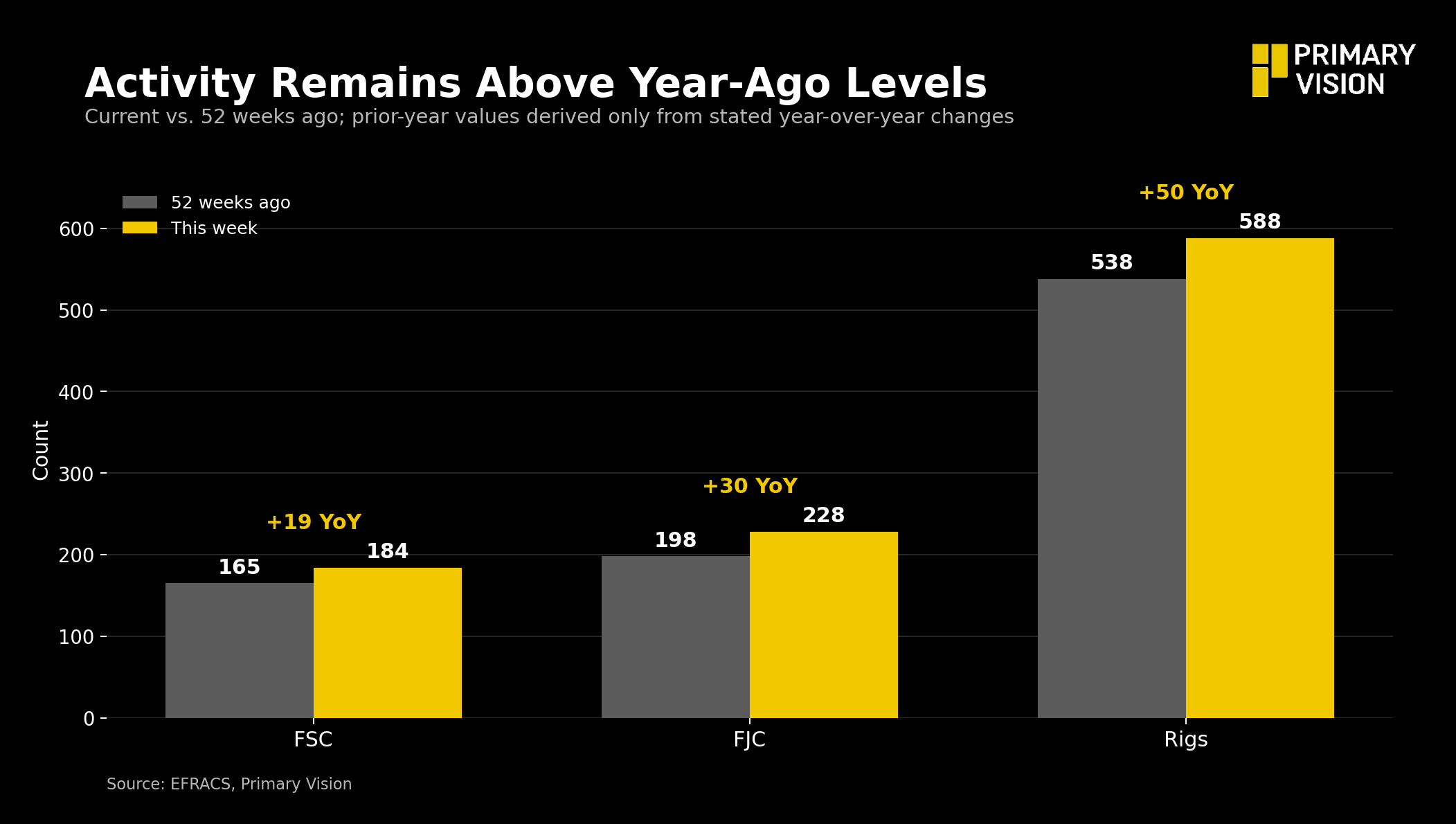
This week’s Frac Spread Count came in at 184, down 9 on the week, while the Frac Job Count fell by the same amount to 228. Both are still comfortably above where they were a year ago, with FSC up 19 and FJC up 30 versus 52 weeks ago. The rig count also slipped by 5 to 588, although it remains 50 rigs higher year over year. At the same time, laterals are getting longer, which means more completion work is being concentrated into each well. Primary Vision’s Frac Chemistry Inspector gives us a useful way to see what that is doing to chemical demand and supplier selection across the Permian.
Several larger shale operators have been trimming spending even with oil prices remaining supportive. Chevron and ConocoPhillips spent roughly 10% less during the first half of the year, while Occidental cut Permian spending by around 20%. APA, HighPeak and Matador have also reduced spending. Higher oil prices are giving operators more cash, but they are not automatically putting that cash back into more drilling and completions. Debt reduction and shareholder returns are still competing for those dollars.
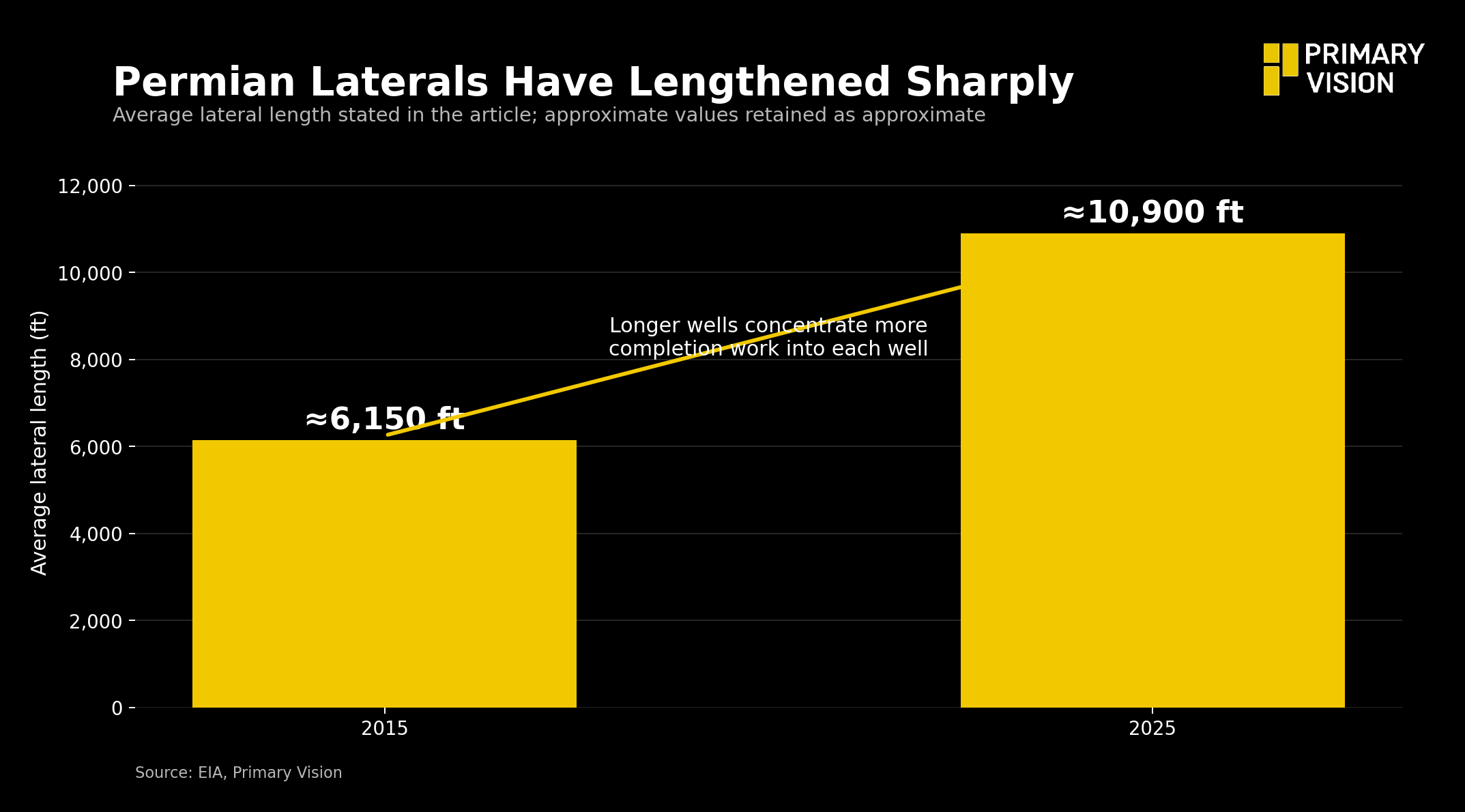
That is useful context for the FSC and FJC numbers because it helps explain why activity can soften even when commodity prices are supportive. It also makes the way operators are spending the remaining completion dollars more important. The latest Permian data showed average lateral length rising from roughly 6,150 feet in 2015 to nearly 10,900 feet in 2025, while wells longer than 15,000 feet now account for 15% of completions. At the same time, annual completion counts have remained around 6,000 wells since 2022, even as laterals kept getting longer.
Primary Vision’s chemical disclosure data gives us a different view of the same development.
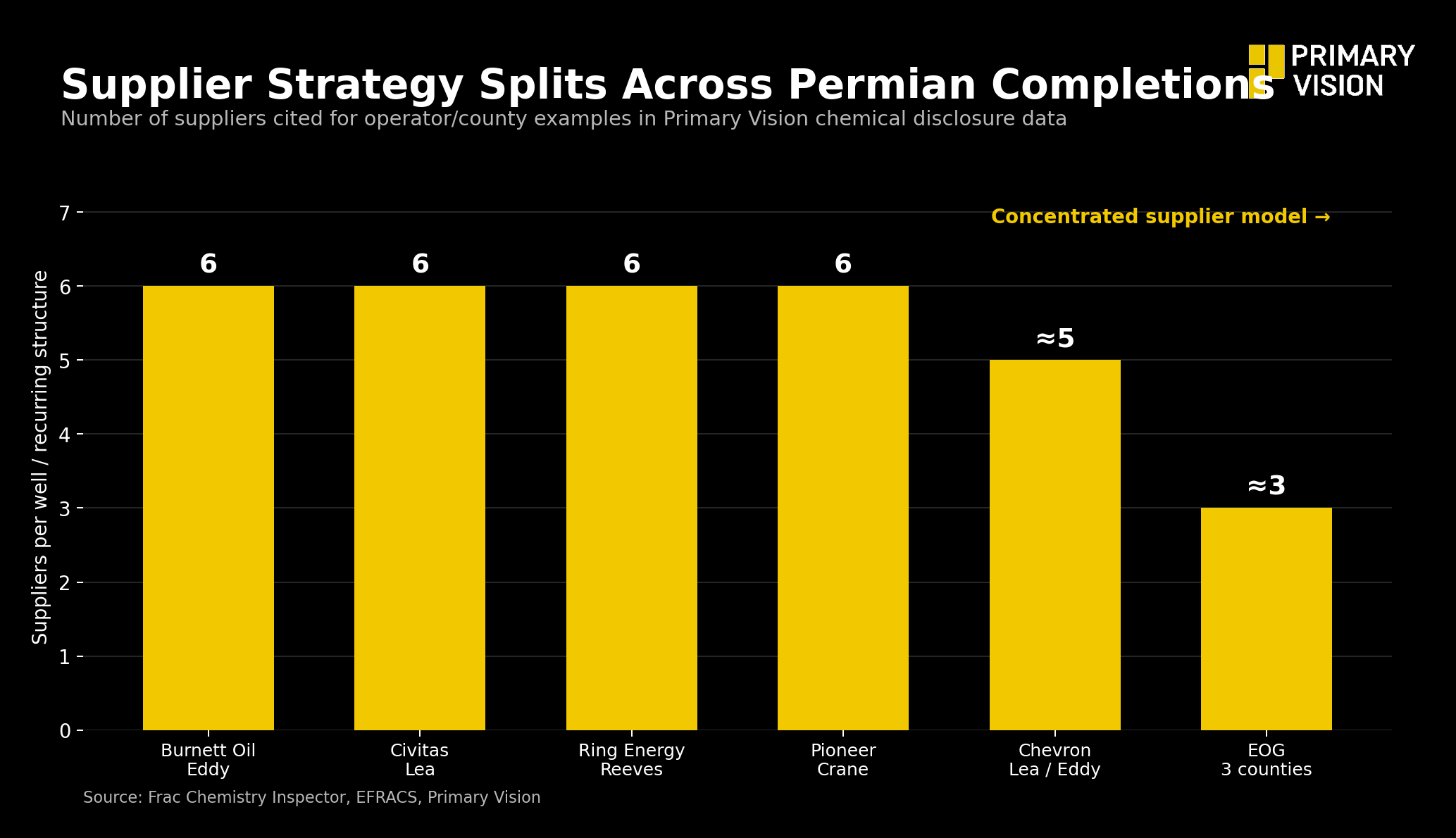
Across Lea, Eddy, Andrews, Reeves, Winkler and Crane counties, we are seeing a clear split in how operators supply these larger completions. Burnett Oil’s Eddy County wells show six separate suppliers on a single job. Civitas shows the same supplier count in Lea County, with different vendors supplying products including biocide, friction reducer, acid and proppant. Ring Energy in Reeves County and Pioneer in Crane County also show six suppliers, while Chevron’s wells across Lea and Eddy generally sit around five.
EOG is taking a much more concentrated approach. Across three counties we track, its wells repeatedly show essentially the same three-supplier structure, with EOG providing part of the fluid and proppant system and Innospec covering products including friction reducer and scale inhibitor. That distinction is becoming more relevant as laterals get longer. Bigger wells mean more stages, larger fluid volumes and more chemical consumption per completion. Some operators are using that scale to consolidate around a smaller group of suppliers. Others are still willing to carry five or six specialist vendors through the same well.
For chemical suppliers, those are two very different sales environments. One favors companies that can cover several additive categories reliably across a large program. The other leaves room for specialist products, but each supplier has to justify a separate place in an increasingly expensive completion. There is also some support for activity holding up despite tighter budgets. Forward pricing still leaves much of U.S. shale economic even after oil pulled back from its highs, with shale economics still holding across a large part of the basin. Operators therefore have room to remain selective without abandoning development altogether.
That is probably the better way to read this week’s numbers. FSC and FJC both moved lower, and spending discipline remains very real, but the dollars that are being spent are going into longer, larger and more chemically intensive wells. For us, the supplier mix inside those completions is becoming just as useful to watch as the headline activity count.
Upgrade to Pro Today and get…
• This article — plus dozens more each month, all within our full Research Module
• Frac Hits — our National-Level Frac Spread Count and Frac Job Count, updated weekly
• Frac Operator Monitor — detailed FSC & FJC by operator
• And so much more, designed to help you track, forecast, and outperform