Monday Macro View: Record Profits, Same Old Frac Count. What's Going On?
By
Osama
on August 2, 2026
in
Market Sentiment
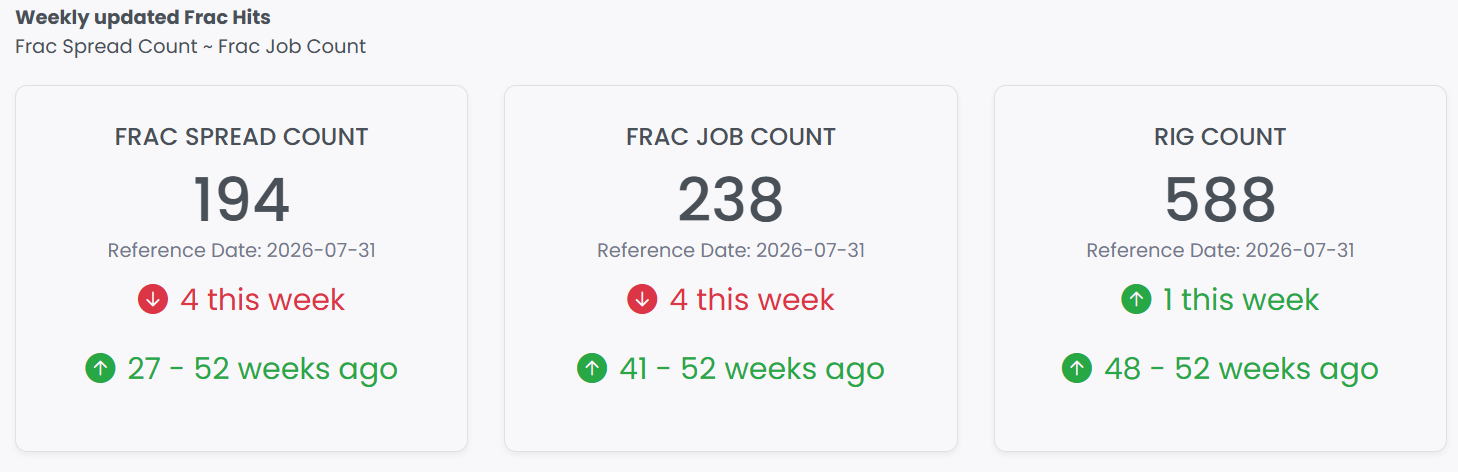
It's been a quieter week on the completions side, but the more interesting moves this week are in earnings and in where China's crude is actually coming from and the two aren't as separate as they first look. Start at home. The National Frac Spread Count came in at 194 as of July 31, down 4 on the week, with the Frac Job Count also off 4 to 238. Rig count ticked up 1 to 588. Spreads are still up sharply from February's trough near 145.
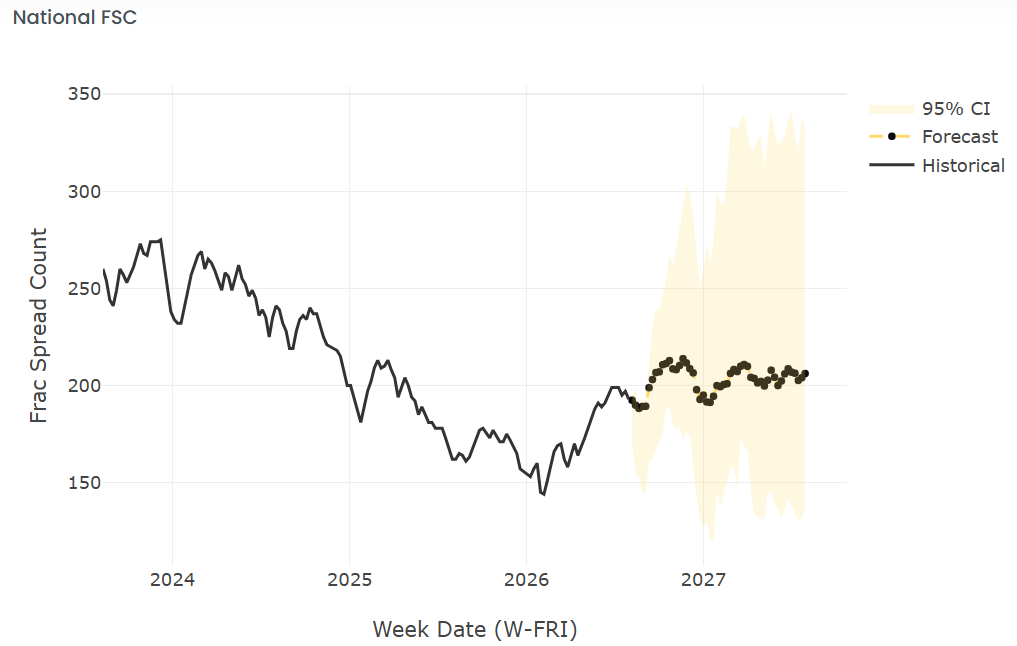
Primary Vision's own basin-level forecast has the count holding broadly in the 200–210 range through the next several weeks before the confidence interval widens considerably heading into 2027. That stability is happening even as Brent has pulled back to the high $80s from its Q2 average near $104 — renewed U.S.-Iran strikes are keeping a floor under prices, but the pullback from spring's peak may be part of why completions activity hasn't pushed higher alongside it.
Source: Primary Vision, CAI, Forecasting
That pullback sits a little oddly next to what the producers and service companies just reported. Halliburton's Q2 revenue rose to $5.7 billion with international revenue at $3.4 billion, its highest second-quarter level in more than a decade, while North America improved sequentially. CEO Jeff Miller pointed to a strong pipeline of contract awards and expects incremental improvement in North America through year-end. On the E&P side, the numbers were more dramatic: Chevron posted Q2 net income of $12.1 billion, up roughly 384% year-over-year from $2.5 billion, with U.S. production hitting a company record on the back of Hess and Permian volumes. That's the clearest sign yet that elevated prices earlier in the quarter flowed straight through to upstream earnings — and it raises a fair question about why completions capital hasn't fully caught up to it yet.
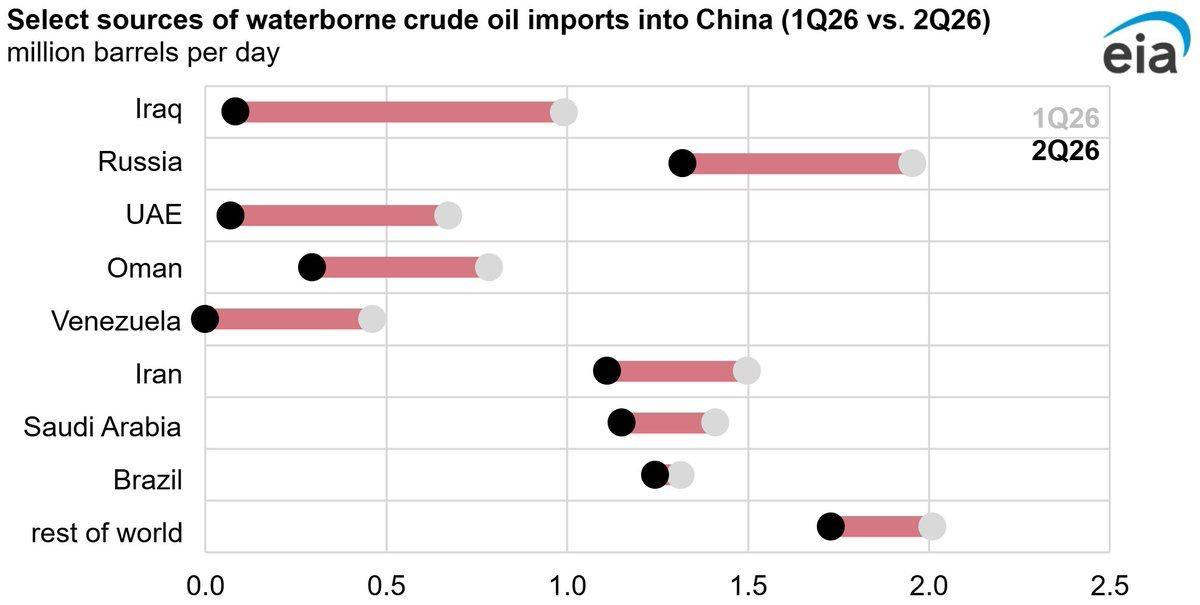
We wrote about China last week and some interesting numbers came out recently. China's crude has historically come mostly from Russia, Saudi Arabia, Iraq, and the UAE, but the mix moved hard this year: waterborne imports from Iraq fell 910,000 b/d between the first and second quarter, Russia dropped 640,000 b/d, and the UAE fell 600,000 b/d, according to the EIA. Russia still held on as China's single largest source through the pullback, but even that relationship lost volume as refiners drew down stockpiles instead of buying fresh cargoes. Iraq and the UAE took the biggest hits, Saudi Arabia held closer to flat, and no single country stepped in to fill the gap.
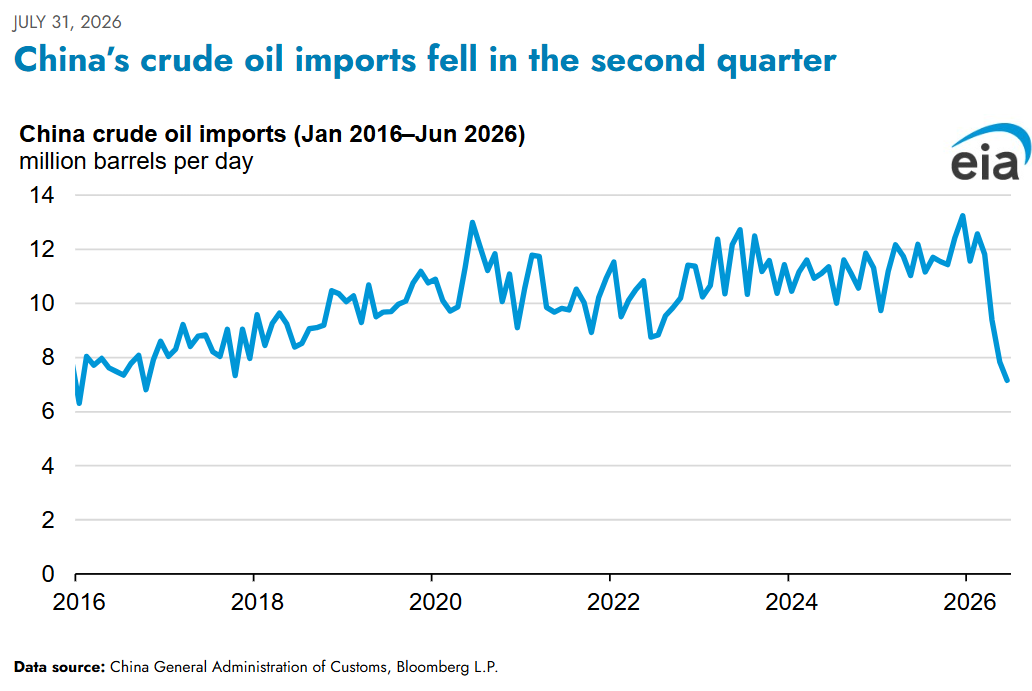
The EIA's own breakdown of China's sourcing, released this week, fills in the mechanism behind the July numbers. China imported just 8.1 million b/d of crude in the second quarter, 32% less than the first quarter.
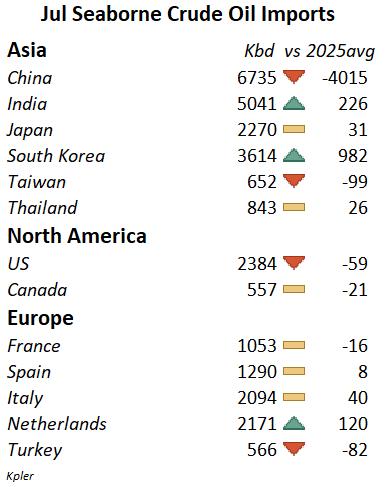
On the import side, July's seaborne numbers show where the slack is landing elsewhere. South Korea came in up 982,000 b/d from its 2025 average, and India was up 226,000 b/d — both picking up more than their usual share. The U.S. itself barely moved, at 2.38 million b/d, down just 59,000 from average. Europe was mixed but mostly flat: the Netherlands was the outlier at +120,000 b/d, likely reflecting its role as a redistribution hub, while Turkey came in lower at -82,000 b/d.
Watch whether 200 holds as a floor or a ceiling. Primary Vision's forecast has spreads sitting in the 200–210 band for weeks out, even as Brent has slipped back to the high $80s and Chevron and Halliburton both posted numbers that would normally argue for more activity, not less. Whether that gap closes — operators chasing the earnings, or the frac count staying anchored where it's been for a month regardless — is the thing worth watching into September.
Upgrade to Pro Today and get…
• This article — plus dozens more each month, all within our full Research Module
• Frac Hits — our National-Level Frac Spread Count and Frac Job Count, updated weekly
• Frac Operator Monitor — detailed FSC & FJC by operator
• And so much more, designed to help you track, forecast, and outperform