






Articles
- BLOG / Articles / View
- Articles
Monday Macro View: The Diverging Paths of U.S. Shale Operators
By Osama on October 5, 2026 in Market Sentiment
The latest Primary Vision data shows that U.S. completion activity has strengthened again. Frac Spread Count has risen from 178 in early September to 196 for the week ending October 2, an increase of just over 10%, while Frac Job Count is holding around 240. On the surface, that points to a firmer market heading into the fourth quarter. But the recovery is not uniform. The Permian has moved up 22%, while Appalachia has registered a gain of more than 64%. That is where the story becomes more interesting: the market is stronger, but the operators driving that strength are moving at very different speeds.
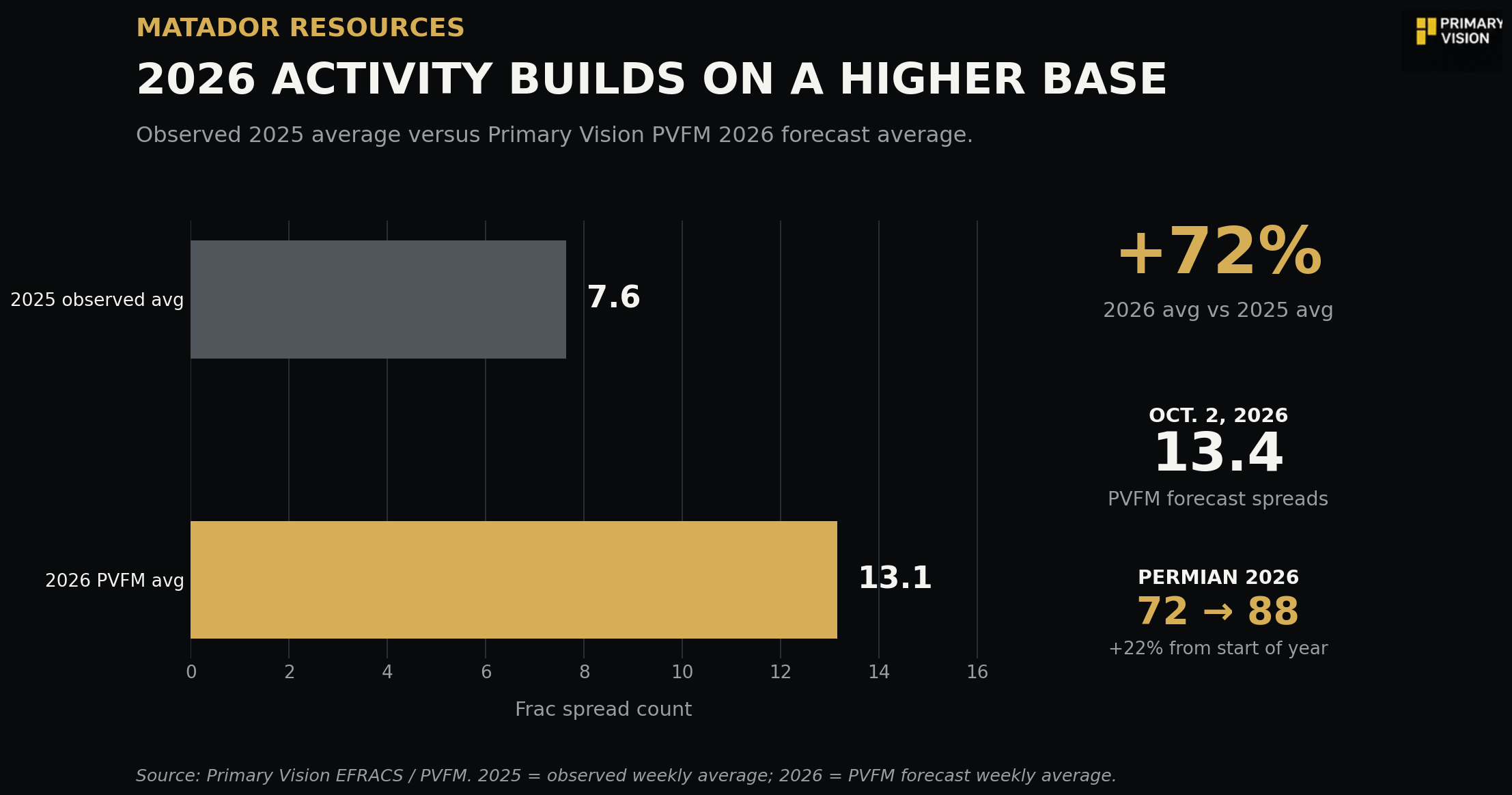
Matador Resources is one of the clearest cases. our Frac Operator monitos hosted inside EFRACS shows Matador averaging 7.6 frac spreads during 2025. Our system now projects an average of roughly 13.1 spreads during 2026, an increase of about 72%, with the October 2 forecast at 13.4. That matters because Matador has just closed its $1.255 billion acquisition of Paloma Permian, adding approximately 16,500 net acres in Eddy and Lea counties, more than 156 net two-mile-equivalent locations and 59 approved drilling permits. The deal therefore lands in a Permian market already running more than 20% above its early-year spread count, while Matador itself is expected to operate at a substantially higher intensity than it did last year. The question is no longer whether Matador has more inventory. It is whether that inventory allows the company to sustain a much larger completion program.
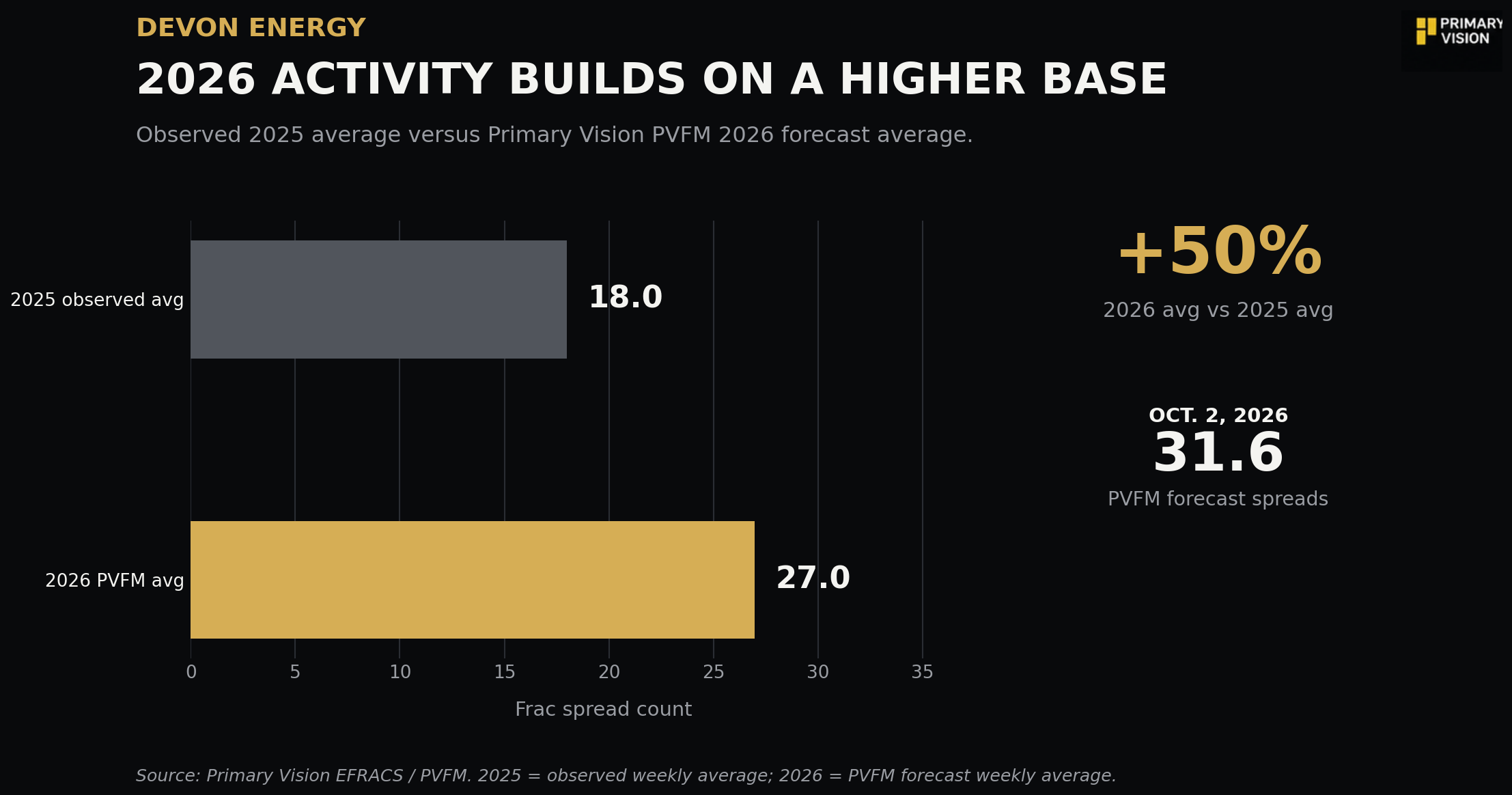
Devon Energy presents a different picture. Its observed activity averaged 18 spreads in 2025, after reaching a peak of 32. PVFM projects an average of approximately 27 spreads in 2026, almost 50% above last year’s average, with the October 2 forecast at 31.6 spreads. Yet that prospective rebuild comes while Devon is actively reshaping its portfolio. It was reported that the company is marketing its Eagle Ford and Powder River Basin assets, with BP having examined the Eagle Ford package before deciding not to proceed. The key question for EFRACS is therefore where those projected spreads ultimately appear. A recovery concentrated in retained assets would look very different from a broad-based return across the portfolio.
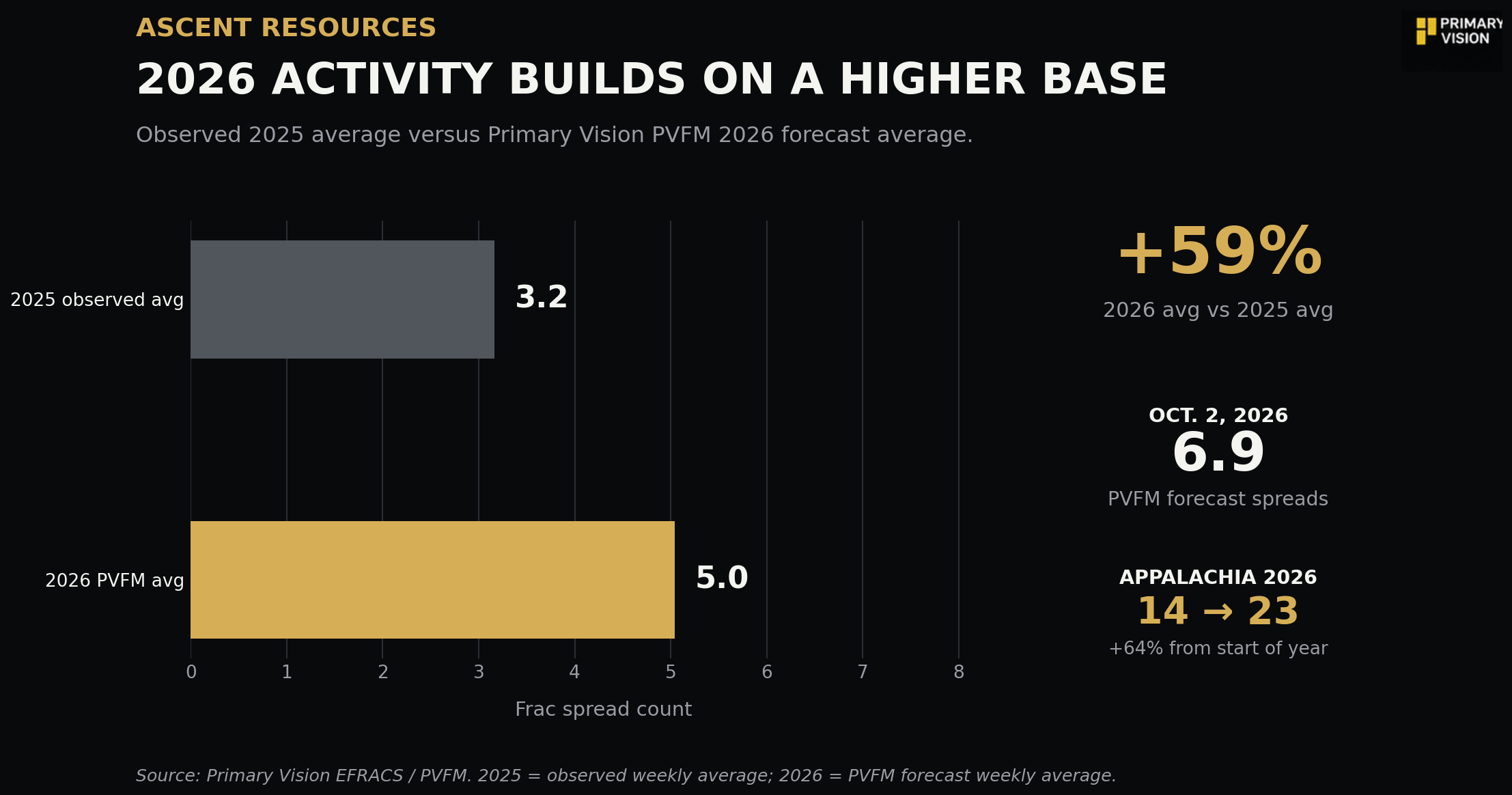
Appalachia offers another kind of divergence. Ascent Resources averaged only 3.2 spreads in 2025, despite briefly reaching nine. PVFM projects that average rising to roughly 5.0 during 2026, an increase of about 59%, with the October 2 forecast at 6.9 spreads. That is occurring inside an Appalachian market where total FSC has already risen more than 60% since the beginning of the year. Ascent has also been changing its commercial positioning, including reducing long-term firm transportation commitments by approximately $700 million. The basin may be stronger, but the operator response remains uneven.
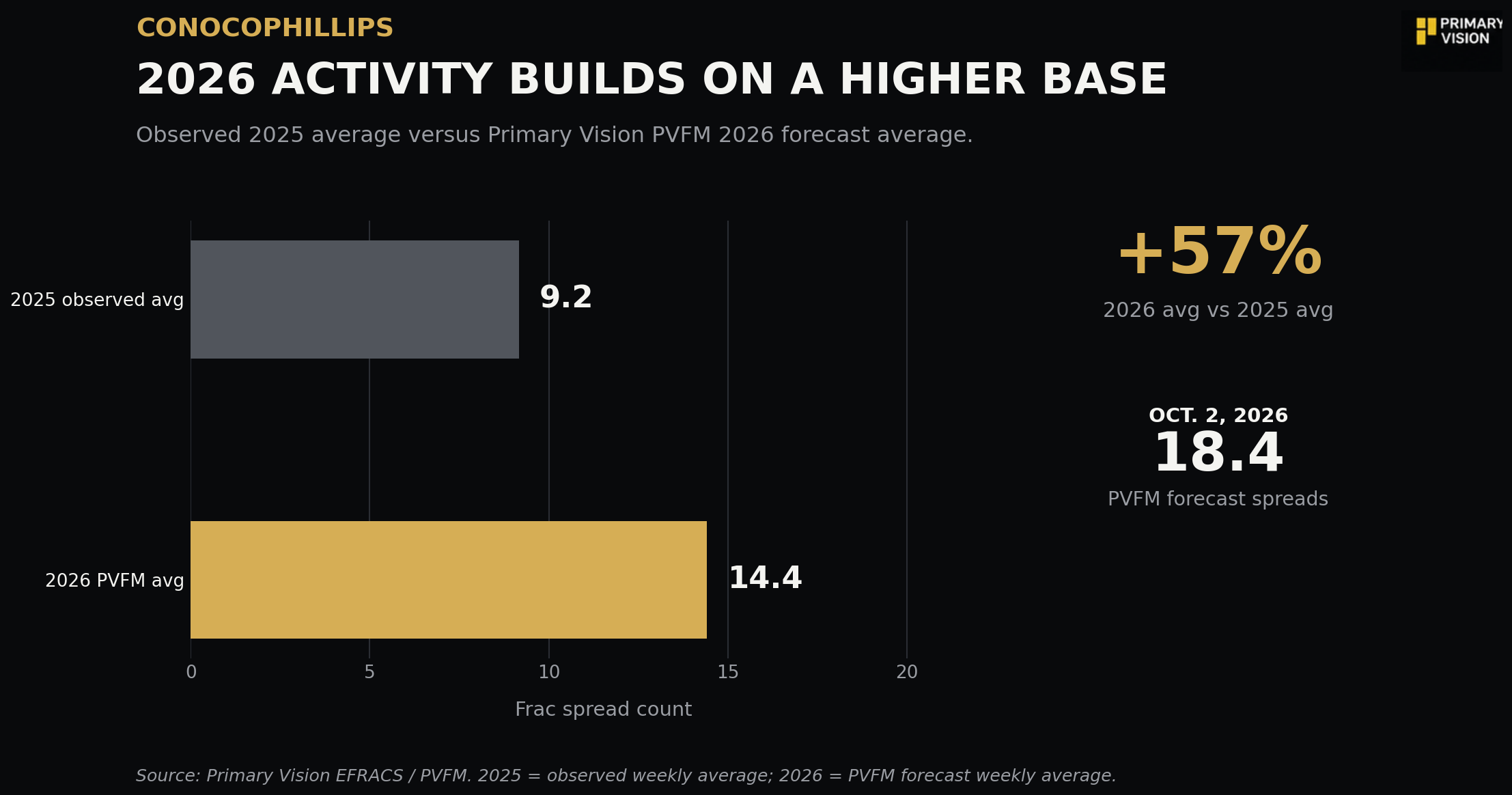
ConocoPhillips provides the fourth pattern. EFRACS shows an observed 2025 average of 9.2 spreads, while PVFM projects roughly 14.4 during 2026, an increase of about 57%. The October 2 forecast stands higher still at 18.4 spreads. At the same time, ConocoPhillips is evaluating the potential sale of its Norway business and UK Teesside asset, part of a continuing reshaping of its global portfolio.
This is why 196 national frac spreads tell only part of the story. Matador, Devon, Ascent and ConocoPhillips all enter the remainder of 2026 with higher projected activity than their 2025 averages, but for very different reasons and against very different basin backdrops. The national count tells us how much equipment is working. EFRACS and PVFM tell us who may be responsible for what comes next.
The divergence changes how we should read the national recovery. If basin activity rises while only a handful of operators account for most incremental spreads, the market is not broadening evenly; it is concentrating. That has implications for service demand, pricing power and eventually production growth. A higher FSC can therefore coexist with a narrower operating base, making operator-level concentration as important as the headline count itself.
Tags:
Permission denied
Upgrade to Pro Today and get…
• This article — plus dozens more each month, all within our full Research Module
• Frac Hits — our National-Level Frac Spread Count and Frac Job Count, updated weekly
• Frac Operator Monitor — detailed FSC & FJC by operator
• And so much more, designed to help you track, forecast, and outperform