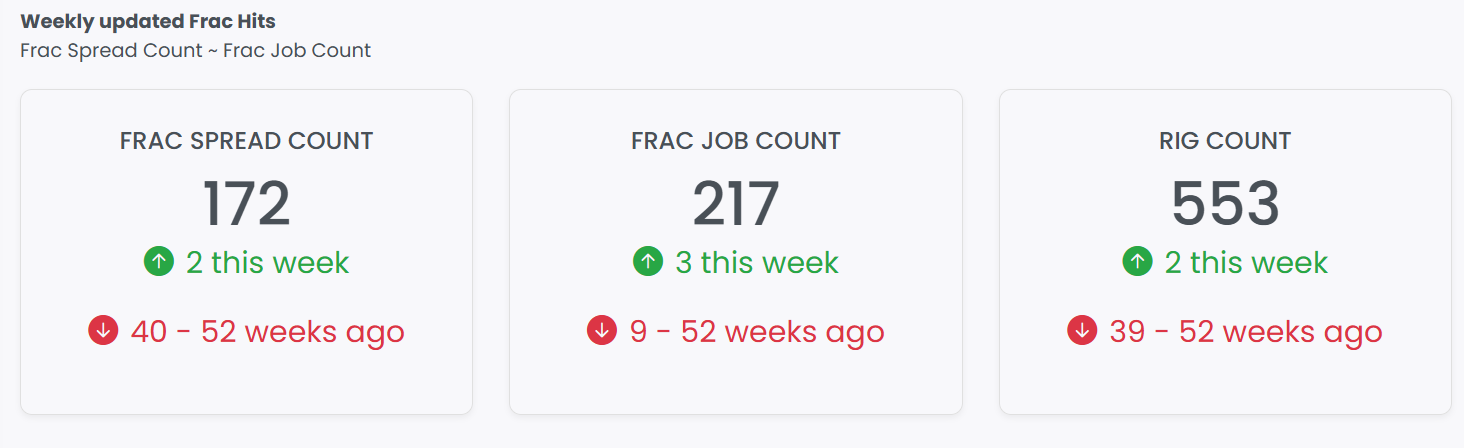
Primary Vision's latest data shows the U.S. Frac Spread Count at 172, up 2 week-over-week, with the Frac Job Count at 217, up 3 over the same period. The move is modest, but the more interesting question right now is not whether spreads are ticking up — it is whether the industry has the capacity to respond meaningfully if demand accelerates from here.
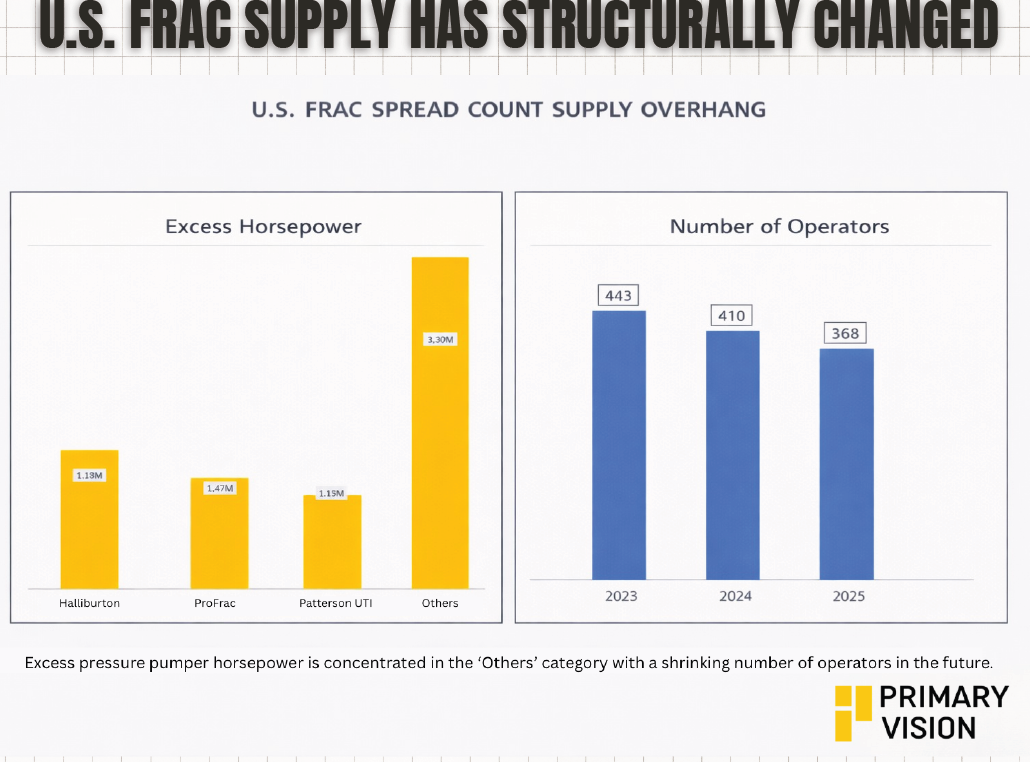
In our recent Third Party Opinion webinar, we discussed the structure of U.S. frac supply and how it has shifted in ways worth understanding. Primary Vision data shows that most of the excess horsepower sits with smaller operators — roughly 3.30 million horsepower — while larger players like Halliburton, ProFrac, and Patterson-UTI each carry between 1.19M and 1.47M. The operator count has consolidated from 443 in 2023 to an estimated 368 in 2025. As the market consolidates around fewer, better-capitalized players, the horsepower that remains is higher quality, better maintained, and more deployable — which means effective, work-ready capacity is actually stronger than the headline numbers suggest.
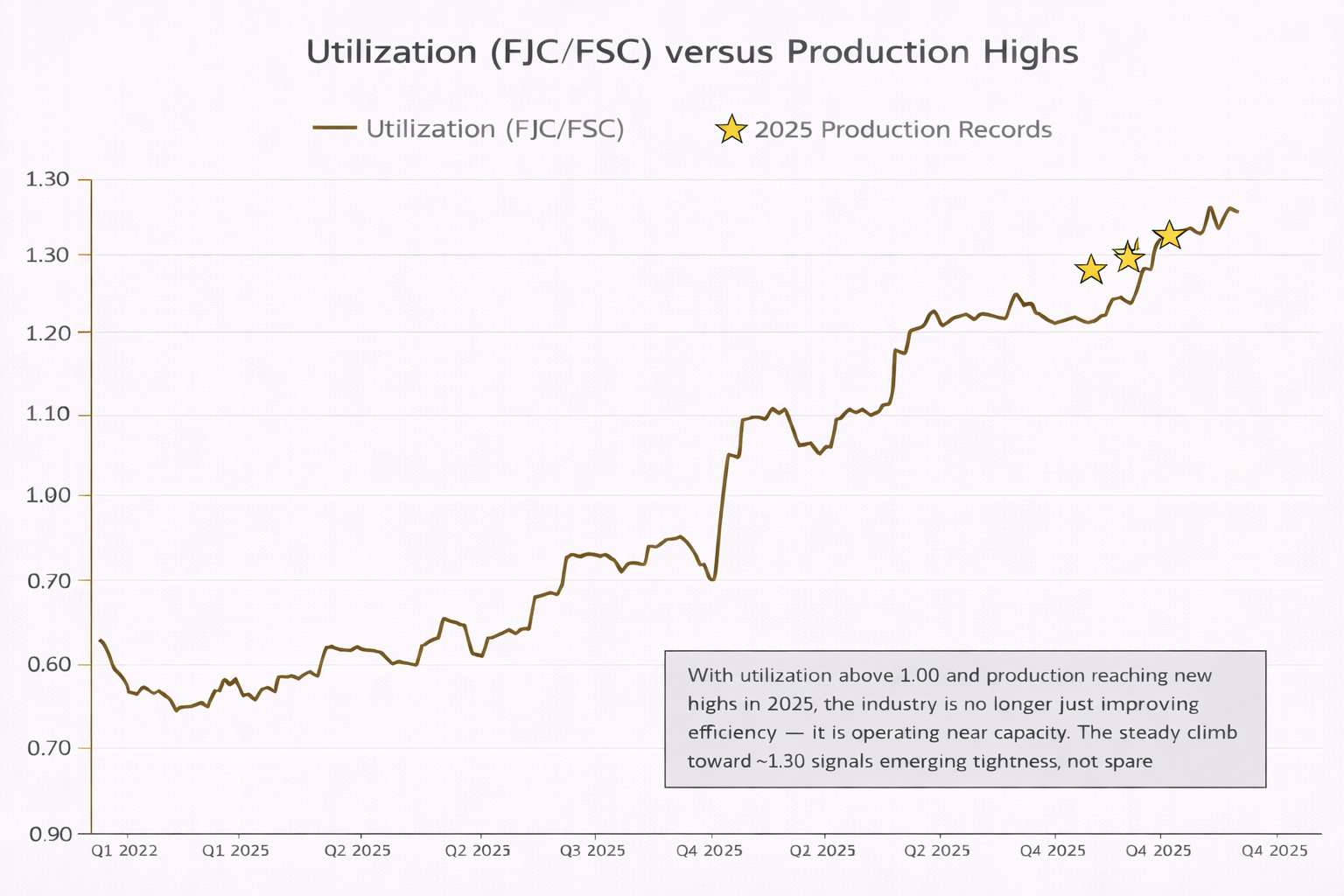
The utilization data tells the same story, and it is worth pausing on what it actually measures. Primary Vision's FJC/FSC ratio divides frac jobs completed by frac spreads active — so when the ratio is below 1.00, spreads are sitting idle between jobs, the market has slack, and operators have pricing power over service companies. When it crosses 1.00, every active spread is fully engaged. At 1.30 today — up from below 0.70 in late 2024 — each spread is completing more than one job per cycle, which is only possible through tighter scheduling, longer operating hours, and less downtime. This means that the market is running at a high level, and it has coincided with U.S. oil and gas production hitting new records through 2025.
Patterson-UTI CEO Andy Hendricks reinforced this read last week, warning that rising U.S. natural gas exports and surging domestic demand will produce a shortage of fracking equipment later this decade. Hendricks identified the Haynesville basin as a particular pressure point, where new pipeline capacity connecting to Gulf Coast LNG export terminals is pulling in more drilling rigs — but where gas-capable frac equipment is already sold out. Patterson-UTI's own Q4 commentary noted that while puvblic fleet counts have declined, total horsepower deployed has held relatively steady, as operators stack older diesel assets and concentrate higher-quality gas-burning equipment on the wellsite. The effect is a quieter but real compression of usable supply, exactly consistent with what Primary Vision's operator count and utilization data show.
Gas-directed completions activity is expected to build through 2026 and into 2027, driven by LNG export demand and AI-related power consumption onshore. A consolidated, high-utilization supply base is well-positioned for that environment. Primary Vision's numbers this week show a stable market. The fundamentals underneath it are quietly strengthening.
Upgrade to Pro Today and get…
• This article — plus dozens more each month, all within our full Research Module
• Frac Hits — our National-Level Frac Spread Count and Frac Job Count, updated weekly
• Frac Operator Monitor — detailed FSC & FJC by operator
• And so much more, designed to help you track, forecast, and outperform