






Articles
- BLOG / Articles / View
- Articles
Monday Macro View: Where Could Venezuela Pull U.S. HHP From?
By Osama on August 31, 2026 in Market Sentiment
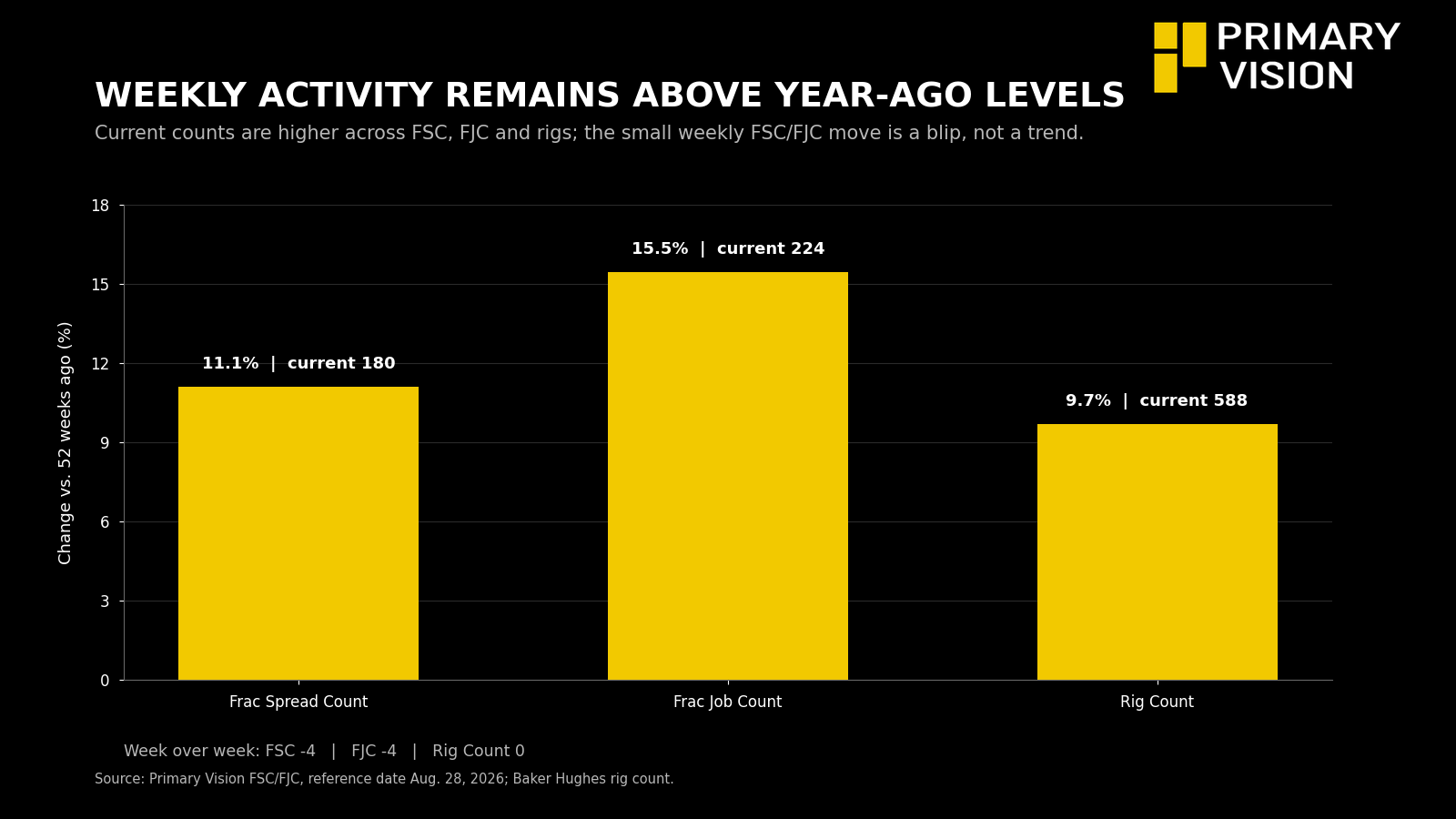
Primary Vision's latest Frac Spread Count came in at 180, down four for the week and up 18 from a year ago, while the Frac Job Count was 224, down four and up 30 year over year. The weekly rig count held at 588, up 52 from last year. Those weekly completion moves look like noise inside a stable range. The biggest news this week came from Venezuela, where a new U.S. framework could open a large service market. The question that we are asking is simple: who is already positioned to win that work, and where does U.S. frac capacity give them additional flexibility?
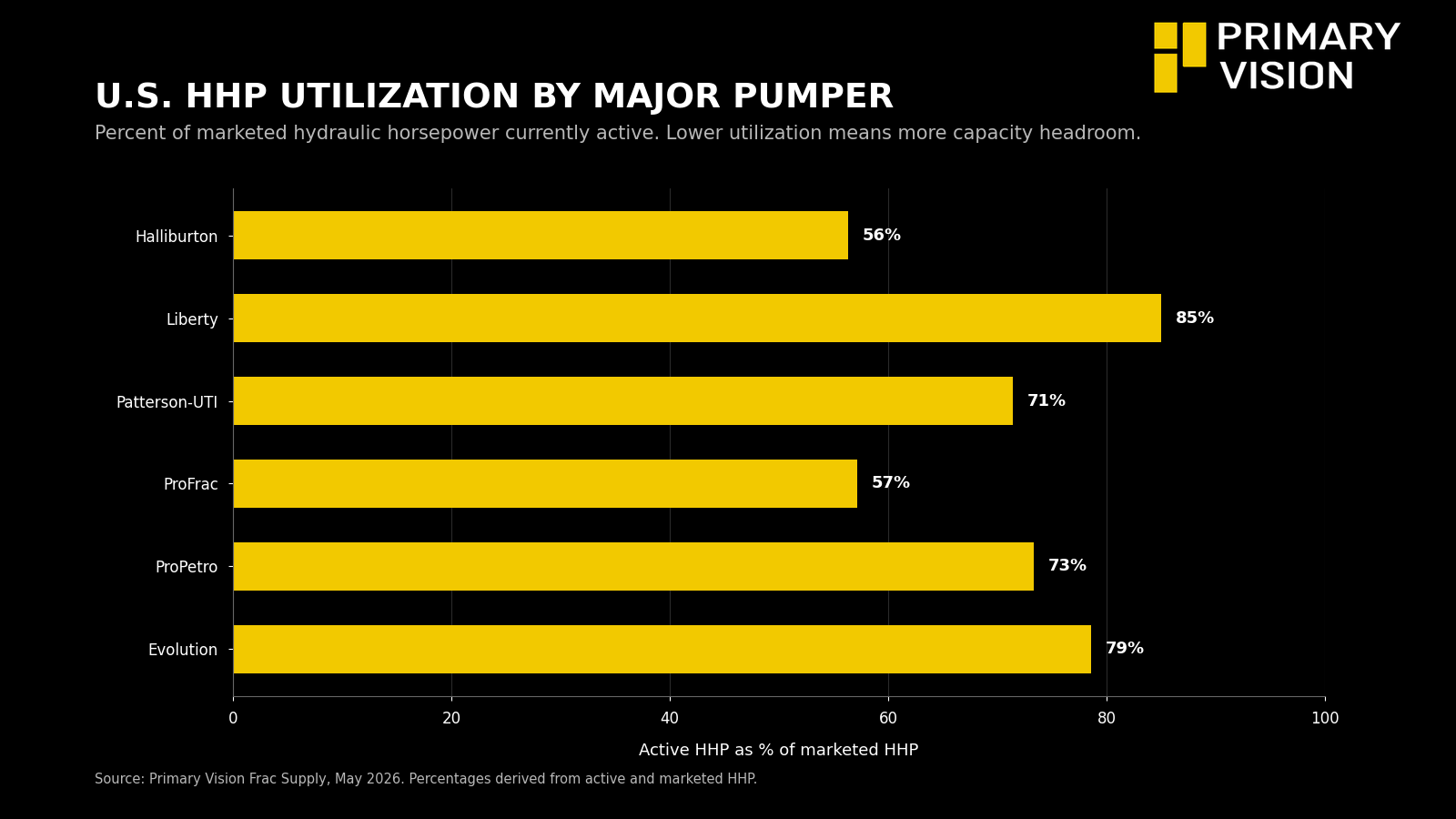
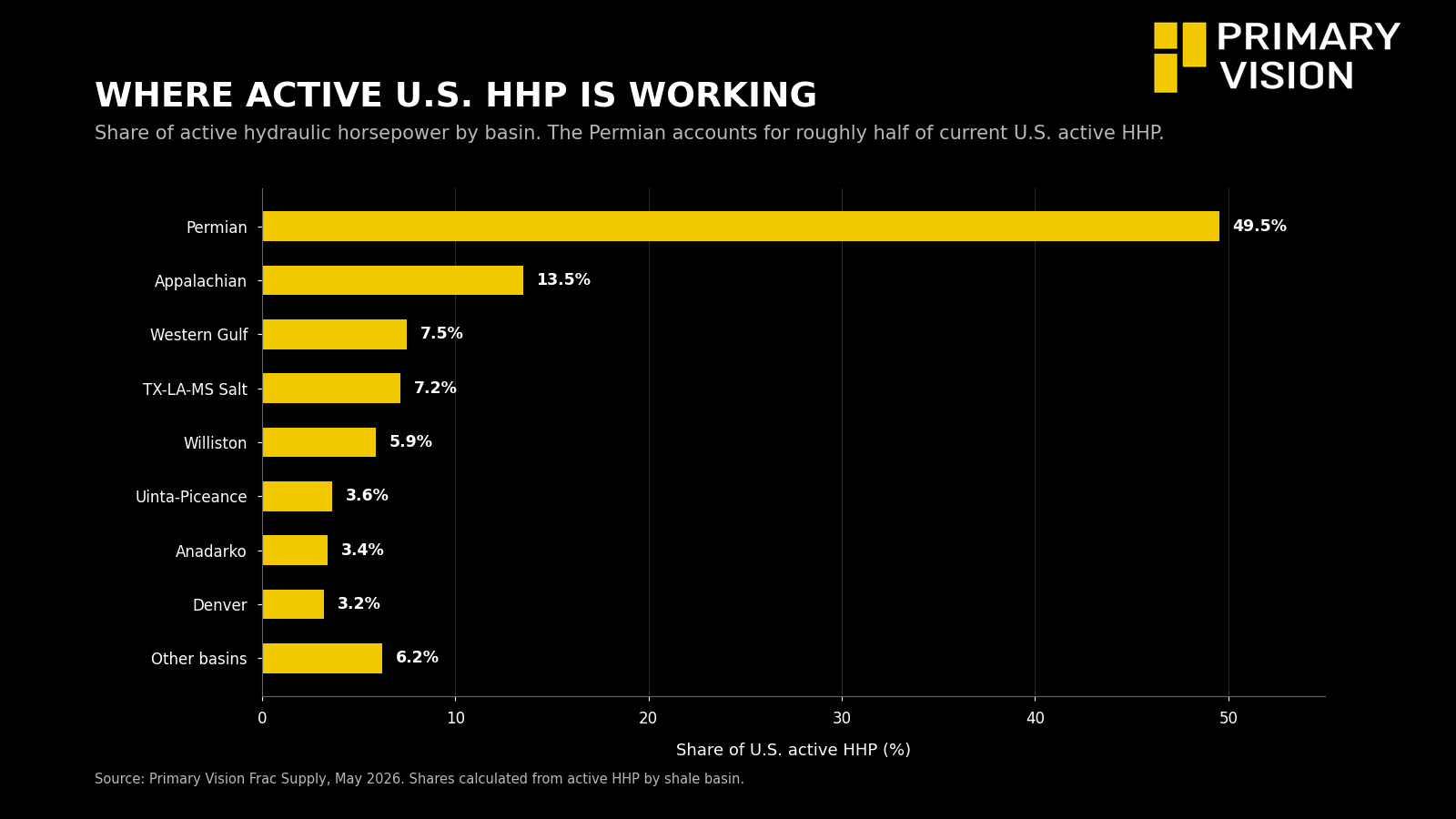
That question makes Primary Vision’s HHP data relevant before we discuss individual companies. Primary Vision supply shows roughly 63% of marketed U.S. HHP currently active, leaving about 37% inactive. That inactive share is capacity headroom, with crews, equipment condition, contracts, and mobilization determining what can actually move. The price backdrop still supports activity: Friday WTI settled at $83.40 before Monday prices moved back above $85. Primary Vision’s rule of roughly three sustained months of elevated pricing therefore remains supportive, although recent volatility makes the timing less mechanical.
Venezuela now gives that capacity question a real destination to monitor. The 17-field framework carries a 25-year horizon and targets more than 1.5 million barrels per day from the identified fields. The portfolio spans Orinoco and Maracaibo, combining greenfield heavy-oil development with mature assets that need rehabilitation. Treasury’s General License 48C authorizes U.S. goods, software, technology, and services for exploration, development, production, repair, and refurbishment. That service mix points first toward reservoir work, artificial lift, intervention, rig reactivation, well integrity, and production optimization, with stimulation demand becoming more relevant as development broadens.
The company ranking further helps us target which firms are going to get an early advantage. SLB ranks first overall because it has maintained a 97-year presence, already has a PDVSA digital framework, and recently gained a reservoir data contract. It is also working to reactivate existing rigs. Halliburton ranks second overall and first for the HHP-linked opportunity because it retains facilities, is negotiating commercial terms, and is now recruiting Venezuela roles. Weatherford ranks third, with retained assets and strong artificial-lift, intervention, and well-services exposure. Baker Hughes follows with an active Maracaibo artificial-lift hiring footprint.
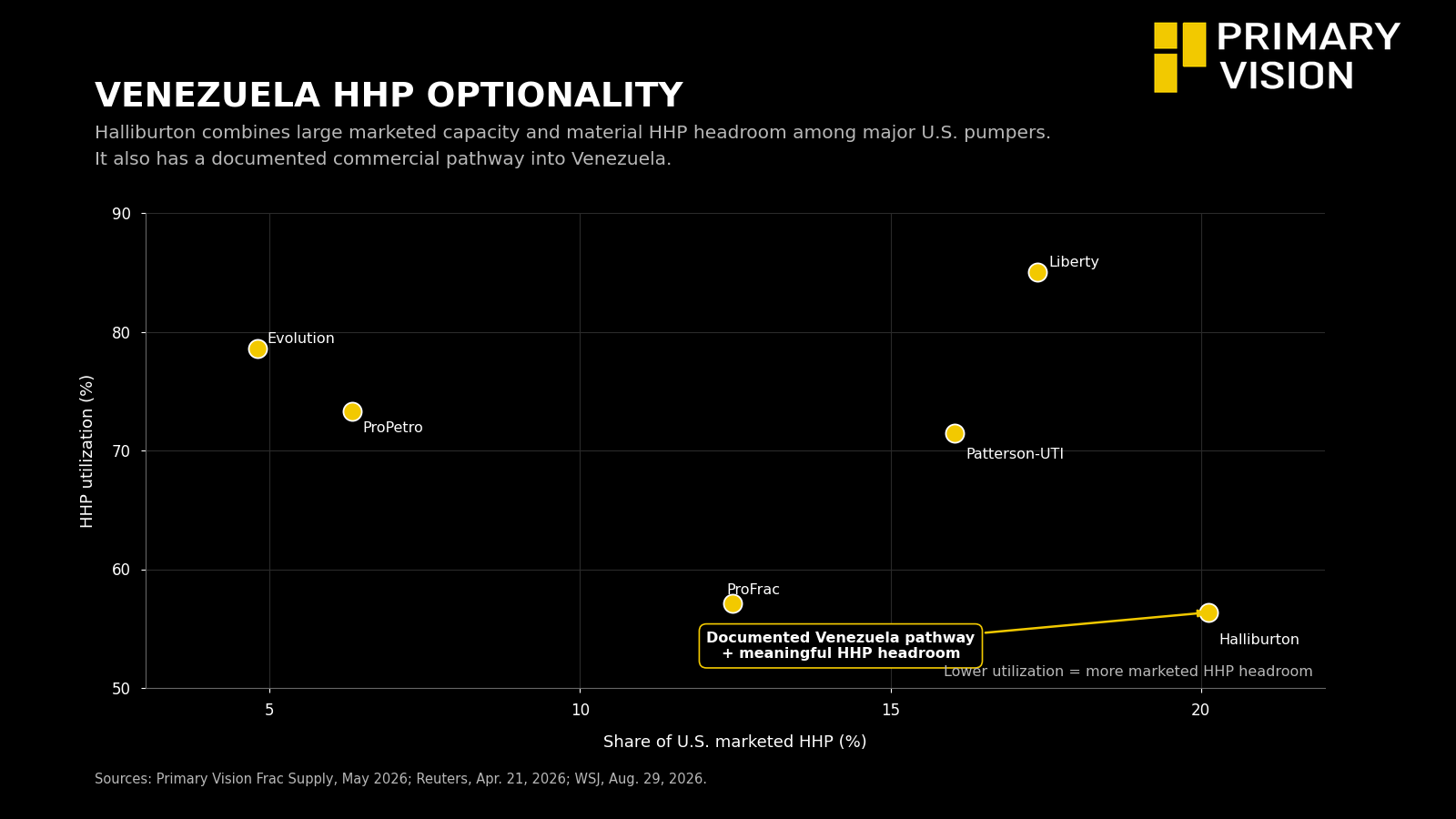
Primary Vision’s HHP screen sharpens that ranking rather than replacing it. Primary Vision utilization puts Halliburton and ProFrac in the high-50% range, Patterson-UTI around 70%, and Liberty around 85% of marketed HHP active. Halliburton therefore combines capacity headroom with a documented commercial path into Venezuela. ProFrac has meaningful headroom, while Patterson-UTI has a cushion and Liberty is running tighter. Their Venezuela positioning is different: we found no comparable public evidence of active Venezuelan facilities, contracts, or hiring for those three. They move onto the direct-beneficiary list when a customer, contract, or mobilization plan appears. SLB also requires separate treatment because its North American OneStim pressure-pumping business moved to Liberty years ago.
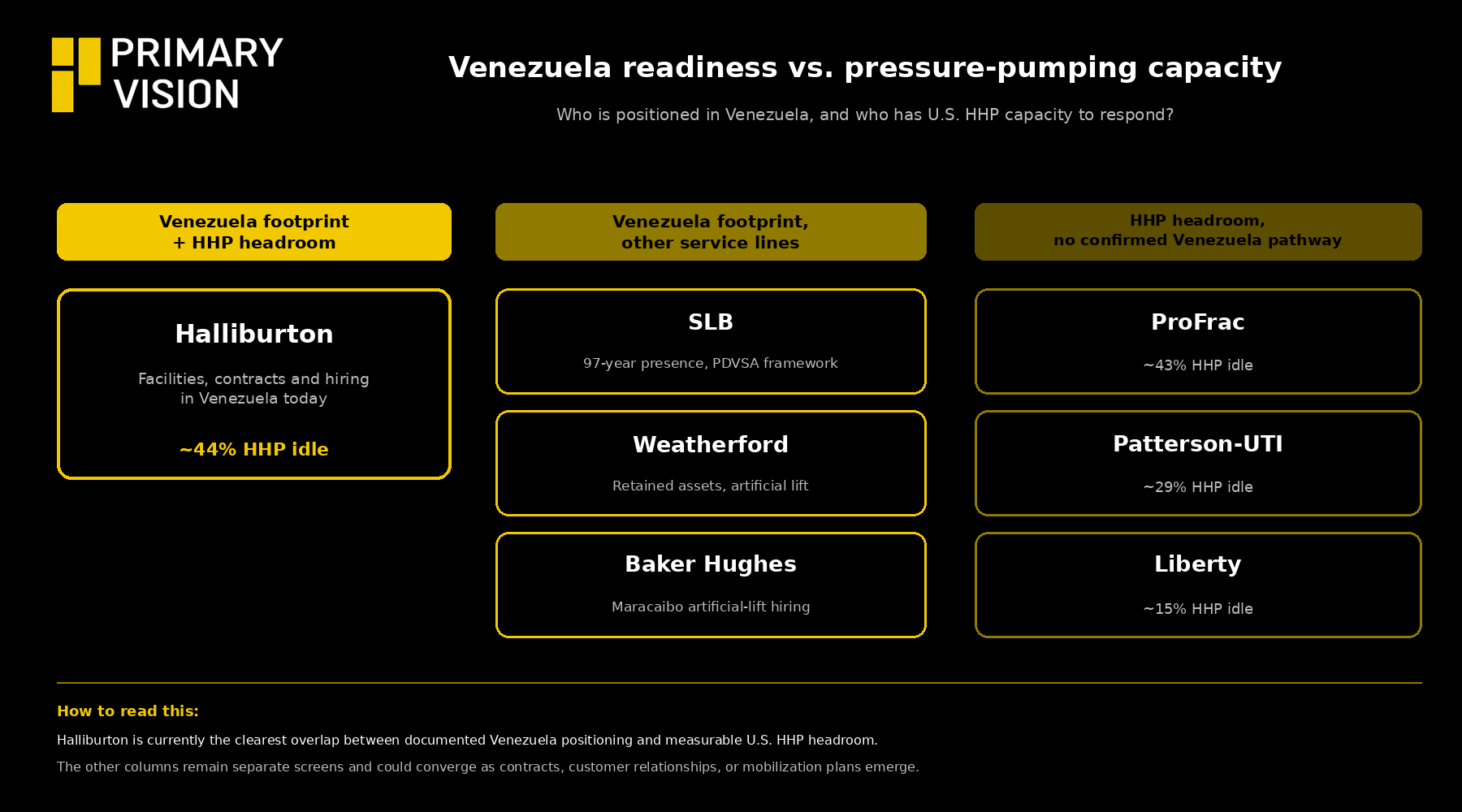
The Primary Vision edge is therefore to track conversion from opportunity into physical movement. Primary Vision can watch Halliburton’s utilization, changes in inactive HHP, basin-level spread movements, and operator relationships while the Venezuela contract picture develops. SLB is strongest overall; Halliburton is strongest where our HHP dataset adds proprietary insight and has the clearest pressure-pumping optionality today; Weatherford has strong brownfield production-services exposure; Baker Hughes has a credible artificial-lift lane. Meanwhile, domestic activity remains stable and materially above year-ago levels. If Venezuelan awards begin absorbing equipment, crews, and capital, the first U.S. signal may be tighter service availability rather than a dramatic change in weekly counts. The direction is constructive, with timing dependent on awards and execution.
Tags:
Permission denied
Upgrade to Pro Today and get…
• This article — plus dozens more each month, all within our full Research Module
• Frac Hits — our National-Level Frac Spread Count and Frac Job Count, updated weekly
• Frac Operator Monitor — detailed FSC & FJC by operator
• And so much more, designed to help you track, forecast, and outperform