







Articles
The Path of a Barrel: How Oil Actually Moves Through the Reserve
By Osama on October 5, 2026 in Free Articles
This is the third installment of The Shrinking Buffer, Primary Vision's series on the Strategic Petroleum Reserve. Part 1 covered why the SPR exists and how it was physically built, and Part 2 looked at where today's inventory actually stands after five years of drawdowns. This piece follows the barrel itself, how it actually moves in and out of the reserve, and where a refill would have to come from right now.
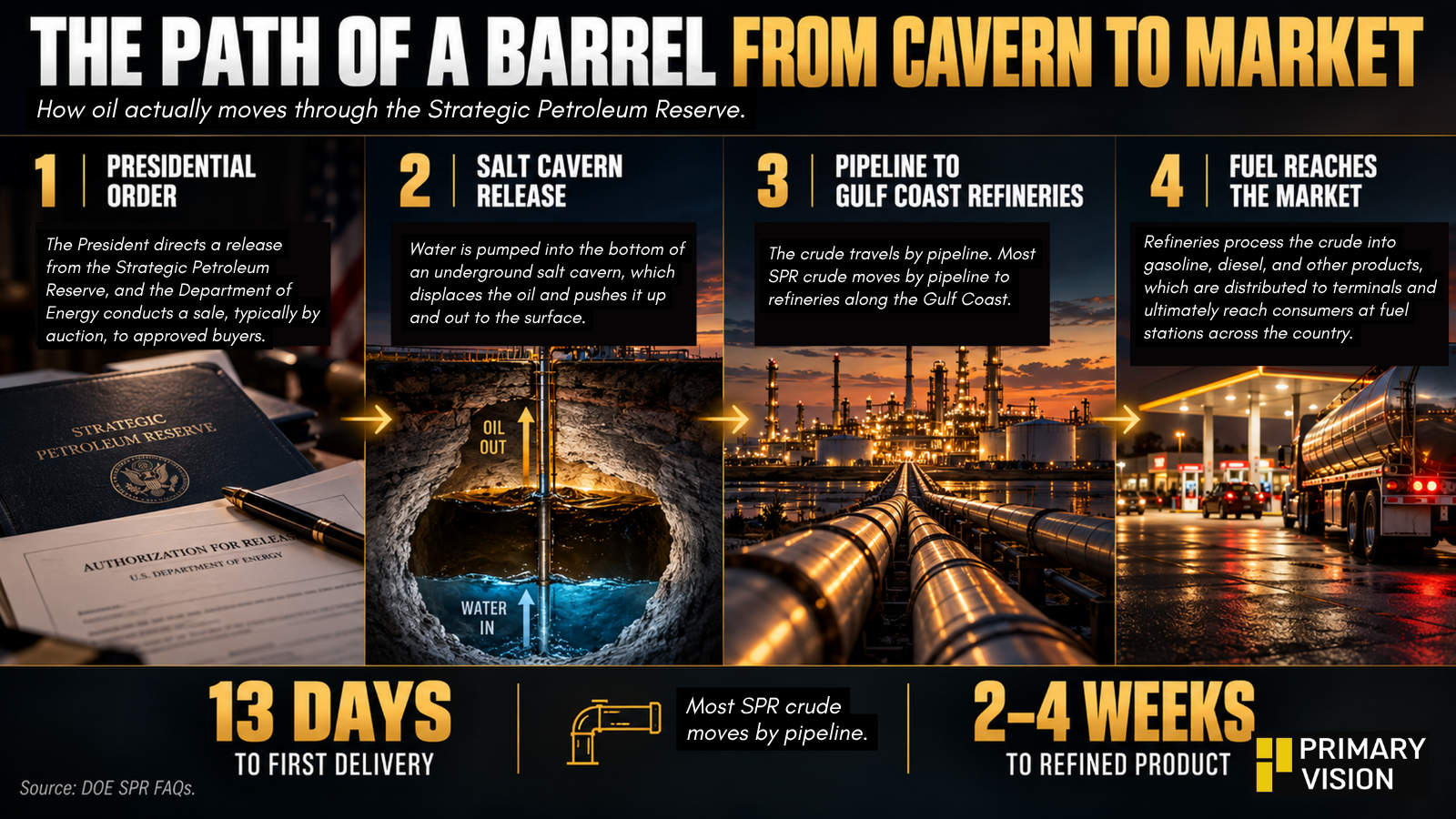
Thirteen days. That's how fast the Department of Energy says the process can move: a presidential order, a competitively auctioned sale with contracts awarded, and then the first barrel of Strategic Petroleum Reserve crude actually loading onto a ship or pipeline. It sounds close to instant for a federal bureaucracy. It is nowhere close to instant for the oil itself, and the gap between those two facts is the real story of how a barrel moves through this system.
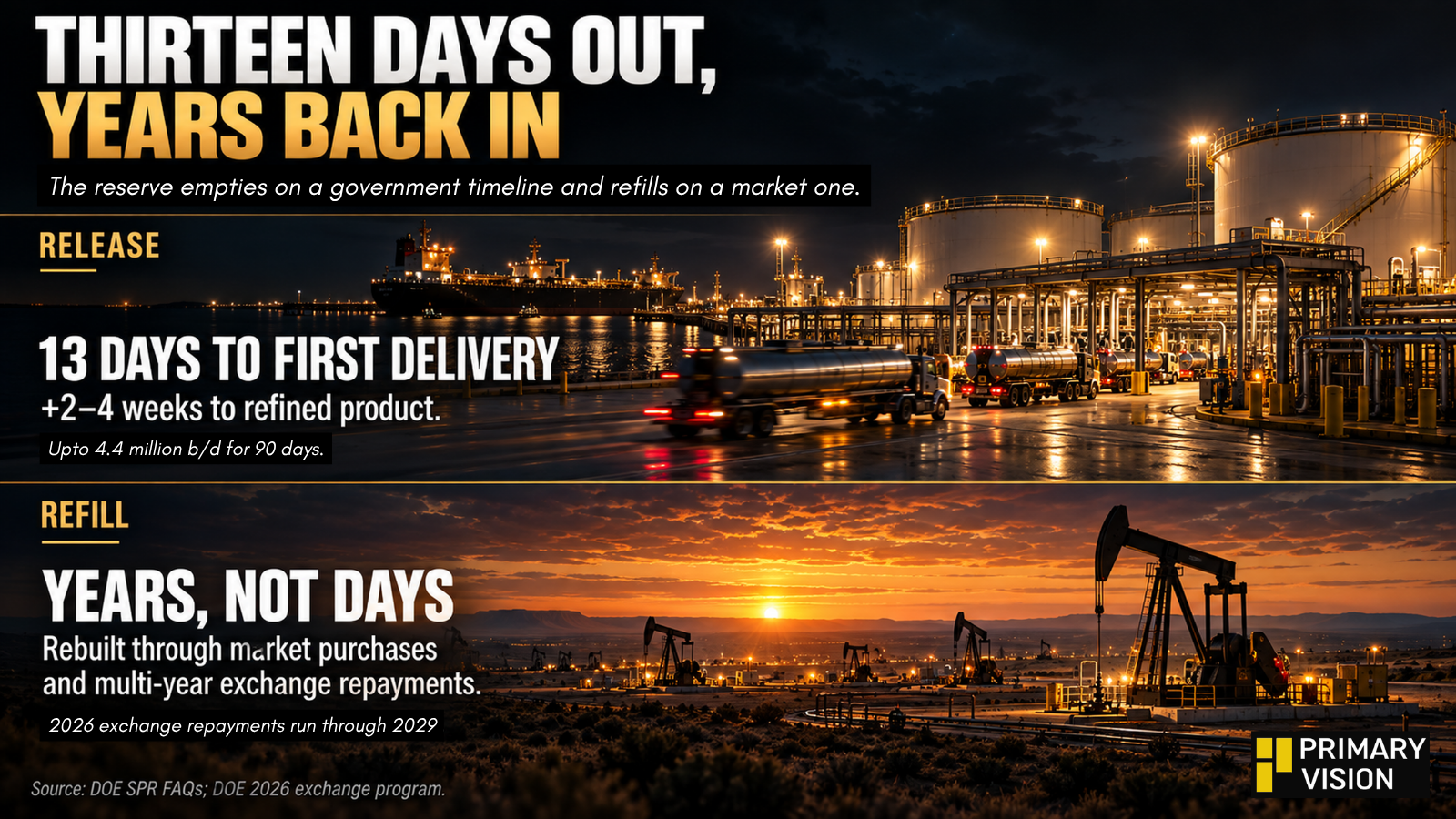
Start with what happens on release day. The mechanism is the same one that filled the caverns in reverse: water gets pumped down into the bottom of a cavern, and because it's denser than oil, it pushes the crude up and out through a separate well. DOE can pull oil out at a maximum rate of 4.4 million barrels a day for up to 90 days before the rate has to start declining as the caverns empty. Run it slower, at a more sustainable 1 million barrels a day, and the reserve's current level could theoretically keep supplying the market for close to ten months. Most of what comes out moves by pipeline straight to Gulf Coast refineries, the same infrastructure that sits a few miles from every storage site by design. From there, refined gasoline and diesel typically reach the market another two to four weeks after the crude itself starts moving, so the full chain from announcement to a gallon of gas at a pump runs closer to a month than to thirteen days.
Filling the reserve back up runs on none of that speed. There is no equivalent fast lane for a refill. DOE has to go out and buy crude at whatever price the market is offering, the same way any other buyer would, and it has done that through ordinary competitive purchases and, more recently, through exchange agreements that swap barrels now for more barrels later. The program launched in 2026 in response to the Iran conflict is a live example: DOE released more than 170 million barrels for delivery through the summer driving season, with the counterparties obligated to repay the oil between late 2026 and 2029, in kind, plus an 18 to 24 percent premium. That premium is the market's own price for speed, the cost of getting barrels out fast now against a promise to return more of them later. A release can move roughly a quarter of the reserve's authorized capacity in three months. Rebuilding that same volume back to where it started has taken years, sometimes over a decade, in every past cycle.
So where would a refill barrel actually come from today? Three shale basins, the Permian, the Eagle Ford, and the Bakken, now produce almost two-thirds of all the crude oil pumped in the United States. The Permian alone accounts for 48 percent of it, close to 6.6 million barrels a day out of West Texas and southeastern New Mexico. The Eagle Ford and Bakken each contribute roughly another 9 percent apiece. Put together, that means a majority of the barrels the country produces come from a stretch of geography that didn't meaningfully exist as an oil-producing region when the SPR's caverns were first being carved out of Gulf Coast salt in the late 1970s.
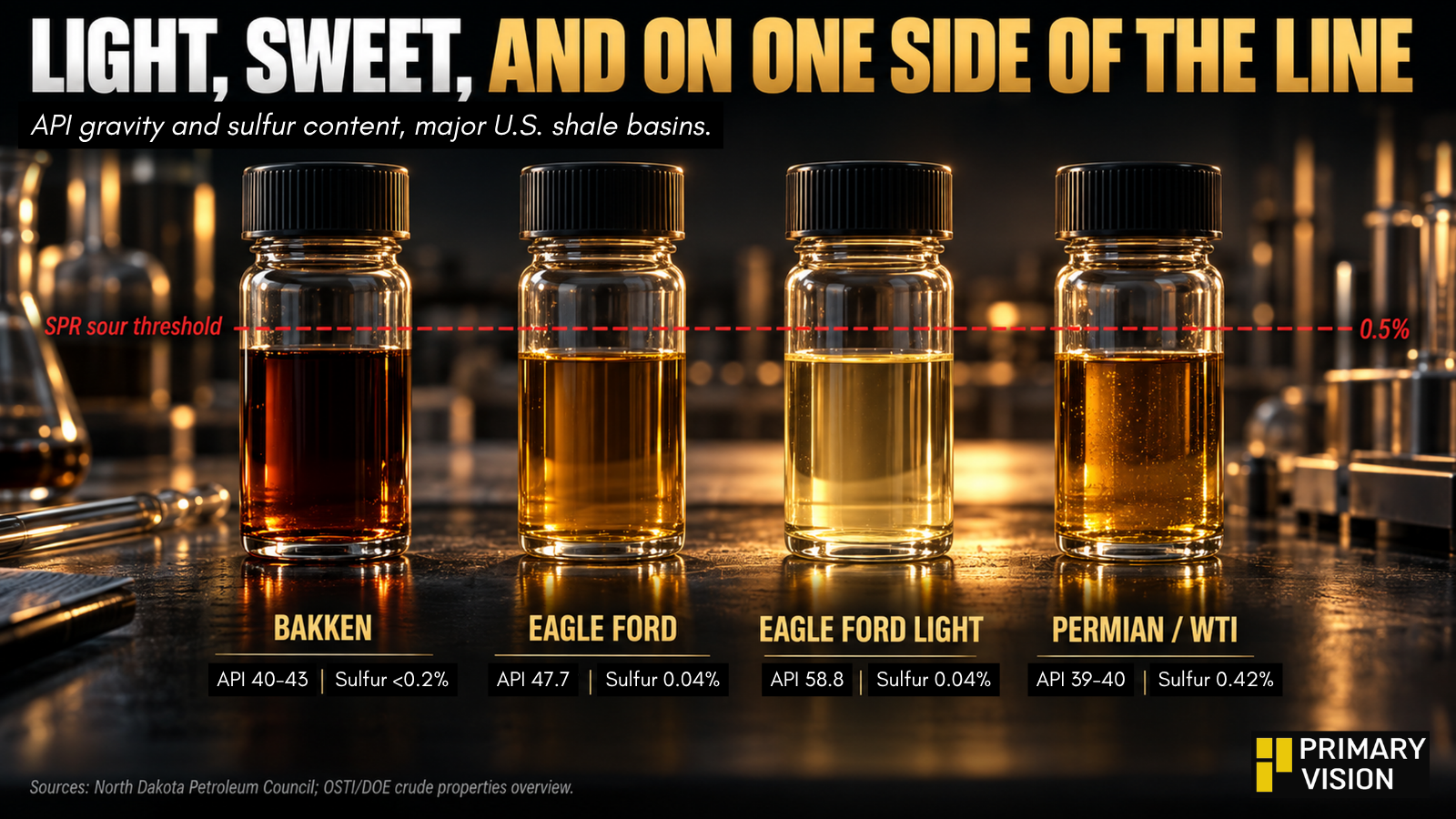
That matters because of what kind of oil those basins actually produce. Bakken crude runs 40 to 43 degrees API gravity with sulfur content under 0.2 percent, a textbook light sweet crude. Eagle Ford runs even lighter, 47.7 degrees API in its standard grade and as high as 58.8 in its lightest condensate stream, with sulfur as low as 0.04 percent. Permian crude, the basis for the WTI benchmark, sits around 39 to 40 degrees API with sulfur near 0.42 percent, sweet by the DOE's own definition but closer to the line than the other two. Nearly all of it, across all three basins, falls on the same side of the sweet-sour divide.
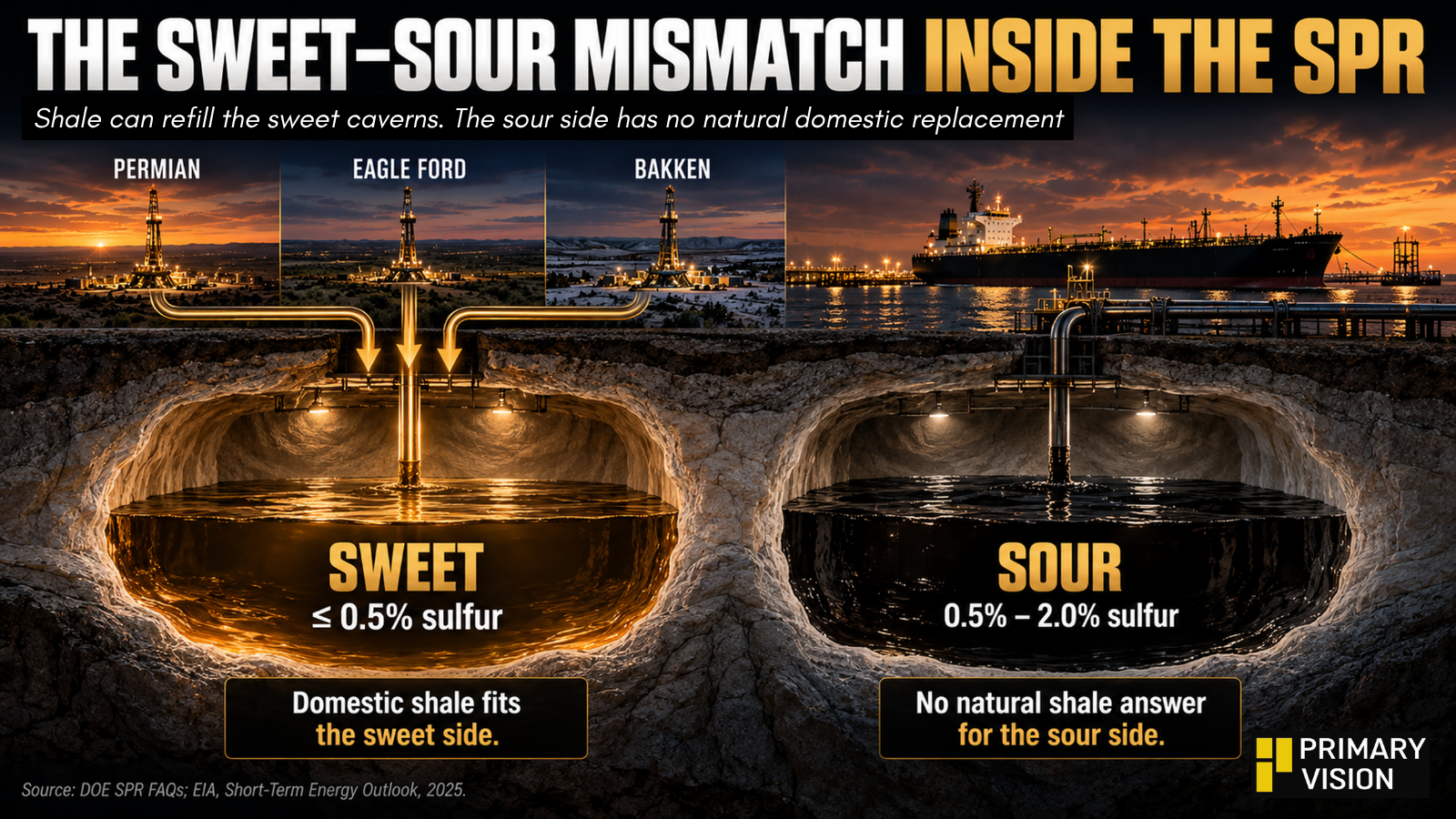
That distinction is the one the reserve was actually built around: sweet crude, at or under 0.5 percent sulfur, and sour crude, between 0.5 and 2.0 percent, kept in separate caverns so buyers always know exactly what grade they're bidding on. Every basin covered here lands on the sweet side of that line, Bakken under 0.2 percent sulfur, Eagle Ford as low as 0.04, Permian at 0.42. None of it touches the sour side at all.
So the sour half of the reserve still has to look overseas for a refill, the same way it did when the caverns were first filled. Whether that's still workable is where this series goes next.
Tags: