






Articles
The Road Ahead: What It Will Take to Rebuild the Reserve
By Osama on November 12, 2026 in Free Articles
This is the sixth and final installment of The Shrinking Buffer, Primary Vision's series on the Strategic Petroleum Reserve. The earlier pieces covered why the reserve exists and how it was built, how far it has fallen, how a barrel physically moves through it, whether its grades still match what the country produces, and what tools the government has to refill it. This piece puts those together and asks the question the series has been building toward: how far is the reserve from full, and where would the oil to fill it come from?
Start with where the exchanges leave the reserve. It held 415.4 million barrels in February and 282.2 million in the week ending October 30, and deliveries on the exchanges DOE has already awarded are still scheduled for November and December, so the level has further to fall before anything comes back. DOE says it has secured the return of more than 216 million barrels beginning early next year, including 44 million additional premium barrels. Add that premium to the pre-release level and the reserve ends at about 459 million if every barrel returns. That is roughly 221 million short of the 680 million peak, and about 41 million short of the more than 500 million barrels the Energy Secretary has hinted at as a refill goal, though no timeline came with it.
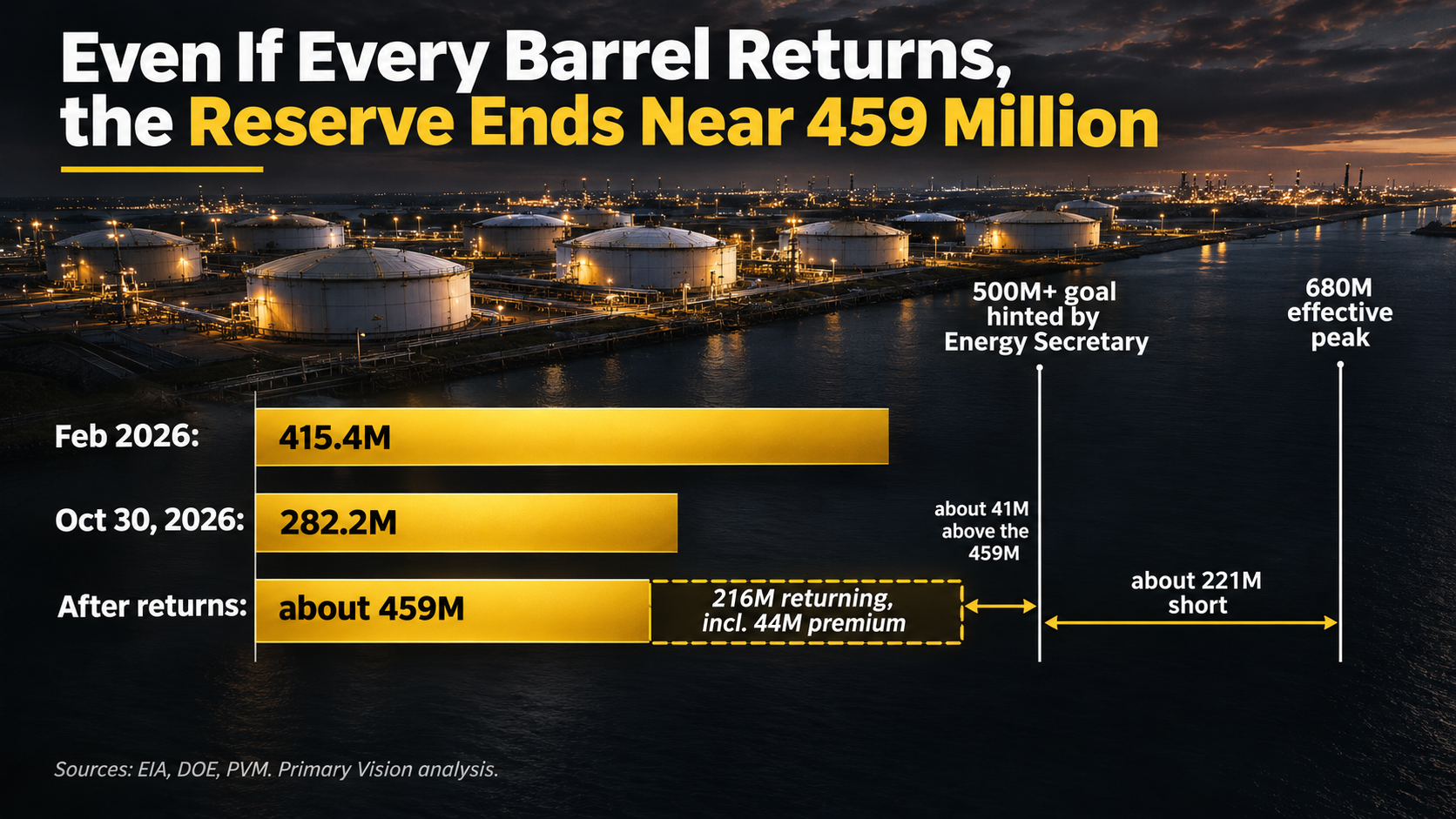
Start with where the exchanges leave the reserve. It held 415.4 million barrels in February and about 282 million at the end of October, and deliveries on the exchanges DOE has already awarded are still scheduled for November and December, so the level has further to fall before anything comes back. DOE says it has secured the return of more than 216 million barrels beginning early next year, including 44 million additional premium barrels. Add that premium to the pre-release level and the reserve ends at about 459 million if every barrel returns. That is roughly 221 million short of the 680 million peak, and about 41 million short of the more than 500 million barrels the Energy Secretary has hinted at as a refill goal, though no timeline came with it.
What stands out is that the oil itself is not scarce. In its November outlook, EIA expects U.S. crude production to average a record 13.9 million barrels a day this year and another record, 14.3 million, next year, which puts 221 million barrels at a little over two weeks of national output. The constraint is price. WTI settled at 86.85 dollars on November 9, above the 79 dollar ceiling DOE has set for its own purchases, so the department is priced out of the market even with producers pumping at a record.

DOE only buys when the price is at or under that ceiling, and that is where new drilling gets harder to justify. The Dallas Fed's first quarter survey put the average Permian breakeven for a new well at 67 dollars, and EIA's reading of the same survey has it at 69 in the Midland Basin and 63 in the Delaware. At today's price producers have a wide margin over those numbers. At a price DOE can actually pay, the margin narrows.
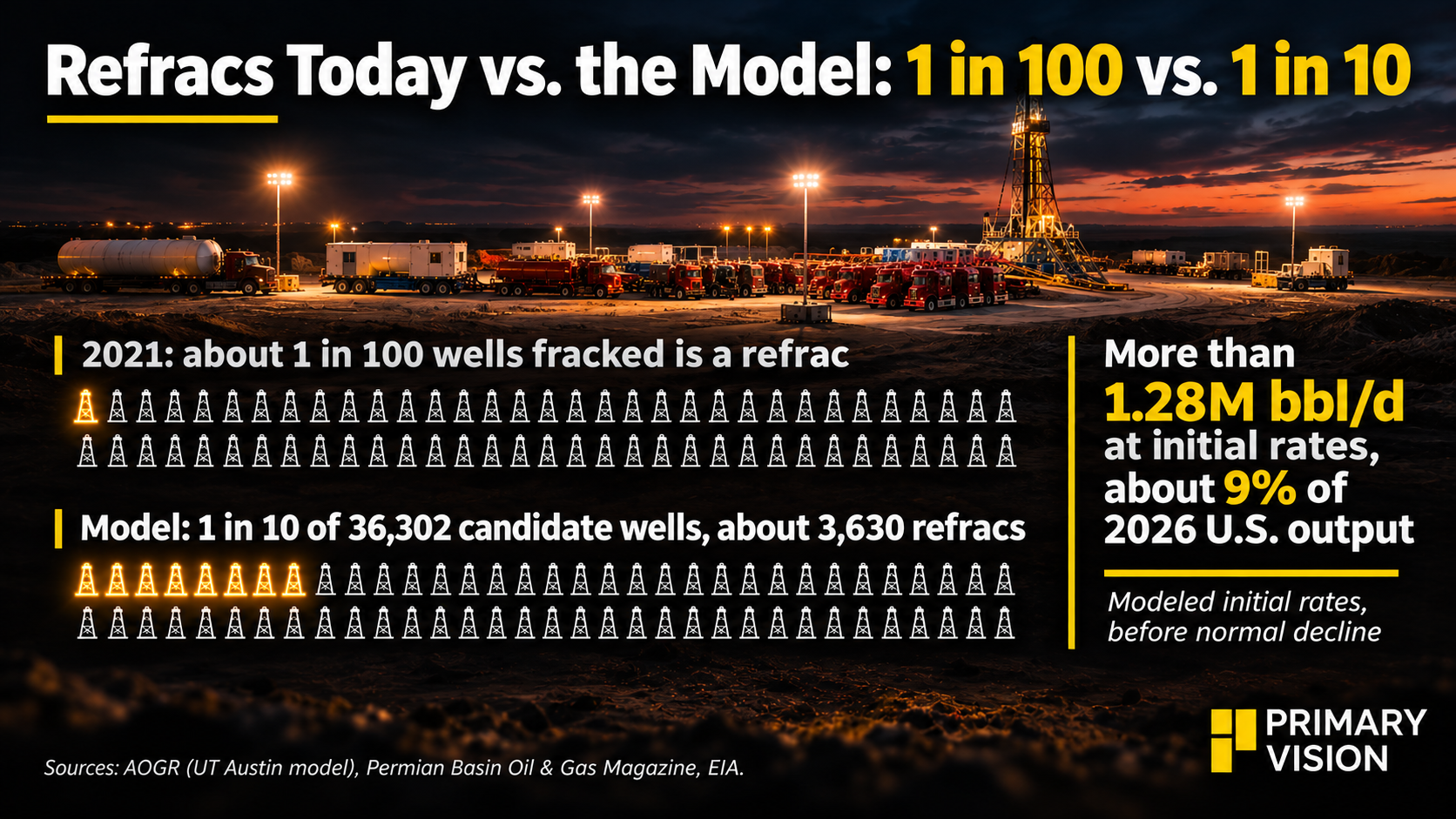
A refrac works differently. It adds production from a well that already exists, with no new permit, no new land negotiation and a lower incremental cost than drilling a new one. The public modeling supports it: in the AOGR analysis, refrac returns beat new wells in the Permian and both Eagle Ford windows for wells with infill issues, on less capital and with fewer supply chain problems. The same study counted 36,302 candidate wells. Refracturing one in ten, about 3,630 wells, would add more than 1.28 million barrels a day at initial rates, before the normal decline. That is a modeled ceiling, not a forecast, but it is the right order of magnitude against a 221 million barrel gap.
It is also a long way from where the industry is. Matt Johnson said in 2021 that for every 100 wells fracked in the United States, one of them is a refrac. How far that has moved is what our Refrac Monitor measures, and it lets us quantify the short-cycle supply response that decides whether the ceiling above stays theoretical. That is the case behind our PURE framework: Policy, Use, Reuse and Emissions reduction. Our view is that refracs and recompletions are the most efficient way to refill the SPR while strengthening domestic and global energy security. When DOE is buying near its ceiling, refrac barrels are the ones that still pencil, and the United States is one of a handful of countries with the technical expertise to do it at scale. It is the idea behind our tagline, America Runs on Refracs.
Our own analysis of completion activity and the reserve adds a timing clue. Week to week, changes in our Frac Spread Count show no meaningful relationship with SPR changes. Month to month, between 2022 and 2026, changes in the count led SPR changes by about two months, with a correlation of -0.35 and a p-value of 0.008. That is a moderate negative relationship from a short window, not a trading rule. The most plausible reading is that both series respond to the same oil-market conditions on different timetables, with completion activity moving first.
Three readings decide whether the reserve actually gets rebuilt, and all of them are public. One is whether returns begin on DOE's early-2027 schedule and at the volumes it has described. Another is whether WTI falls from nearly 87 dollars to under DOE's 79 dollar ceiling and stays there long enough for buying to resume. The third is whether Congress funds purchases at a scale that matters. Our Frac Spread Count, Frac Job Count and Refrac Monitor cover the producer side of all three: how much new oil the country is set up to produce at whatever price the market settles at.