U.S. Capex Cuts Are Fading — Yet Producers Are Not Chasing Growth
By
Avik
on October 6, 2026
in
Articles
U.S. Producers Move to Stop The Capex Crunch
We discussed U.S. energy producers’ frac job activity and energy production in a recent article. But we did not discuss what their capital expenditure trend points to until now.
U.S. shale producers are responding to higher oil prices. But they are not rushing into another growth-capex cycle. Instead, companies are adding activity selectively, using existing inventory and improving capital efficiency. That means activity is recovering faster than budgets, creating more work for OFS companies without yet creating broad pricing power.
Higher Oil Prices Are Not Automatically Driving Capex
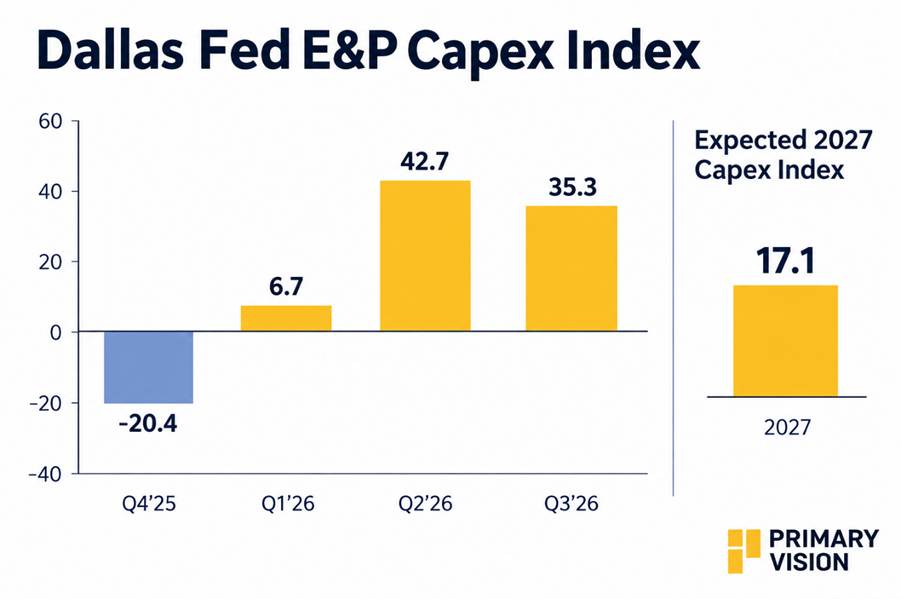
The Dallas Fed survey shows the shift clearly. The E&P capex index remains positive, and expectations for 2027 have improved. But most producers still expect little change in spending. The improvement is therefore more about fewer cuts than bigger budgets.
Oil prices also explain the caution. WTI was around $99/bbl during the survey. Yet producers' longer-term price expectations were much lower. They are not willing to build multi-year investment plans around today's spot price.
Instead, higher cash flow is being split between selective investment, balance-sheet strength and shareholder returns. That is very different from 2022, when a 39% increase in WTI was followed by roughly a 58% increase in capex across the tracked E&P peer group. Producers today appear much less willing to turn a strong oil-price environment into a broad increase in drilling and development spending, reflecting a stronger focus on returns and capital discipline.
Activity Is Moving Faster Than Budgets
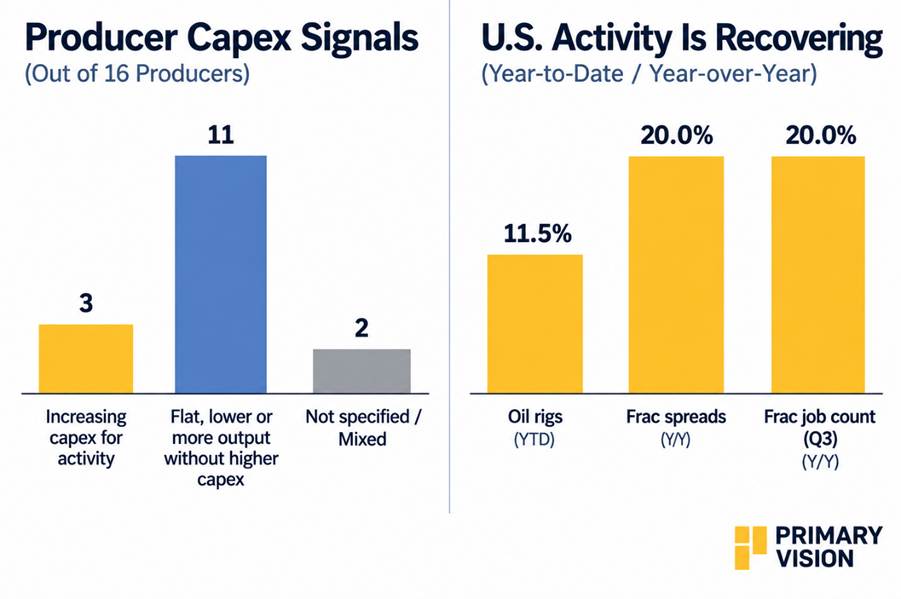
The oilfield is already getting busier. U.S. oil rigs are up 11.5% YTD. Primary Vision's frac data also show a meaningful recovery in completion activity. Preliminary Q3 data point to Permian frac jobs being roughly 20% higher year over year.
So what is driving the increase if budgets are not rising at the same pace? The answer is efficiency and existing inventory. Producers can increase completions and production without immediately committing to a large increase in drilling capital.
Company Level Capex vs Activity
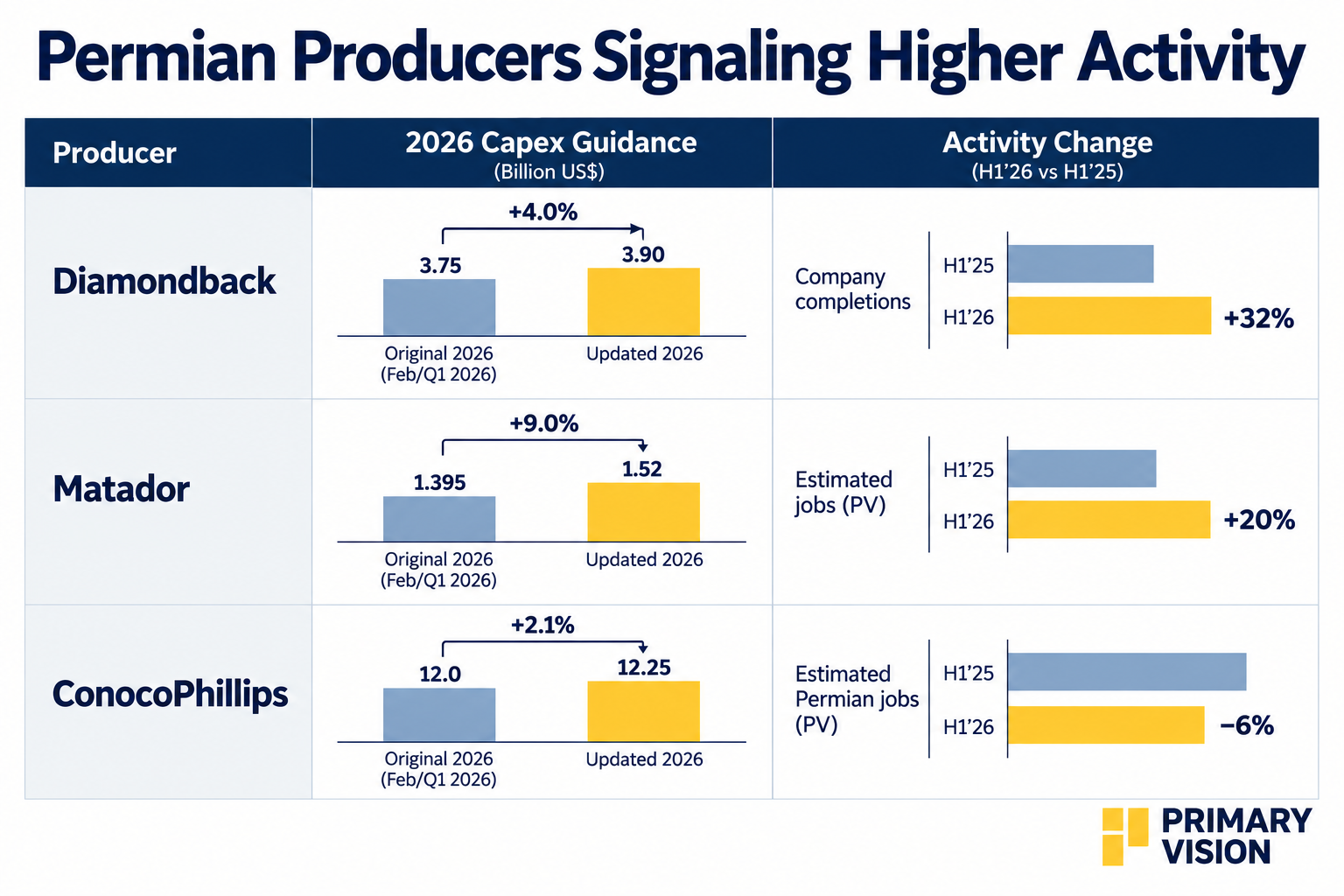
Diamondback is a good example of how producers can increase activity without materially changing their capital framework. It raised its 2026 capex plan by about 4%, while adding a fifth frac spread. Yet company completions were up 32% in H1'26, while drilling activity remained lower. It is supported partly by a roughly 100-well net DUC drawdown. Diamondback is therefore getting more wells into production without requiring a proportional increase in new drilling investment.
Matador is taking a more aggressive approach. It raised capex by about 9%, accelerated activity and increased its production target. ConocoPhillips is more measured, with a roughly 2% capex increase that includes incremental Permian activity. Interestingly, the additional Permian activity has not yet shown up in its completion data through Q2, suggesting that the company's higher spending has yet to translate into a visible increase in completion activity.
Together, the three examples show how the current recovery is being driven by selective increases in activity rather than a broad-based expansion in producer spending.
What Does This Mean for OFS?
For oilfield services, this creates a useful but unusual setup. Utilization is improving, but pricing and margins are not following at the same pace. Producers want more activity, but they are still pushing hard on costs.
For now, the recovery is being driven by efficiency, inventory, and selective spending, rather than a major drilling expansion.
The next test will come as DUC inventories are worked down. If completion activity stays high, producers will eventually need to drill more wells to maintain it. That could turn today's activity recovery into a genuine capex cycle.
Upgrade to Pro Today and get…
• This article — plus dozens more each month, all within our full Research Module
• Frac Hits — our National-Level Frac Spread Count and Frac Job Count, updated weekly
• Frac Operator Monitor — detailed FSC & FJC by operator
• And so much more, designed to help you track, forecast, and outperform