Market Sentiment Tracker: U.S. Labor Market Collapsing Faster Than Expected?
By
Osama
on February 10, 2026
in
Market Sentiment
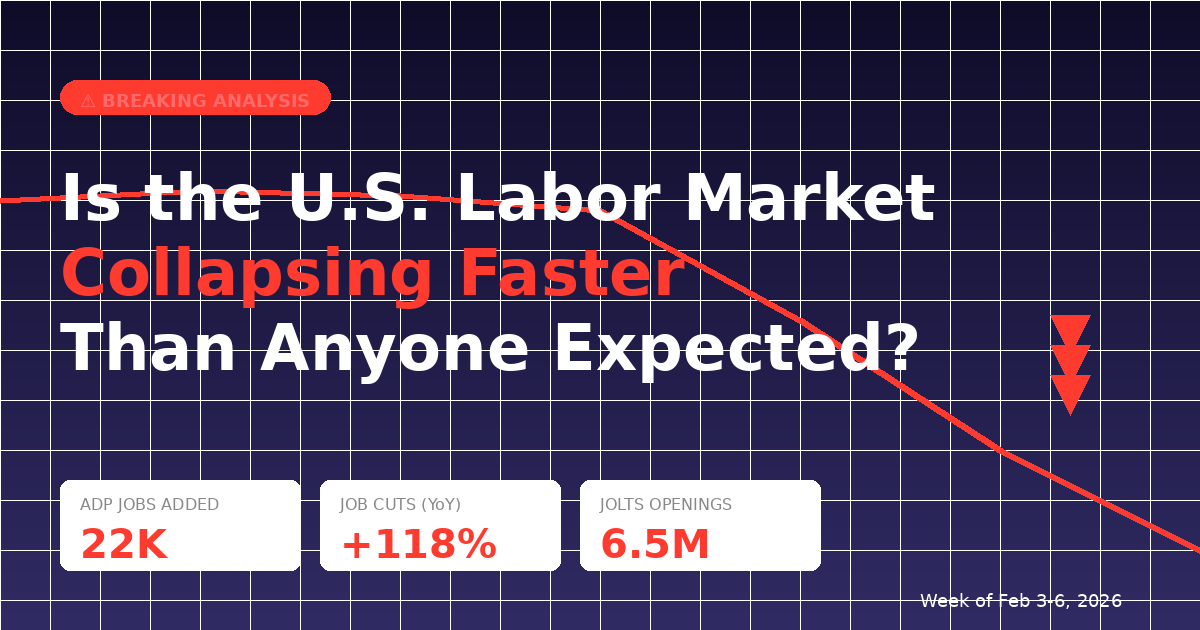
The past week's economic releases reveal a developed world economy caught between divergent forces. In the United States, we observed an unsettling labor market that directly contradicts the resilience narrative that has sustained risk assets through much of the past year. The ADP employment figure of just 22,000 new jobs represents a serious concern in private sector hiring momentum, falling more than 50% below consensus expectations. This was not an isolated data point. JOLTS job openings plummeted to 6.542 million, nearly 10% below expectations, while Challenger job cuts more than tripled year-over-year to exceed 108,000. Initial jobless claims rose to 231,000, and continuing claims approached 1.85 million. The mortgage market reinforced this weakness, with purchase applications falling to 165.4 from 193.3 the prior period.
What we are witnessing is the leading edge of a labor market transition from tight to slack. The speed of this shift matters enormously for positioning. Job openings have now declined for consecutive months, and the ratio of openings to unemployed workers is normalizing rapidly. This suggests that the Federal Reserve's restrictive stance is achieving its intended effect, but the velocity of change introduces execution risk. A soft landing requires a gradual cooling, not an abrupt freeze.
The services sector readings provide some offset to these concerns. The ISM Non-Manufacturing PMI held at 53.8, and business activity within that index actually accelerated to 57.4. The S&P Global Services PMI registered 52.7, consistent with modest expansion. These figures suggest that consumer-facing businesses continue to operate in growth mode, though the employment subindex within ISM services fell short of expectations at 50.3, barely above the expansion threshold. Consumer sentiment metrics from the University of Michigan rose modestly, which offers a thin buffer against recessionary fears, but inflation expectations remain uncomfortably elevated at 3.5% for the one-year horizon and 3.4% for the five-year horizon. This persistent stickiness in inflation psychology complicates the Federal Reserve's path forward and limits its flexibility to respond to labor market weakness.
Across the Atlantic, Europe presents a more fragmented picture. Germany delivered a surprise with factory orders surging 7.8% month-over-month, well above the expected decline, and the trade surplus expanded to 17.1 billion euros. German exports rebounded sharply by 4.0%, suggesting that external demand may be stabilizing after months of contraction. However, industrial production fell 1.9%, missing expectations badly, and this inconsistency between orders and output raises questions about supply chain bottlenecks or inventory dynamics rather than genuine demand strength. France, by contrast, continues to struggle. Inflation decelerated sharply to 0.3% year-over-year, undershooting expectations and flirting with deflationary conditions. Industrial production contracted 0.7%, car registrations fell, and the trade deficit widened beyond forecasts. The services PMI remained below 50, signaling ongoing contraction, and the composite PMI at 49.1 confirms that France remains in a technical downturn. Italy showed marginal improvement with services and composite PMIs edging into expansion, but retail sales fell more than expected. Spain saw rising unemployment and a sharp deceleration in services activity.
China's data opacity during this period is itself noteworthy. The limited readings—RatingDog Services PMI at 52.3 and a composite at 58.4—suggest continued expansion, but the absence of hard industrial data, trade figures, or credit numbers prevents meaningful assessment of whether Beijing's stimulus measures are gaining traction. This informational vacuum comes at a critical juncture when Western investors are attempting to gauge whether China can offset slowing developed market demand.
Upgrade to Pro Today and get…
• This article — plus dozens more each month, all within our full Research Module
• Frac Hits — our National-Level Frac Spread Count and Frac Job Count, updated weekly
• Frac Operator Monitor — detailed FSC & FJC by operator
• And so much more, designed to help you track, forecast, and outperform








%20(1).png)
%20(1).png)
.png)