







Articles
- BLOG / Articles / View
- Articles
Special Report: Is There a Shale Boom Happening in China?
By Osama on January 15, 2026 in Market Sentiment
Disclaimer: China’s oil and gas production data is sourced from state authorities and lacks third party verification. Reported gains should be interpreted as indicative of policy direction and investment focus rather than exact volumetric truth.
At Primary Vision, we have long tracked developments in the U.S. shale patch while closely monitoring upstream trends globally. Our recent analysis of Mexico’s shale output, which was subsequently cited by Bloomberg, reflected this broader focus. We now turn our attention to China, where a series of recent discoveries, rising output, and sustained state investment are prompting questions about whether the country is entering its own phase of shale development. The following analysis examines that hypothesis against the available data.
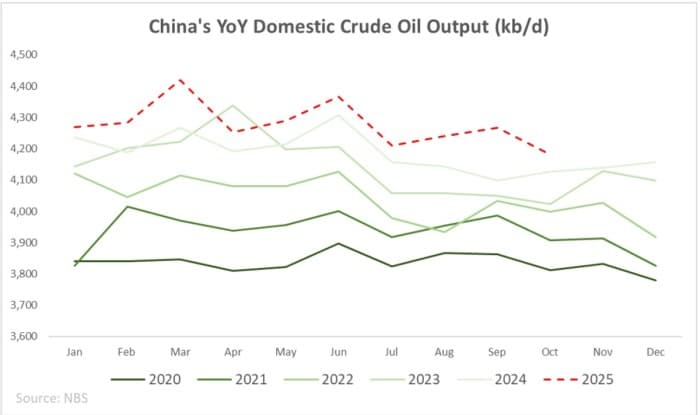
China’s shale oil output has been rising gradually, supported by sustained investment, expanded exploration activity, and a growing number of verified discoveries. According to recent data, outlook for shale oil production in China has strengthened as state-owned firms accelerate appraisal and pilot development. However, it is important to not that this improvement reflects deliberate policy responses to declining output from mature conventional fields, rather than a shift toward rapid shale-led growth. National production data point to steady gains from a low base. National Energy Administration reported a roughly 30 percent year-on-year increase in shale oil output in 2024, to about 6.0 million tons (approximately 120,000 barrels per day). Although this increase reflects meaningful growth, shale oil continues to account for only a small fraction of China’s total crude production. This suggests that shale can contribute to stabilizing supply trends, but is not yet positioned to fundamentally reshape national production profiles.
State-owned producers remain central to shale expansion. PetroChina and Sinopec are leading shale and tight oil development, with limited participation from international firms such as Shell and ExxonMobil, which have scaled back involvement. This pattern reflects national energy security priorities, enabling projects to proceed despite high costs and uncertain commercial returns.
On the other hand, geological challenges continue to constrain output growth. China’s shale resources are distributed across basins including Ordos, Junggar, Songliao, Sichuan, Qaidam, and Bohai Bay, but many resources lie deeper and in more geologically complex formations compared with major U.S. shale plays. Current pilot projects typically produce between 10,000 and 50,000 barrels per day, substantially below output levels from major conventional fields such as Daqing Oil Field. This geological complexity limits scalability and slows the pace of production increases at a national level.
Recent discoveries point to improving technical capability. State media and reporting confirm major shale oil discoveries in the Sichuan Basin, including the Qiluye-1 well in Qijiang, Chongqing, where operators reported daily production of roughly 38.6 cubic meters of oil and 10,000 cubic meters of gas, with estimated reserves exceeding 100 million tons. These findings suggest enhanced geological understanding and development prospects in some regions, though large-scale commercial production remains several years away. Production breakthroughs have also emerged in established basins. As per a recent report, major shale oil production zone in northwest Xinjiang’s Jimsar County exceeded 1.7 million tons of crude output in the latest reporting year, up from 322,000 tons in 2020. This reflects localized success while underscoring the incremental nature of broad industry progress.
Company-level data further illustrate this pattern. PetroChina accounted for about 85 percent of China’s shale oil output in 2024 with approximately 5.1 million tons, concentrated in projects such as the Changqing oilfield in the Ordos Basin. Changqing exceeded 20 million tons in cumulative shale production by late 2025. These gains are meaningful within the shale segment but remain modest relative to overall national demand. In contrast, conventional and offshore production continues to dominate China’s oil balance. National reporting shows that fields such as the Bohai Oilfield delivered over 40 million tons of oil and gas equivalent output in 2025, highlighting the much larger scale of legacy and offshore assets. National crude production is expected to approach record levels in 2025, further illustrating the small relative share of shale within China’s overall oil supply.
Overall, the available data suggest that China’s shale oil output is improving in a measured and incremental manner. Shale development can help offset declines from aging fields and support energy security objectives, but it is unlikely to lift national oil production to a materially higher level in the near term. Future gains will depend on whether recent discoveries can be developed at commercial scale and whether continued investment can overcome persistent geological and cost constraints
Tags:
Permission denied
Upgrade to Pro Today and get…
• This article — plus dozens more each month, all within our full Research Module
• Frac Hits — our National-Level Frac Spread Count and Frac Job Count, updated weekly
• Frac Operator Monitor — detailed FSC & FJC by operator
• And so much more, designed to help you track, forecast, and outperform