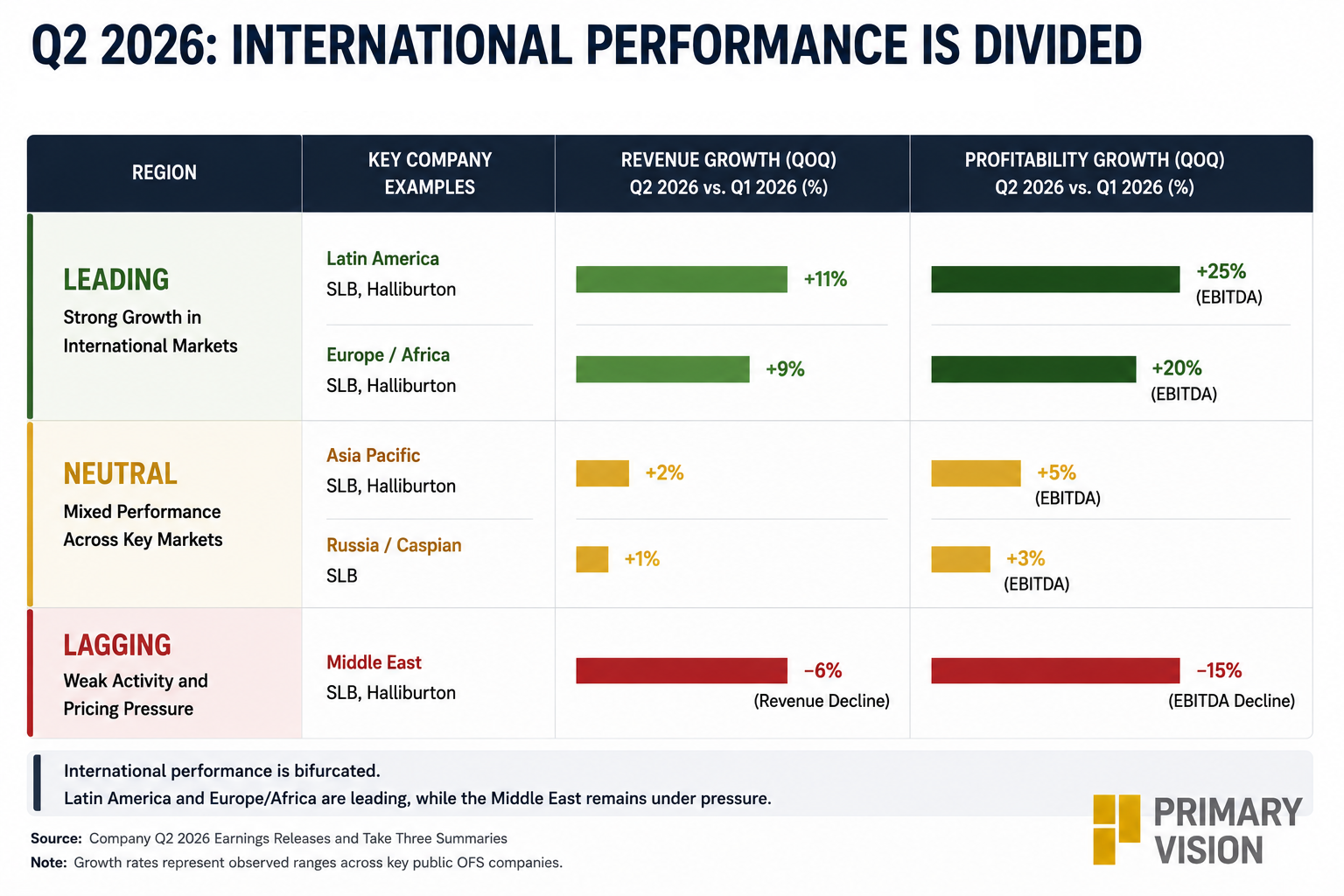
International markets are showing stronger momentum than North American drilling. Halliburton's international revenue increased 5% sequentially, with Europe/Africa particularly strong, while Latin America also grew. Middle East activity remained under pressure.
SLB reported a similar geographic divergence, with international growth led by offshore activity across Latin America, Europe/Africa and Asia. The difference from North America is important. Offshore and international activity is more project-oriented and longer-cycle, making it less dependent on short-term changes in U.S. rig counts.
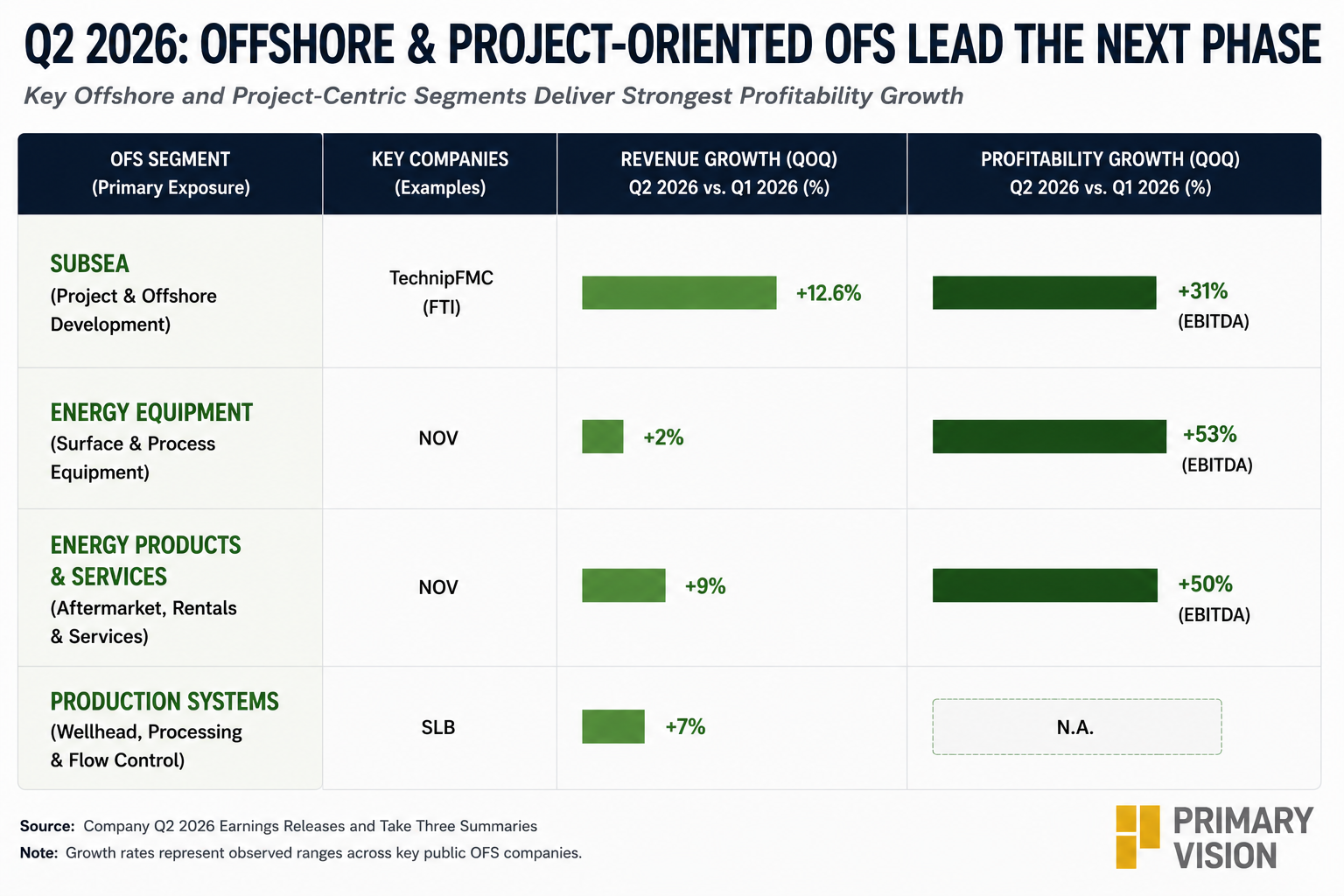
Project-Oriented OFS Is Delivering Operating Leverage
The project-driven businesses are also showing strong earnings momentum. TechnipFMC's Subsea business delivered double-digit sequential revenue growth, while EBITDA increased substantially faster. NOV's Energy Products & Services and Energy Equipment businesses showed a similar pattern, with profitability growing much faster than revenue.
This is more than a volume story. Higher project activity, utilization, and mix are allowing fixed costs to be absorbed more efficiently. SLB's Production Systems business also grew 7% sequentially, highlighting another area of growth: helping customers increase production and recovery rather than simply adding new wells.
Gas Infrastructure Is a New Growth Engine
Gas infrastructure is creating another source of demand for OFS companies with industrial technology exposure.
Baker Hughes is the clearest example. Its Industrial & Energy Technology business generated record Q2 orders of $7.1 billion, while IET order backlog reached $37.1 billion. Gas Technology Equipment represented $15 billion of that backlog and Gas Technology Services another $16.7 billion.
The significance is the duration of this opportunity. Gas processing, LNG, turbines, compression and related infrastructure are tied to multi-year projects rather than the short-cycle dynamics of North American completions.
Technology Is Increasing the Value of OFS
Technology is also becoming more central to the growth model. Digital solutions, automation, production optimization and reservoir technologies allow OFS companies to capture more value from existing assets.
The shift is visible in the emphasis major companies are placing on production enhancement and higher-value technology rather than simply increasing equipment volumes. This can support margins even when underlying activity remains uneven.
OFS Is Expanding Beyond the Oilfield
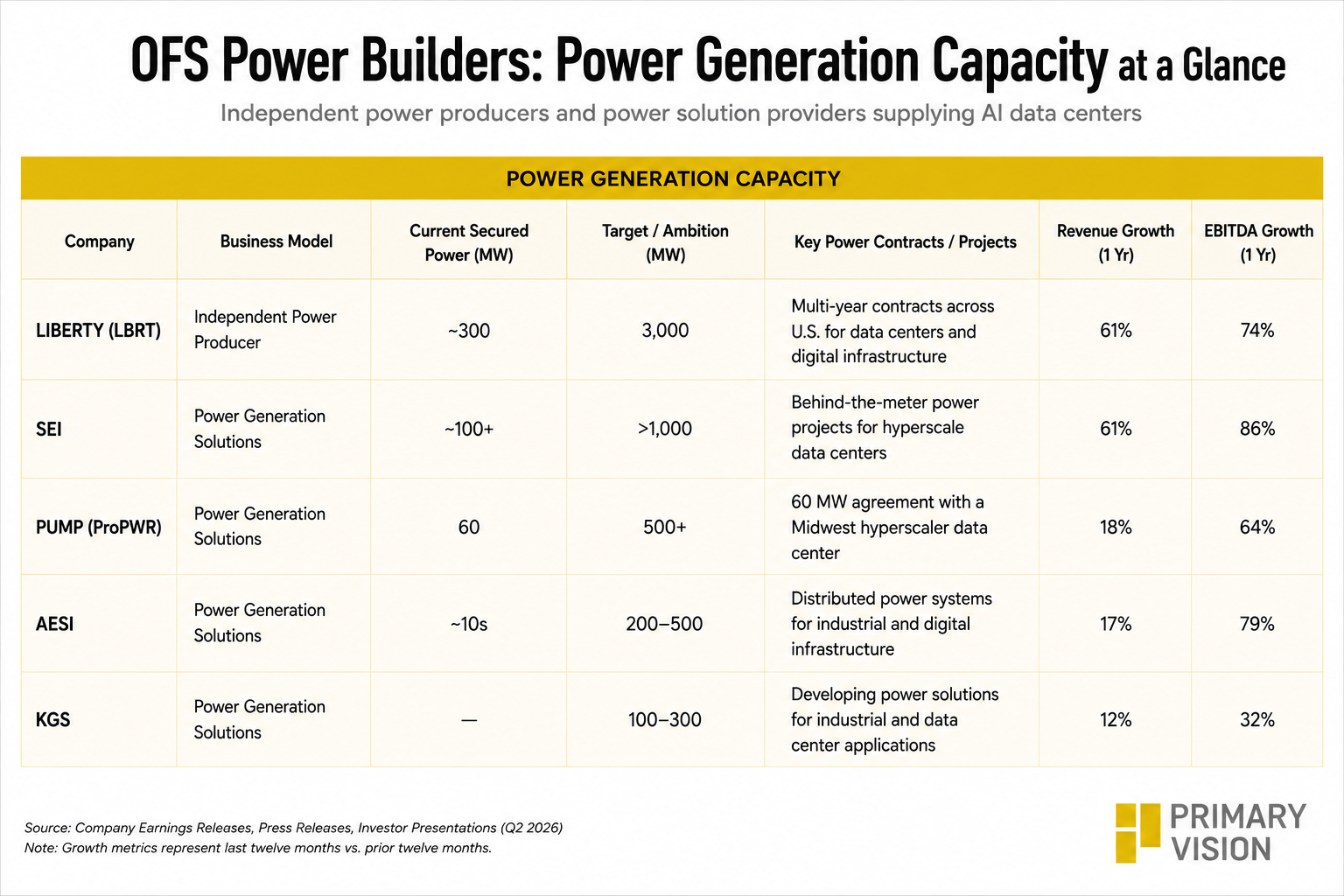
The final trend is diversification. Several OFS companies are developing businesses outside traditional oilfield services, including power generation and other infrastructure markets.
We explored the emerging power opportunity in our previous series. Here, the broader point is more important: OFS companies are increasingly applying their engineering, equipment and project-management capabilities to adjacent markets.
What Q2 Changes
The OFS recovery is no longer a single-cycle story. North American completions are recovering through utilization. International and offshore markets are benefiting from projects. Gas infrastructure is building long-cycle backlogs. Technology is increasing the value captured from existing activity. And diversification is opening new markets.
The traditional oilfield cycle remains important, but Q2 shows that the strongest OFS companies are increasingly building multiple sources of growth around the same technical and operational capabilities.
Upgrade to Pro Today and get…
• This article — plus dozens more each month, all within our full Research Module
• Frac Hits — our National-Level Frac Spread Count and Frac Job Count, updated weekly
• Frac Operator Monitor — detailed FSC & FJC by operator
• And so much more, designed to help you track, forecast, and outperform