





Articles
- BLOG / Articles / View
- Articles
From Frac Spreads to Power Platforms
By Avik on July 10, 2026 in Articles
How OFS Builds a Multi-GW Position in AI Market
The first three articles established the demand side of the AI power story and how excess hydraulic horsepower could potentially be converted into power-generation assets.
Part One: From AI to Oilfield Power: The AI Power Stack
Part Two: From AI to Oilfield Power: The AI Company
Part Three: The Missing Layer: How OFS Companies Became AI Power Builders
The opportunity has evolved considerably since then. Rather than simply repurposing underutilized equipment, several OFS companies are now building dedicated power-generation businesses. What started as an equipment-conversion story is increasingly becoming an infrastructure-development story. The shift matters because it changes how investors should think about the opportunity. Excess horsepower remains an important foundation, but the industry’s ambitions now extend far beyond monetizing idle assets. A growing number of companies are pursuing power generation as a long-term growth platform.
From Ambitions to Execution
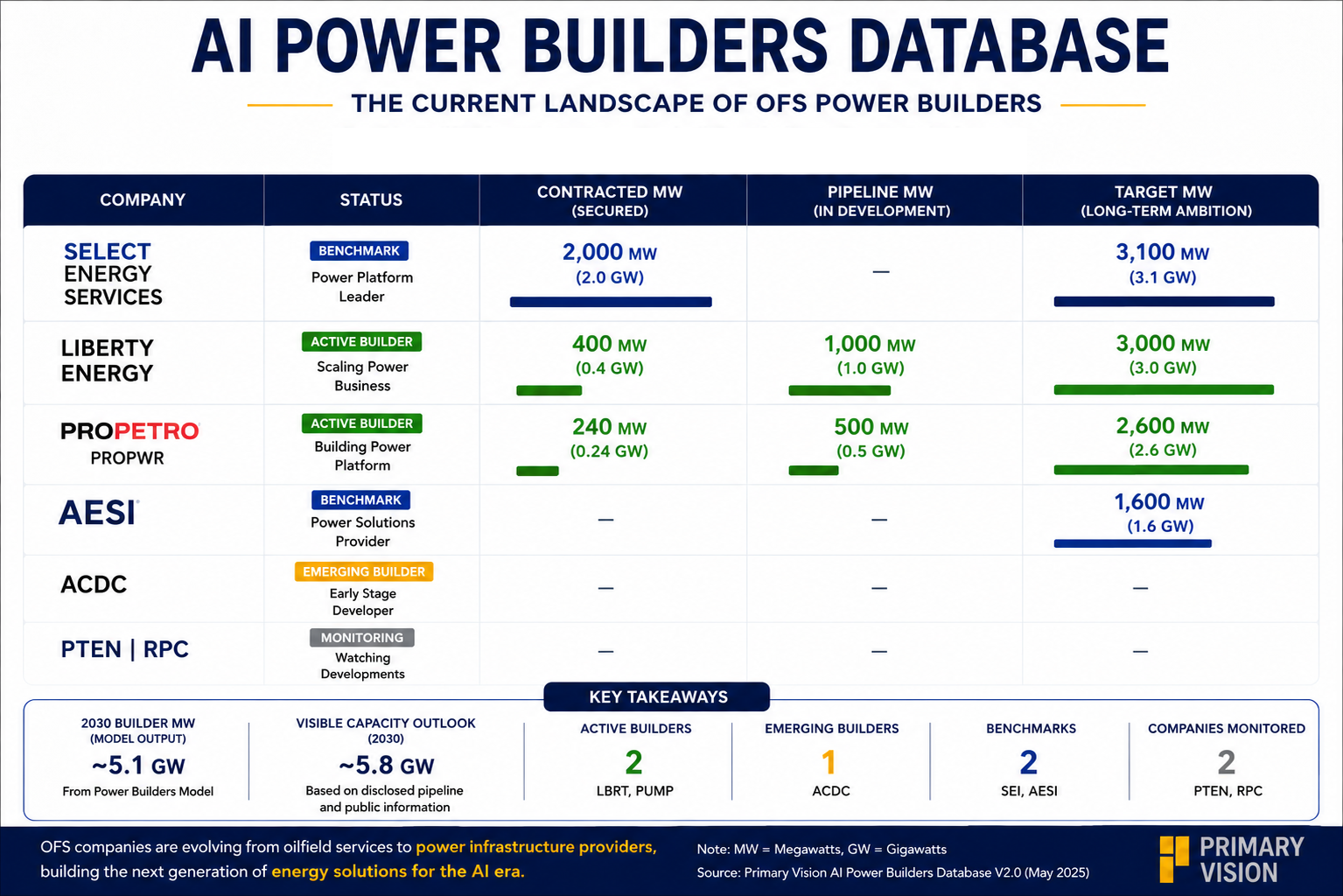
Rather than aggregating disclosed ambitions alone, the research now focuses on execution. The AI Power Builders Database tracks contracted capacity, development pipelines, target capacity and commercial progress across leading companies. This approach provides a more realistic view of what could ultimately become operational rather than simply summing long-term aspirations.
Primary Vision’s internal model suggests an illustrative OFS power supply potential of approximately 3.1 GW under conservative assumptions, 5.2 GW under the base case, and as much as 9.5 GW in an optimistic scenario by 2030. These scenarios are model outputs rather than forecasts and depend on commercial execution, customer demand, equipment availability and project conversion.
The Builders Are Scaling
Solaris Energy Infrastructure remains the industry benchmark, with more than 2 GW of contracted capacity and a long-term target of approximately 3.1 GW. Liberty Energy and ProPetro are emerging as the leading OFS power builders, expanding Liberty Power Innovations and PROPWR to serve AI infrastructure, industrial facilities, and other large power consumers. Together, they demonstrate that dedicated power platforms are moving beyond strategy and into commercial execution.
The competitive landscape is also broadening. Atlas Energy Solutions has identified power infrastructure as a strategic growth vertical, while Kodiak Gas Services is evaluating opportunities that leverage its natural gas compression and power-generation expertise. The latest AI Power Builders Database therefore shifts the focus from announced ambitions to execution, tracking how contracted capacity, development pipelines, and operating experience translate into long-term power supply.
Resource Ownership Still Matters
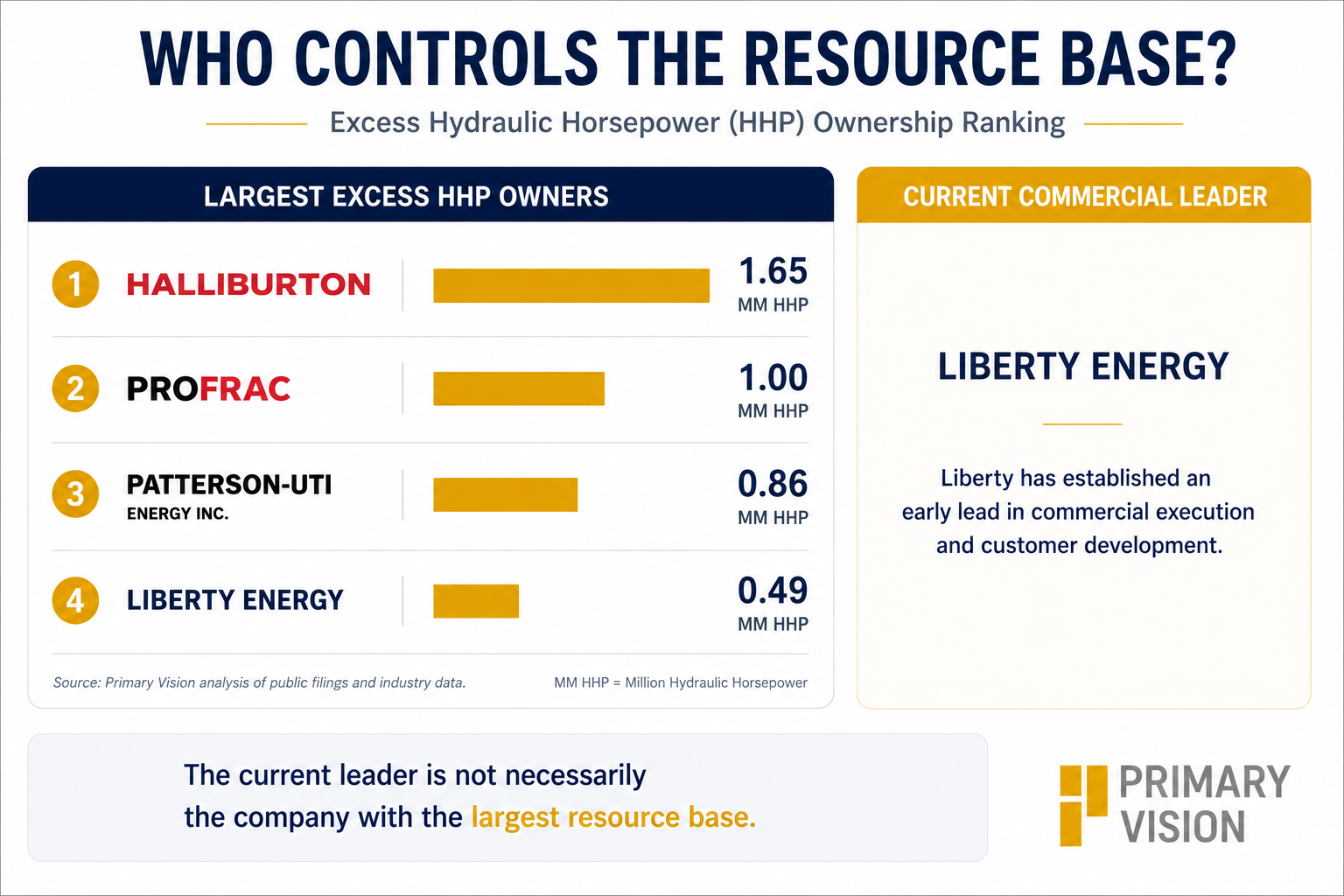
Importantly, the estimated ~7 MM of effective excess HHP represents the industry's strategic resource base rather than equipment immediately available for power generation. The model assumes that only a portion of this capacity is commercially captured and technically convertible over the forecast period, resulting in the illustrative 3.1–9.5 GW supply range identified by Primary Vision's excess HHP model. The 7 MM HHP represents an estimated gross excess hydraulic horsepower potentially subject to further technical and commercial screening. It is also important to remind that excess HHP serves as a proxy for the industry's available equipment base. It does not imply simply towing idle frac pumps to data centers as power sources.
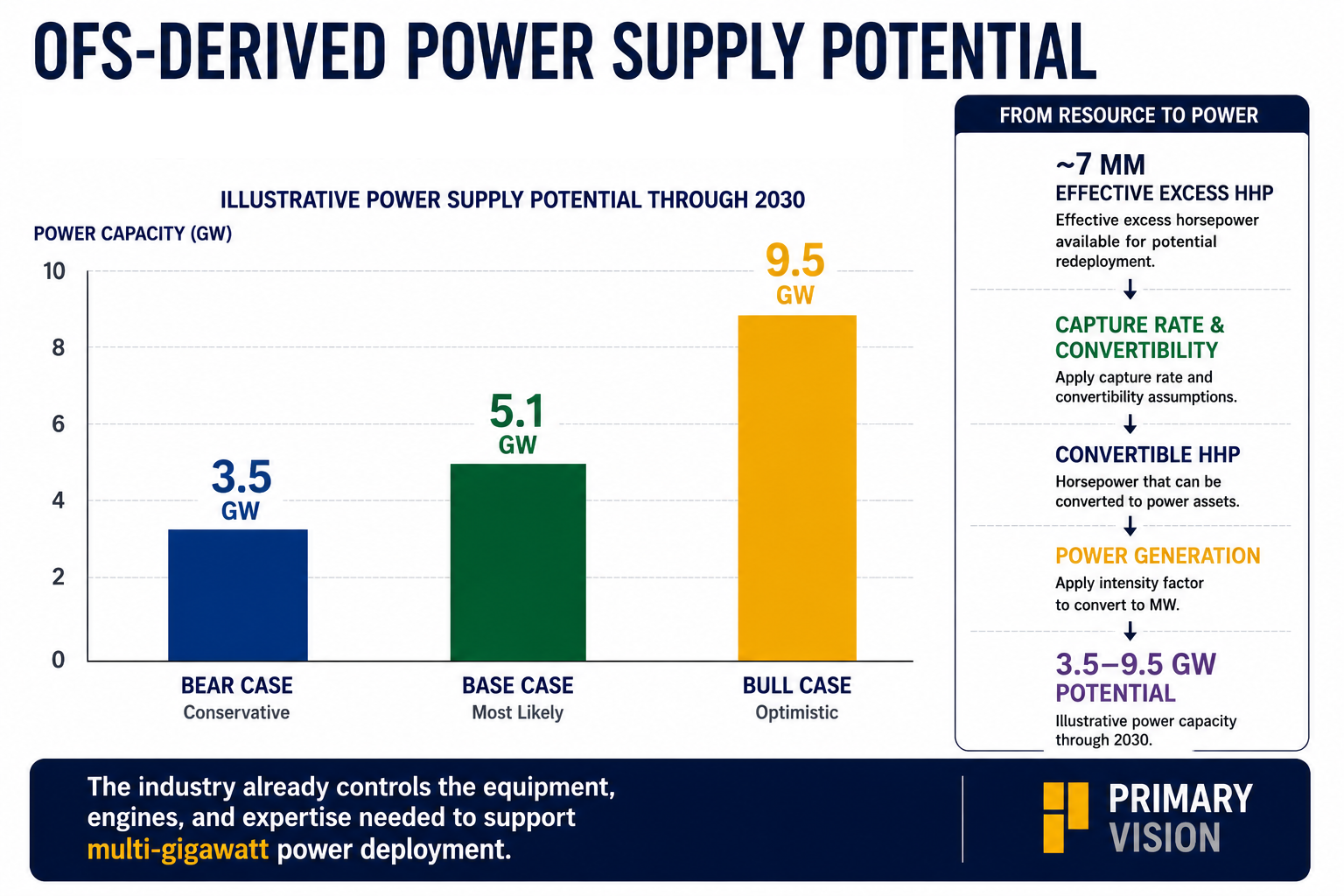
Halliburton as the industry's largest holder of effective excess hydraulic horsepower, with approximately 1.65 million HHP, followed by ProFrac (1.0 million HHP), Patterson-UTI (0.86 million HHP), and Liberty Energy (0.49 million HHP). Collectively, these four companies control a significant share of the industry's convertible equipment base, highlighting the scale of latent power-generation capacity embedded within existing frac fleets.
The rankings also reveal an important competitive divergence. Liberty has emerged as one of the earliest commercial builders through Liberty Power Innovations, yet Halliburton controls more than three times Liberty's effective excess HHP, while ProFrac and Patterson-UTI each maintain substantially larger equipment inventories. As AI-driven power demand accelerates, these companies possess a sizeable strategic reserve of convertible assets that could be deployed into power generation, potentially reshaping the competitive landscape beyond today's early commercial leaders.
A New Growth Vertical for OFS
The latest version of the AI Power Builders Database indicates that the industry already possesses the equipment base, operating expertise, and commercial momentum required to support a meaningful share of future AI-related power demand. While the ultimate opportunity remains uncertain, the current model supports an illustrative 2030 supply potential of roughly 3.1–9.5 GW, with a base case of approximately 5.2 GW.
Not every announced megawatt will ultimately be built. However, the scale of disclosed commitments indicates that power generation is emerging as one of the most significant growth opportunities within the oilfield services sector. So, the next question is who supplies the equipment, engines, turbines, and infrastructure required to support them. We are going to find out next.
Tags:
Permission denied
Upgrade to Pro Today and get…
• This article — plus dozens more each month, all within our full Research Module
• Frac Hits — our National-Level Frac Spread Count and Frac Job Count, updated weekly
• Frac Operator Monitor — detailed FSC & FJC by operator
• And so much more, designed to help you track, forecast, and outperform