






Articles
- BLOG / Articles / View
- Articles
The Missing Layer: How OFS Companies Became AI Power Builders
By Avik on July 8, 2026 in Articles
An Industry Built for a Larger Market
The first two articles established the demand side of the AI power story, introducing the AI Power Stack and the hyperscalers driving unprecedented infrastructure investment. This article turns to the missing layer: the oilfield service companies that are emerging as a new class of AI power builders.
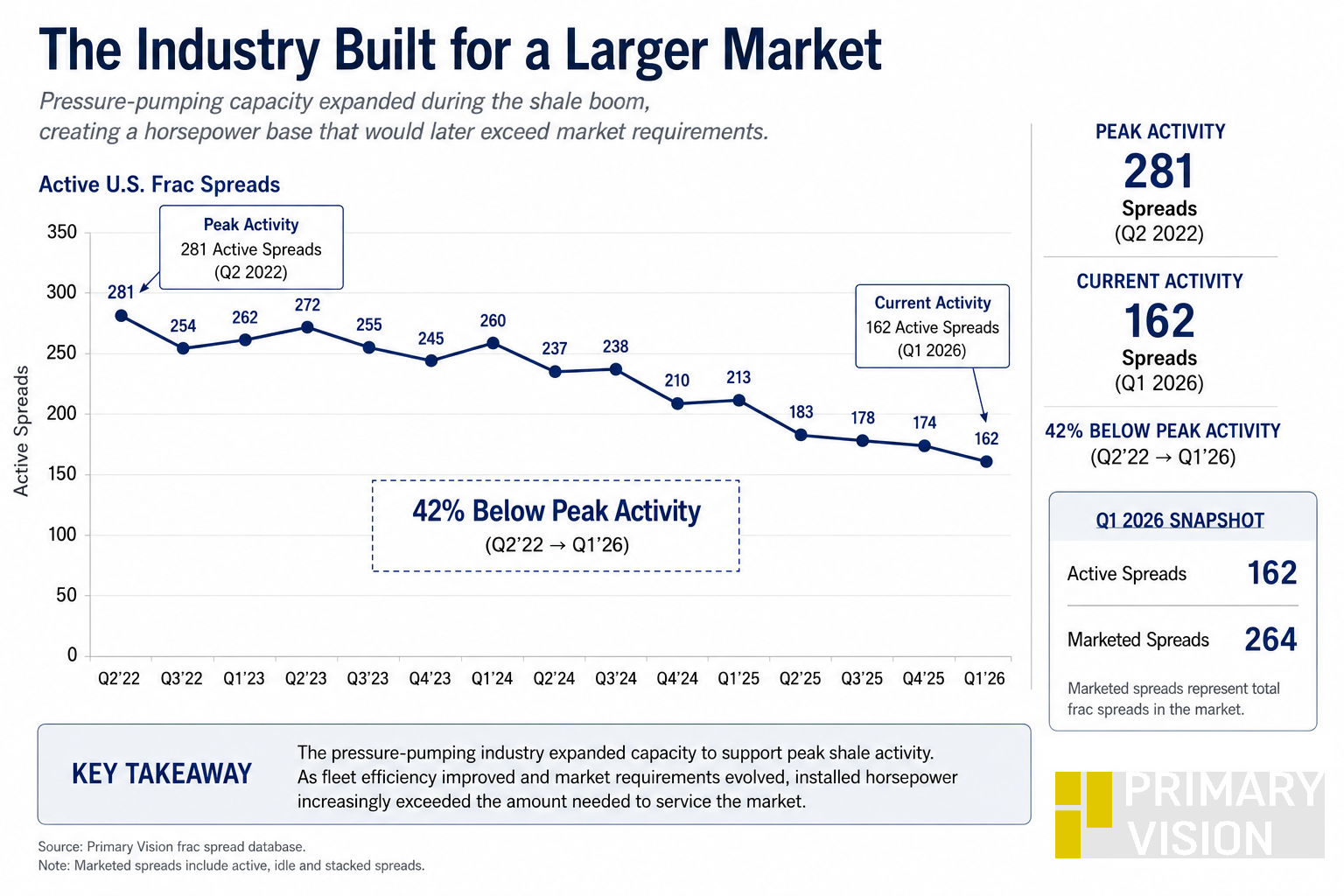
The shale boom required enormous amounts of pressure-pumping equipment. As drilling and completion activity expanded, service companies invested aggressively in hydraulic horsepower to support growing demand. The industry’s installed capacity grew rapidly as operators raced to secure equipment, crews, and market share.
For a time, those investments were justified. Completion activity remained strong and pressure-pumping fleets operated at high utilization levels. Industry planning assumed that demand would continue to absorb the growing horsepower base. Over time, however, the market evolved. While completions remained a large and important business, the industry ultimately found itself with more installed horsepower than it required.
Electrification Changed the Equation
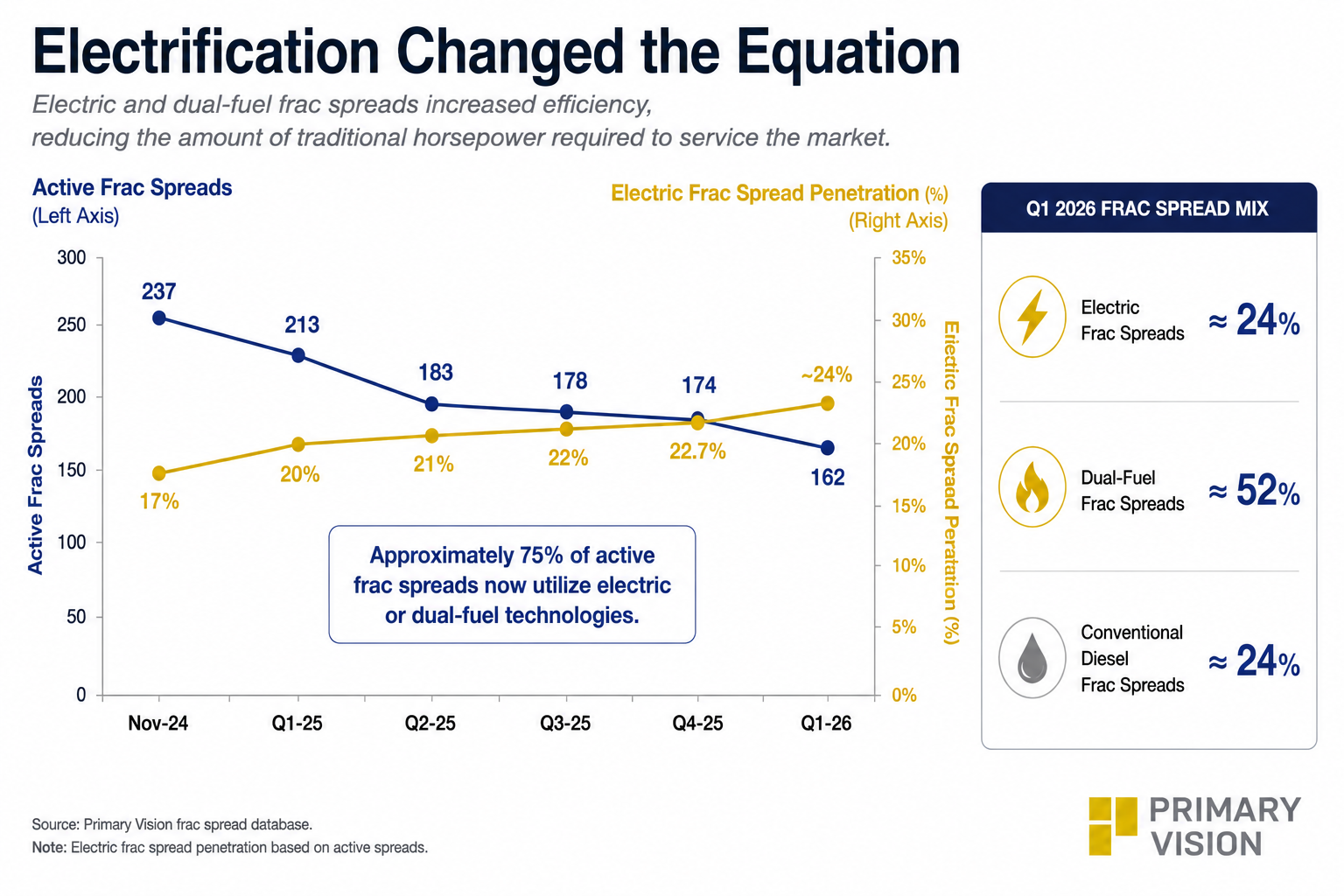
The shift was not driven solely by activity levels. The nature of the equipment itself began to change. Electric and dual-fuel frac spreads steadily gained market share across the industry. These next-generation spreads improved fuel efficiency, reduced emissions, and increased operational flexibility. More importantly, they allowed operators to complete work more efficiently than many traditional diesel-powered spreads.
The result was a subtle but important change. The industry was not simply operating fewer spreads. It was operating a more efficient spread mix. As efficiency improved, the amount of conventional horsepower required to support completion activity began to decline. Capacity that once appeared necessary increasingly became underutilized.
A Surplus Resource Emerges
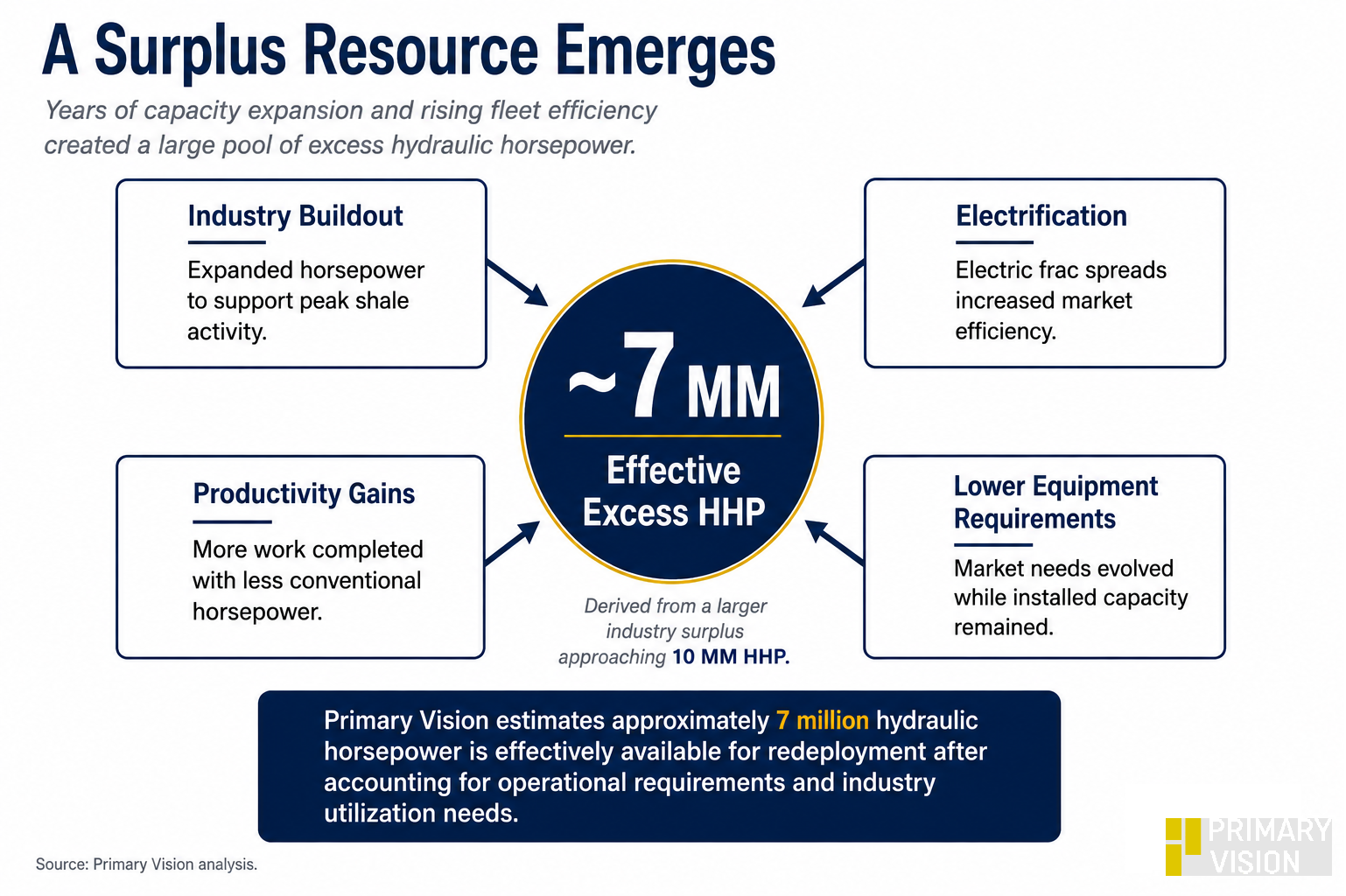
Years of capacity expansion combined with improving operational efficiency created a large surplus resource. Primary Vision estimates that approximately 7 million hydraulic horsepower is effectively available for redeployment after accounting for operational requirements and industry utilization needs. This figure represents effective excess horsepower rather than the industry’s total surplus inventory.
By itself, excess horsepower has limited value. Idle equipment generates little return and becomes increasingly difficult to monetize as markets mature. For the pressure-pumping industry, the challenge became finding productive uses for a resource base that exceeded immediate market requirements. At the same time, a very different problem was beginning to emerge elsewhere in the economy.
AI Creates a New Power Challenge
Artificial intelligence is driving an unprecedented wave of data-center investment. Training and operating large-scale AI models requires enormous amounts of electricity, creating demand growth that utilities and grid operators are struggling to accommodate.
Power has become one of the primary constraints on AI infrastructure development. Interconnection queues continue to grow, transmission projects require years to complete, and many regions face increasing difficulty delivering reliable power to new facilities. As a result, data-center developers have begun searching for alternative sources of dispatchable generation that can be deployed more quickly than traditional utility-scale infrastructure. The market suddenly needed power.
The Missing Layer
The pressure-pumping industry possessed something unusual: engines, power-generation expertise, natural gas experience, field operations capabilities, and a substantial pool of underutilized horsepower. The AI industry needed reliable power. Neither industry developed with the other in mind. Yet the combination created a potential opportunity that few investors anticipated only a few years ago.
What began as an excess-capacity problem increasingly looked like a potential infrastructure solution. The existence of excess horsepower alone does not determine the size of the opportunity. The more important question is how much of that resource can realistically be transformed into power-generation capacity and which companies are best positioned to pursue it. To answer that question, we built the industry’s first AI Power Builders database (next in the series).
Tags:
Permission denied
Upgrade to Pro Today and get…
• This article — plus dozens more each month, all within our full Research Module
• Frac Hits — our National-Level Frac Spread Count and Frac Job Count, updated weekly
• Frac Operator Monitor — detailed FSC & FJC by operator
• And so much more, designed to help you track, forecast, and outperform