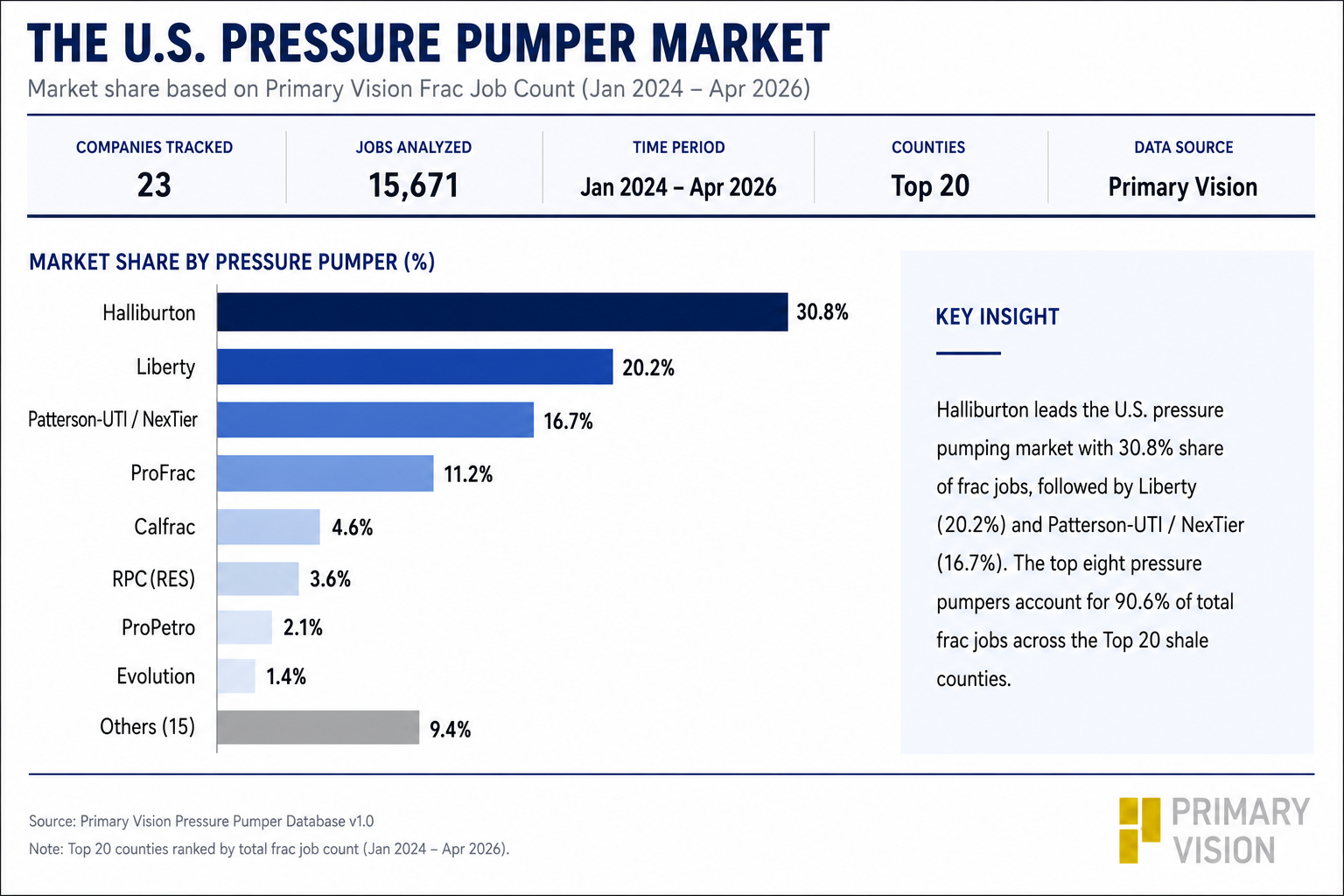
The pressure pumping market remains firmly concentrated around four companies. Halliburton leads the industry with 35.5% of tracked frac jobs, followed by Liberty (22.3%), Patterson-UTI/NexTier (17.8%) and ProFrac (10.4%). Together, these companies account for 86.1% of all tracked activity across the top 20 shale counties, reinforcing the scale advantages enjoyed by the industry's largest providers.
The companies’ recent management commentary indicates that this leadership is being defended through operational performance rather than fleet expansion. Halliburton emphasized disciplined execution and capital allocation, Liberty highlighted record fleet utilization and pumping efficiency, while Patterson-UTI continued optimizing its high-spec fleet.
County Leadership Reveals A Different Competitive Landscape
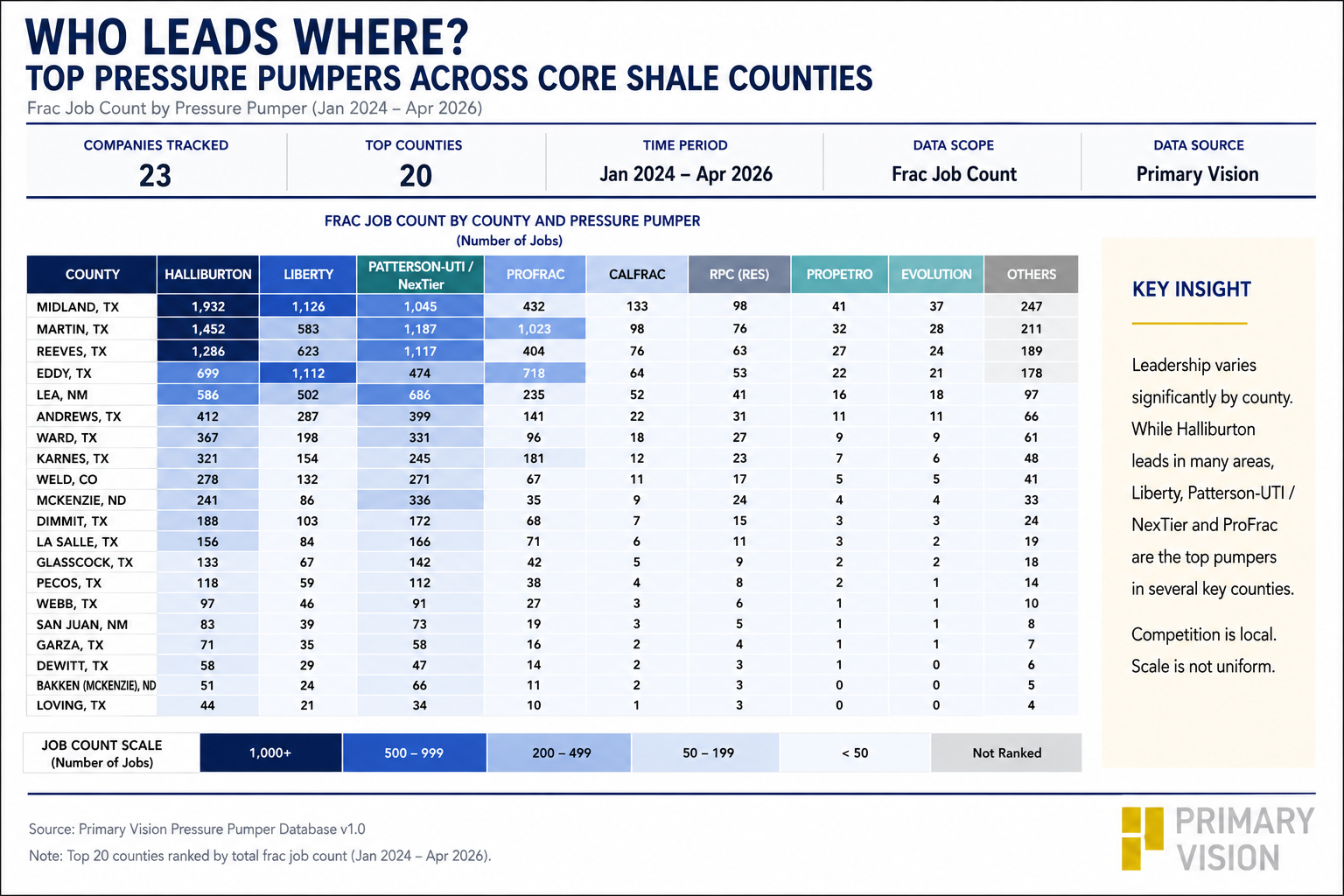
National market share masks a much more competitive picture at the county level. Halliburton leads 14 of the 20 tracked counties, while Liberty leads four and Patterson-UTI/NexTier leads two. Leadership also shifts across the Permian Basin itself, with different companies establishing stronger positions in Midland, Martin, Reeves, Eddy and Lea. The data demonstrate that competitive advantage is determined locally, where operator activity and customer relationships vary from county to county.
This aligns closely with recent management commentary. Operators continue concentrating development within their highest-return acreage. They are typically the preferred service providers for long-term completion programs. Liberty emphasized premium completion execution and technology-enabled services. Patterson-UTI focused on disciplined fleet deployment and utilization. Rather than competing for every available frac job, pressure pumpers are increasingly positioning fleets around their strongest customer relationships.
Competitive Positioning Is Becoming More Specialized
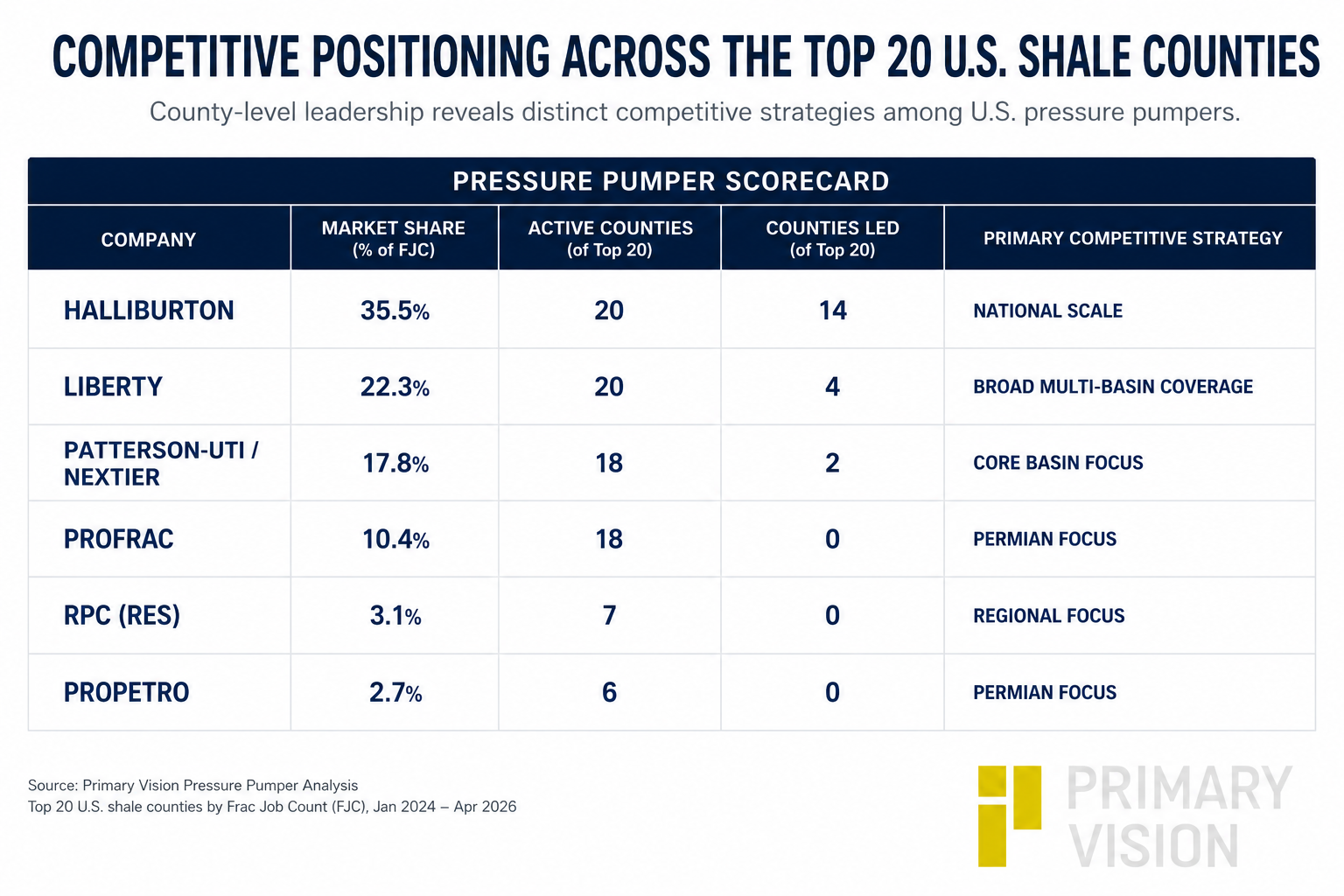
The competitive scorecard highlights that market presence alone does not determine market leadership. Halliburton and Liberty are active across all 20 tracked counties, yet Halliburton leads 14 counties compared with Liberty's four. Patterson-UTI/NexTier maintains a presence across 18 counties but leads only two, while regional providers remain focused on selected markets where local relationships support competitive positions. The result is an industry where geographic coverage and competitive leadership are no longer the same thing.
Q1 earnings calls reinforce this shift. Across the sector, management teams consistently discussed fleet utilization, technology investment, and operational efficiency. The industry's competitive focus is moving away from adding horsepower and toward deploying the right fleet with the right customer in the right county. That shift is becoming increasingly visible in county-level market leadership.
Outlook
Primary Vision's county-level analysis suggests that the next phase of pressure pumping competition will be defined less by fleet size and more by fleet positioning. National market share remains an important measure of scale, but county-level leadership provides a clearer indication of where competitive advantages are being established.
As operators continue concentrating capital within premium development programs, service companies with stronger customer relationships, disciplined fleet deployment, and differentiated operating capabilities should be best positioned to defend and expand their market positions. We will look at the breadth of this in our next analysis. Stay tuned!
Upgrade to Pro Today and get…
• This article — plus dozens more each month, all within our full Research Module
• Frac Hits — our National-Level Frac Spread Count and Frac Job Count, updated weekly
• Frac Operator Monitor — detailed FSC & FJC by operator
• And so much more, designed to help you track, forecast, and outperform