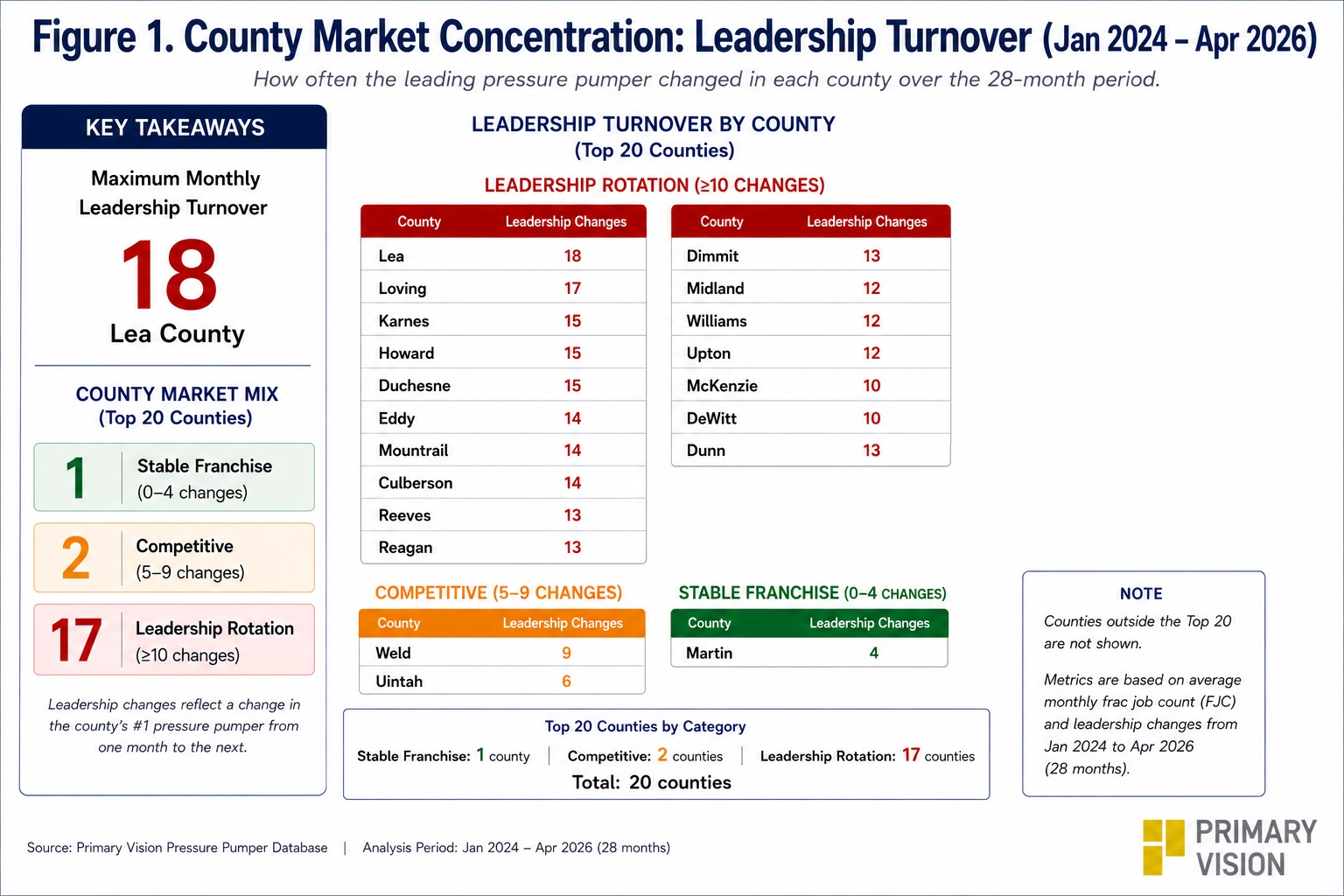
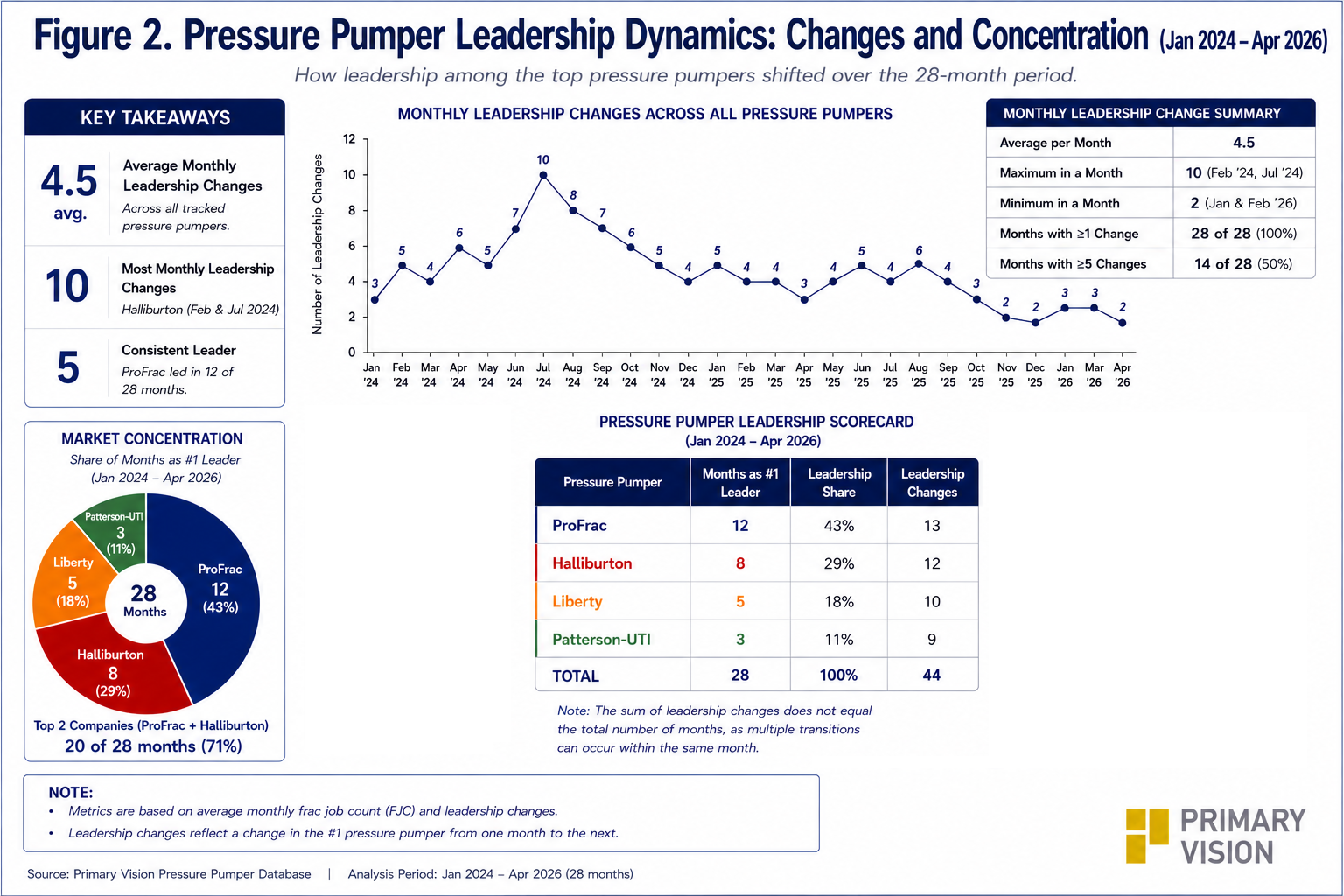
Competition across the Top 20 shale counties has become increasingly dynamic. Lea County recorded 18 leadership changes during the 28-month study period, while 17 of the Top 20 counties experienced double-digit leadership turnover, indicating that market leadership is continually contested within the industry's most active regions.
Recent Q1 earnings commentary provides an important explanation. Pressure pumpers consistently described customers concentrating activity within core acreage while maintaining disciplined capital programs. Rather than expanding geographically, operators are allocating more work to fewer counties, forcing service providers to compete repeatedly within the same local markets.
County geography has therefore become a defining competitive factor. Success increasingly depends on defending customer relationships and executing consistently within the industry's highest-value counties.
Pressure Pumpers Are Following Different Strategies
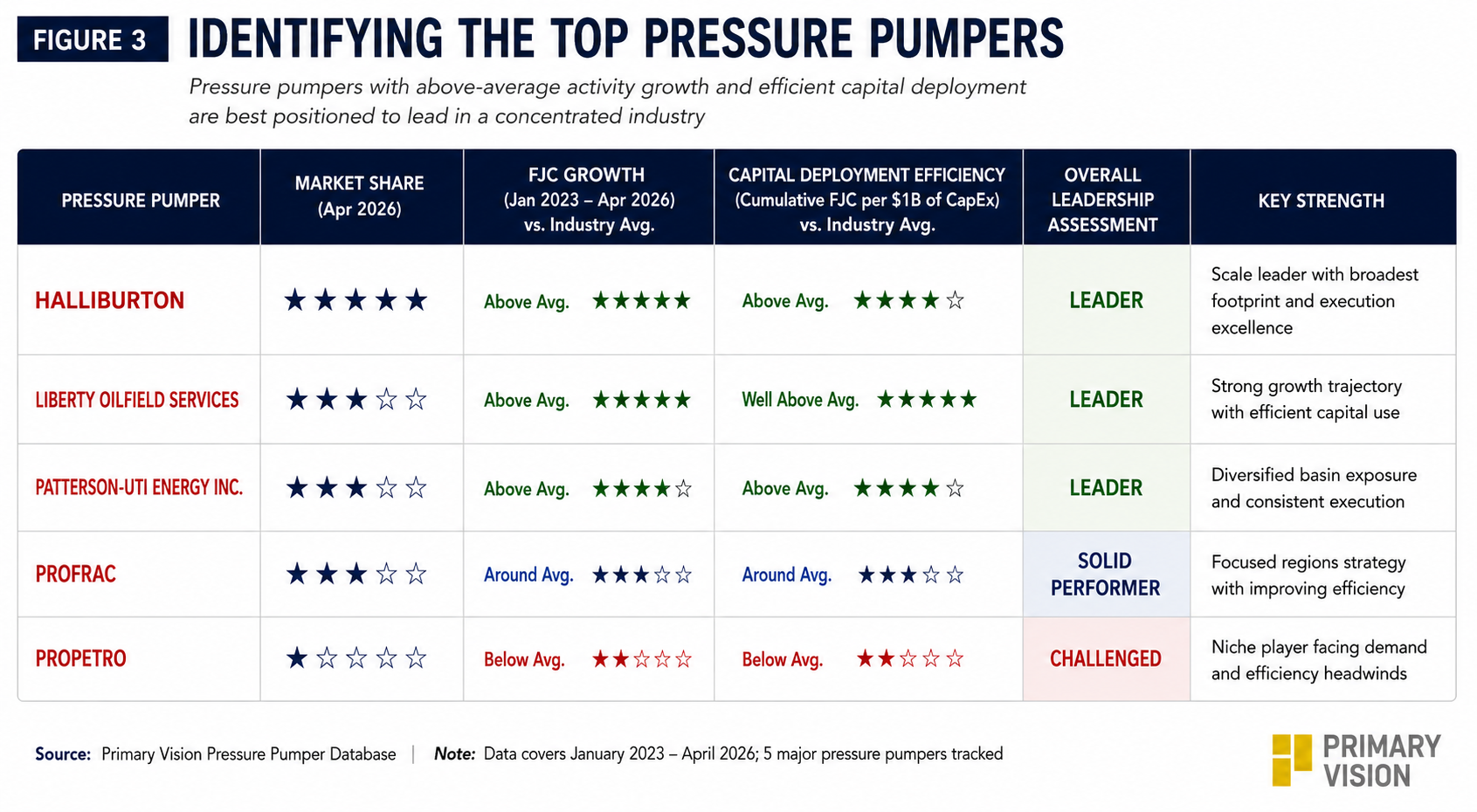
The response to this changing competitive landscape varies significantly across companies. Liberty increased monthly frac job activity by approximately 71% during the study period, compared with roughly 23% for Halliburton, while both companies expanded activity across ten growing counties, the strongest geographic expansion among peers.
Management teams attributed these trends to disciplined fleet allocation rather than capacity growth. Halliburton emphasized technology integration and fleet utilization, Liberty highlighted operational execution, while ProFrac and ProPetro continued prioritizing concentrated regional positions. The result is a market where deployment strategy has become as important as fleet size in sustaining competitive advantage.
Competitive Leadership Is Becoming More Localized
The county analysis provides a more complete picture of competitive positioning than national activity alone. Halliburton combines the industry's highest average monthly activity with the broadest operating footprint, reinforcing its role as the industry's benchmark operator. Liberty has strengthened its position through disciplined expansion into growing markets, while Patterson-UTI, ProFrac, and ProPetro demonstrate that diversified and regional strategies can also produce durable competitive positions.
Recent earnings calls reinforce a common theme across the industry. Management teams consistently prioritized utilization, customer quality, and capital discipline over aggressive fleet additions. As activity becomes increasingly concentrated, sustainable competitive advantage is shifting from fleet ownership toward efficient deployment within the counties that matter most.
Key Takeaway
County-level competition provides a deeper perspective than national market share alone. While market share identifies the industry's largest pressure pumpers, county-level analysis explains how they maintain leadership.
As shale development continues concentrating within a smaller group of high-activity counties, competitive success will increasingly depend on securing work in those markets through disciplined fleet allocation, strong customer relationships, and consistent operational execution. For investors, county-level deployment is emerging as a leading indicator of long-term competitive positioning rather than simply another operational metric.
Upgrade to Pro Today and get…
• This article — plus dozens more each month, all within our full Research Module
• Frac Hits — our National-Level Frac Spread Count and Frac Job Count, updated weekly
• Frac Operator Monitor — detailed FSC & FJC by operator
• And so much more, designed to help you track, forecast, and outperform