The next question is how that demand translates into the natural gas market.
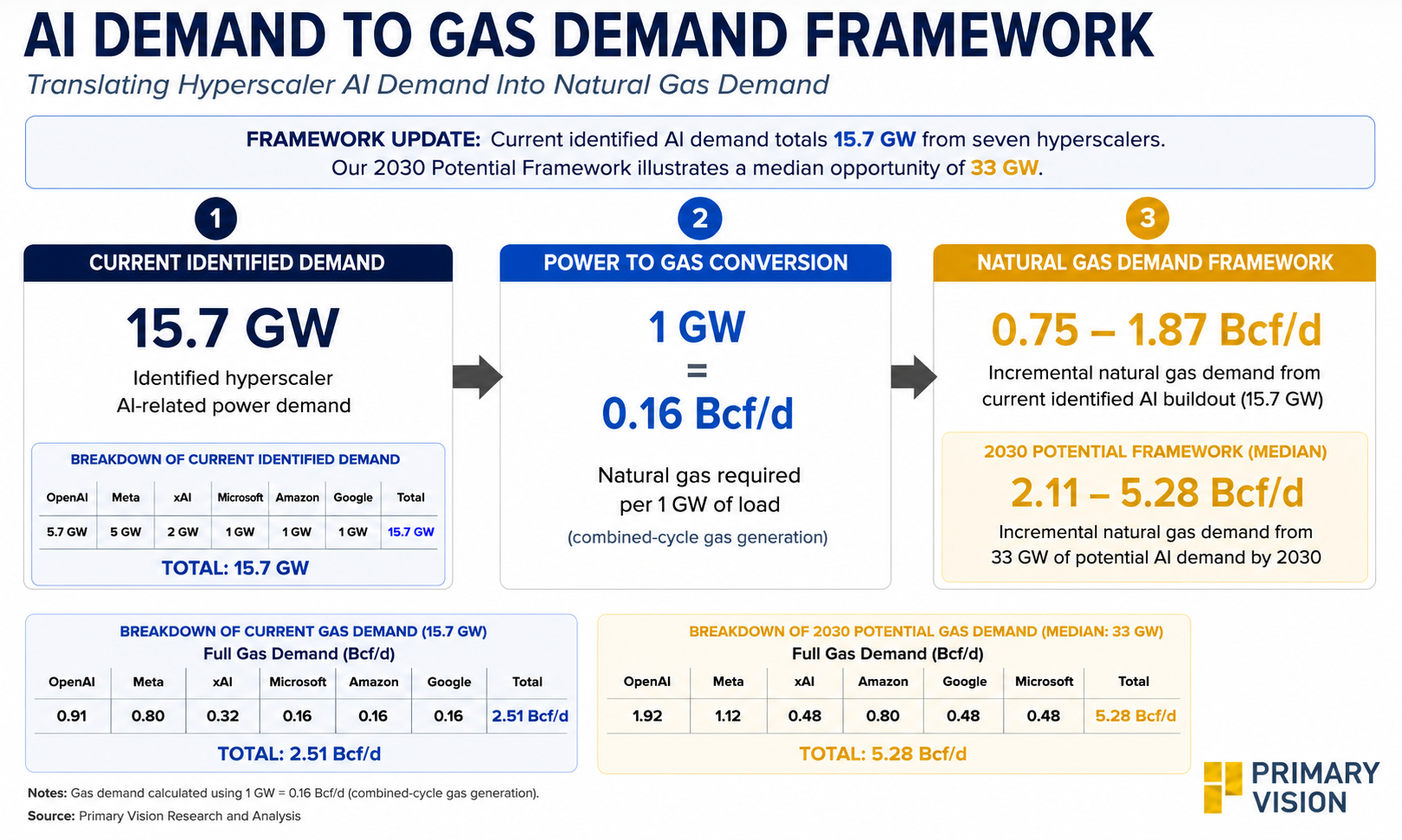
Figure 1 provides the analytical framework. Using a combined-cycle gas generation assumption of 0.16 Bcf/d per gigawatt, AI demand can be converted directly into natural gas demand. That creates a repeatable methodology that links hyperscaler announcements to measurable energy demand. It also distinguishes today's identified opportunity from the broader 2030 Potential Framework, providing a consistent basis for evaluating future database updates rather than relying on individual project announcements.
How Much Gas Demand Could AI Create?
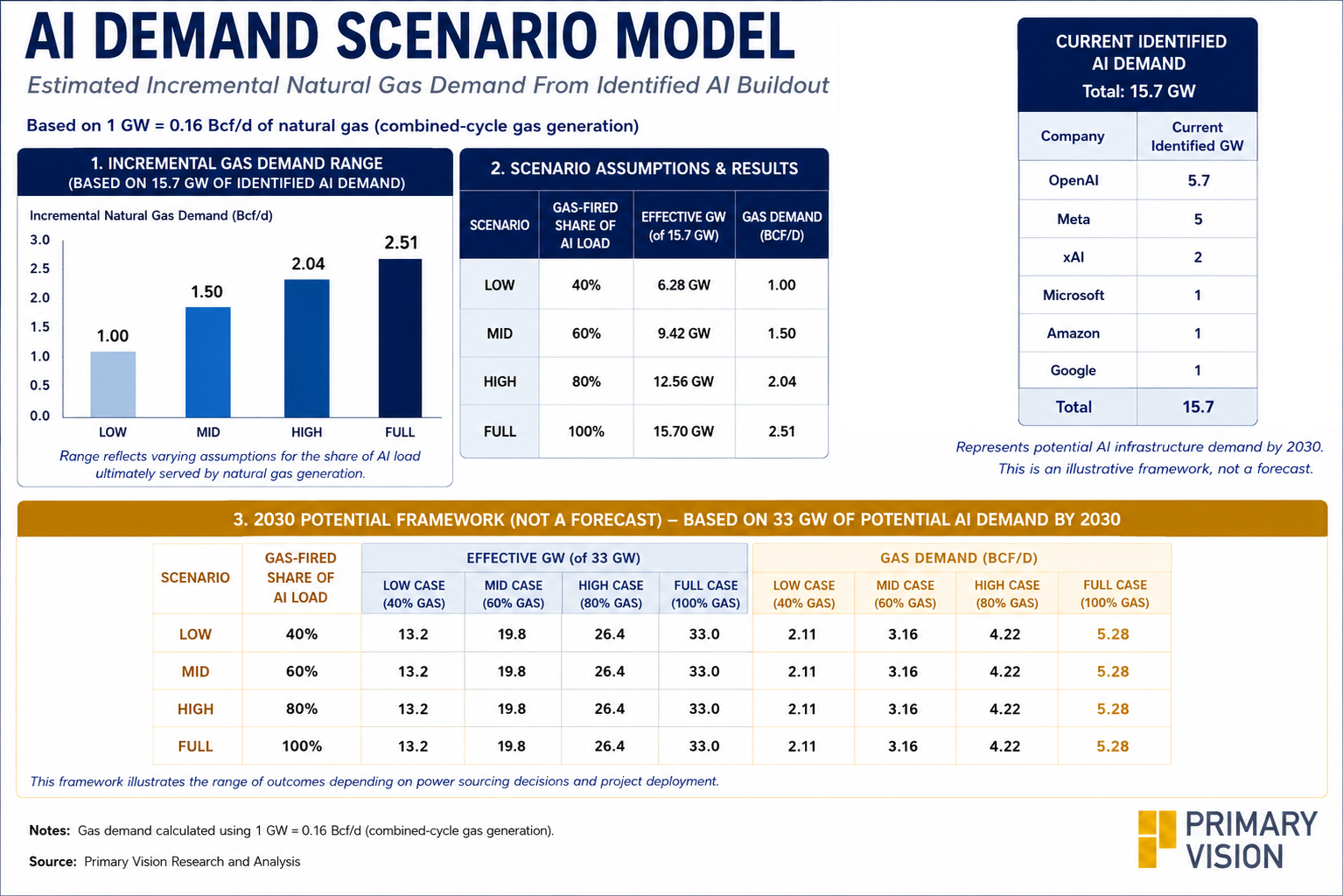
The scenario analysis shows that the current 15.7 GW pipeline could support between 1.00 and 2.51 Bcf/d of incremental natural gas demand, depending on how much AI load is ultimately served by gas-fired generation. The midpoint scenario reaches approximately 1.5 Bcf/d, while the 2030 Potential Framework demonstrates how the opportunity could exceed 5 Bcf/d if identified demand expands toward 33 GW.
The numbers are meaningful, but their significance lies in where demand emerges rather than how much demand is created. AI is unlikely to transform the overall North American gas market on its own. Instead, it is more likely to reshape regional demand patterns and create localized opportunities.
Haynesville Emerges As The Primary Beneficiary
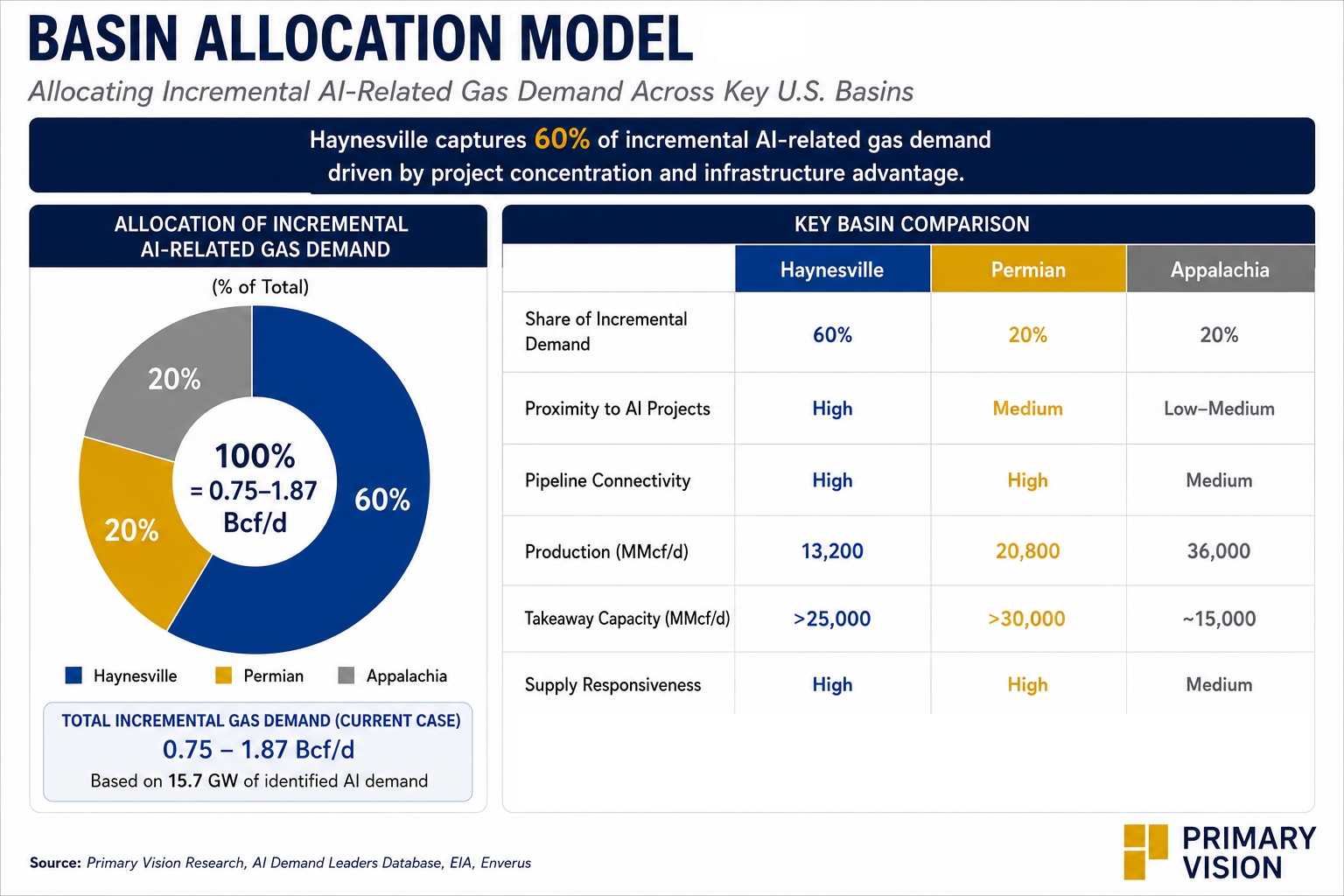
The basin comparison explains why Haynesville stands out. Although Appalachia produces more gas and the Permian offers larger takeaway capacity, the current geography of announced AI projects aligns most closely with Haynesville. Combined with strong Gulf Coast pipeline connectivity and high supply responsiveness, those advantages position the basin to capture approximately 60% of incremental AI-related gas demand, compared with roughly 20% each for the Permian and Appalachia.
For investors, the implication is straightforward. AI demand is unlikely to benefit every producer equally. Geography, infrastructure, and the ability to respond quickly to new demand may prove more important than absolute production scale.
Looking Ahead
The current framework is based on identified hyperscaler projects rather than total AI demand. As additional projects are announced and the database expands, the natural gas opportunity will evolve alongside it. Future updates will determine whether identified demand begins moving toward the 33 GW potential framework.
Takeaway
The updated AI Demand Leaders Database provides a practical framework for translating AI infrastructure into natural gas demand. Today's identified project pipeline supports 1.00–2.51 Bcf/d of incremental demand, while the longer-term framework illustrates how that opportunity could grow as AI deployment expands. Just as importantly, our analysis suggests that geography—not production scale alone—will determine the primary beneficiaries, positioning Haynesville as the basin with the clearest exposure to one of North America's fastest-growing sources of power demand.
Upgrade to Pro Today and get…
• This article — plus dozens more each month, all within our full Research Module
• Frac Hits — our National-Level Frac Spread Count and Frac Job Count, updated weekly
• Frac Operator Monitor — detailed FSC & FJC by operator
• And so much more, designed to help you track, forecast, and outperform