





Articles
- BLOG / Articles / View
- Articles
How AI Ultimately Drives OFS Activity
By Avik on July 22, 2026 in Articles
Two Pathways Connect AI To Oilfield Services
The first six articles established the scale of AI infrastructure investment and the companies building the supporting power ecosystem.
Part One: From AI to Oilfield Power: The AI Power Stack
Part Two: From AI to Oilfield Power: The AI Company
Part Three: The Missing Layer: How OFS Companies Became AI Power Builders
Part Four: From Frac Spreads to Power Platforms
Part Five: Building the OFS Power Ecosystem
Part Six: From AI Demand to Natural Gas Demand
The process follows two complementary pathways. Companies participating in distributed generation, mobile power, microgrids, and integrated power platforms benefit directly as AI infrastructure is constructed. Traditional pressure pumpers participate later as higher electricity demand increases natural gas production, eventually translating into additional drilling, completions, and pressure-pumping activity. These opportunities are connected, but they occur at different stages of the AI investment cycle.
Note: We have updated both sides of the framework since our previous articles, adding newly identified AI data center projects on the demand side and newly verified OFS power capacity on the supply side. These additions improve coverage of the market without changing the overall investment thesis.
The Direct AI Power Opportunity Continues To Expand
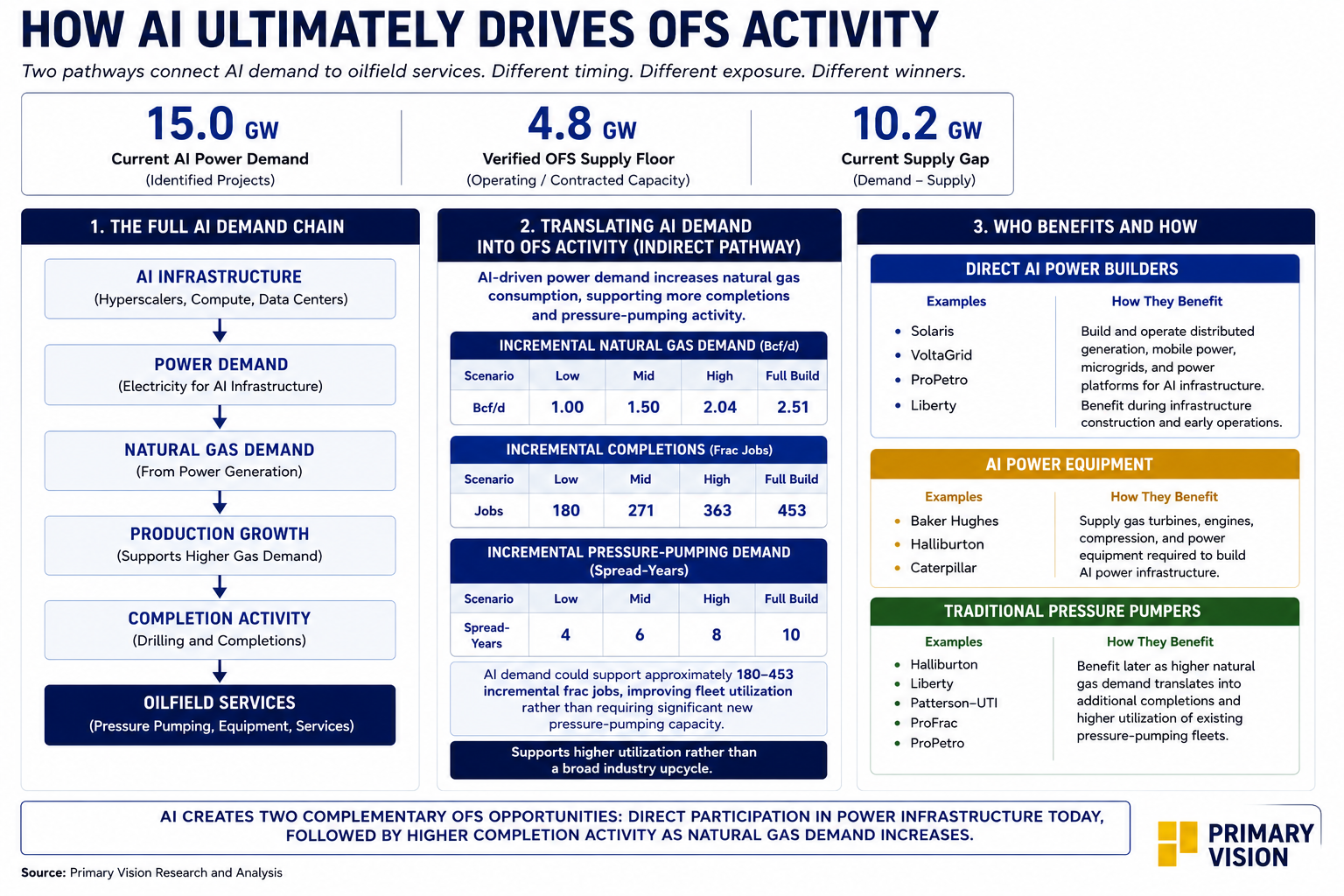
Publicly disclosed AI projects now represent approximately 15.0 GW of identified power demand, compared with only 4.8 GW of verified operating or contracted OFS power capacity. The currently identified market is therefore roughly 3.1× larger than verified OFS participation, leaving a 10.2 GW supply gap.
Note: The supply assessment now distinguishes between verified operating or contracted capacity and longer-term disclosed ambitions, providing a more conservative measure of today's commercial participation.
While most future capacity will be supplied by utilities and independent power producers, the analysis also demonstrates that OFS companies remain significantly underrepresented in AI power infrastructure. As the market expands, distributed generation, gas turbines, mobile power, and integrated energy platforms provide a meaningful runway for additional OFS participation.
The Indirect Opportunity Is Quantifiable
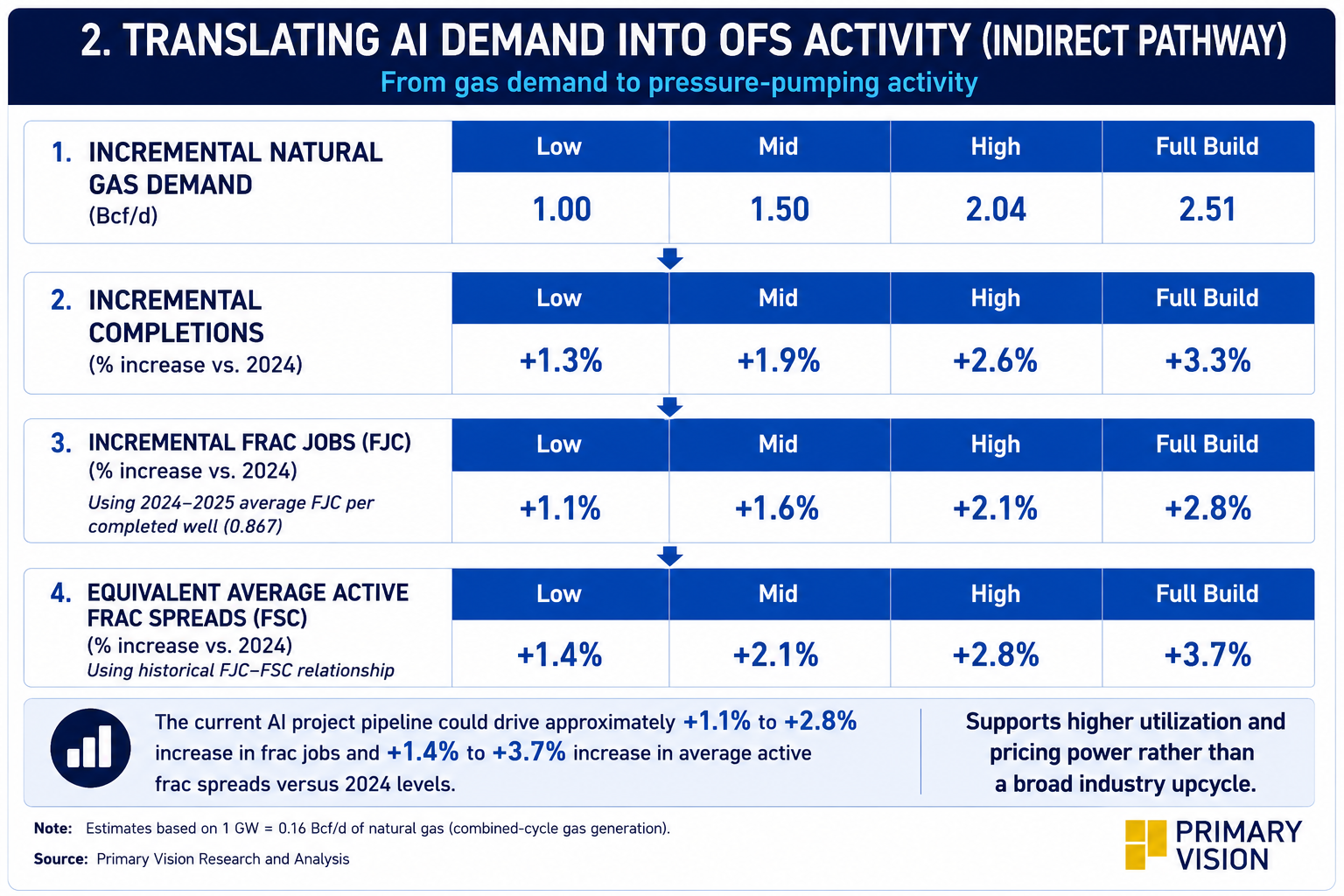
The indirect pathway begins once AI infrastructure increases electricity consumption. Under the current demand framework, AI could support approximately 1.00–2.51 Bcf/d of incremental natural gas demand, equivalent to roughly 1.3%–3.3% additional U.S. completions, 1.1%–2.8% higher frac jobs, and 1.4%–3.7% higher average active frac spreads versus recent industry activity.
The opportunity is meaningful because it improves utilization of existing pressure-pumping fleets rather than requiring a broad expansion of industry horsepower. Higher utilization typically supports stronger pricing, improved operating margins, and better returns on existing equipment before significant new capacity is required.
Participation At Different Points In The Value Chain
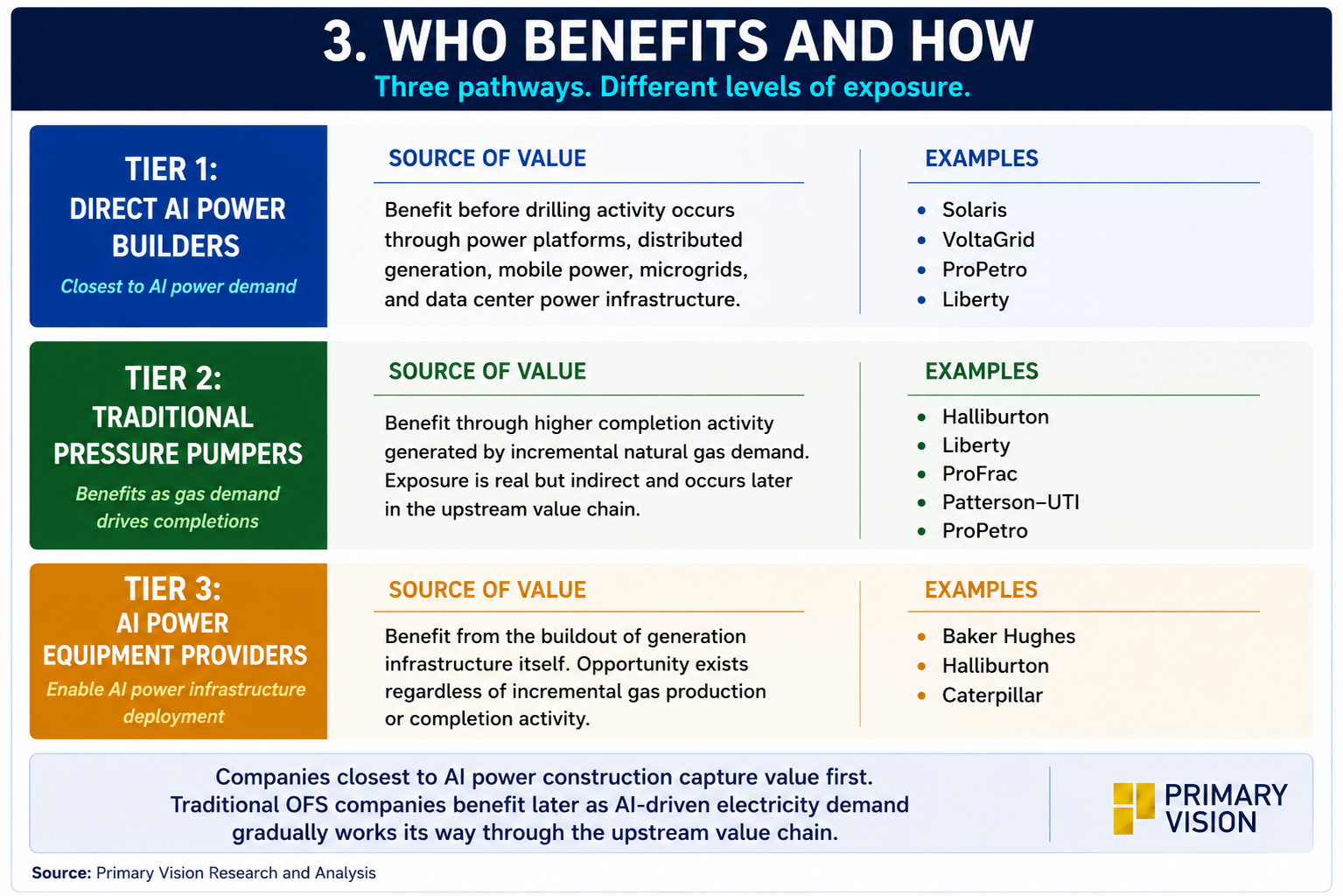
Not every OFS company benefits in the same way. Direct AI power builders—including Solaris, VoltaGrid, ProPetro, and Liberty—participate immediately through distributed generation, mobile power, microgrids, and integrated power platforms supporting AI infrastructure.
Equipment suppliers—including Baker Hughes, Halliburton, and Caterpillar—benefit through the deployment of turbines, engines, compression, and supporting equipment required to construct AI power systems.
Traditional pressure pumpers—including Halliburton, Liberty, ProFrac, Patterson-UTI, and ProPetro—benefit indirectly as higher natural gas demand gradually translates into additional completions and higher fleet utilization.
The distinction is important because companies positioned closest to AI infrastructure capture revenue during the construction phase, while pressure pumpers participate later as demand propagates through the upstream energy value chain.
Takeaway
AI is creating a new demand cycle for oilfield services that extends well beyond hydraulic fracturing. The earliest beneficiaries are companies building the distributed power infrastructure that enables AI data centers, while traditional pressure pumpers gain exposure later through higher natural gas production and incremental completion activity.
For investors, evaluating a company's position within the emerging AI power ecosystem may prove more informative than measuring conventional oilfield exposure alone. As AI infrastructure continues to scale, direct participation in power generation, equipment supply, and integrated energy solutions is likely to become an increasingly important source of differentiation across the OFS sector.
Tags:
Permission denied
Upgrade to Pro Today and get…
• This article — plus dozens more each month, all within our full Research Module
• Frac Hits — our National-Level Frac Spread Count and Frac Job Count, updated weekly
• Frac Operator Monitor — detailed FSC & FJC by operator
• And so much more, designed to help you track, forecast, and outperform