The first seven articles established the AI power thesis, connecting hyperscaler electricity demand, natural gas, distributed power infrastructure, and the emergence of OFS companies as a new class of power builders.
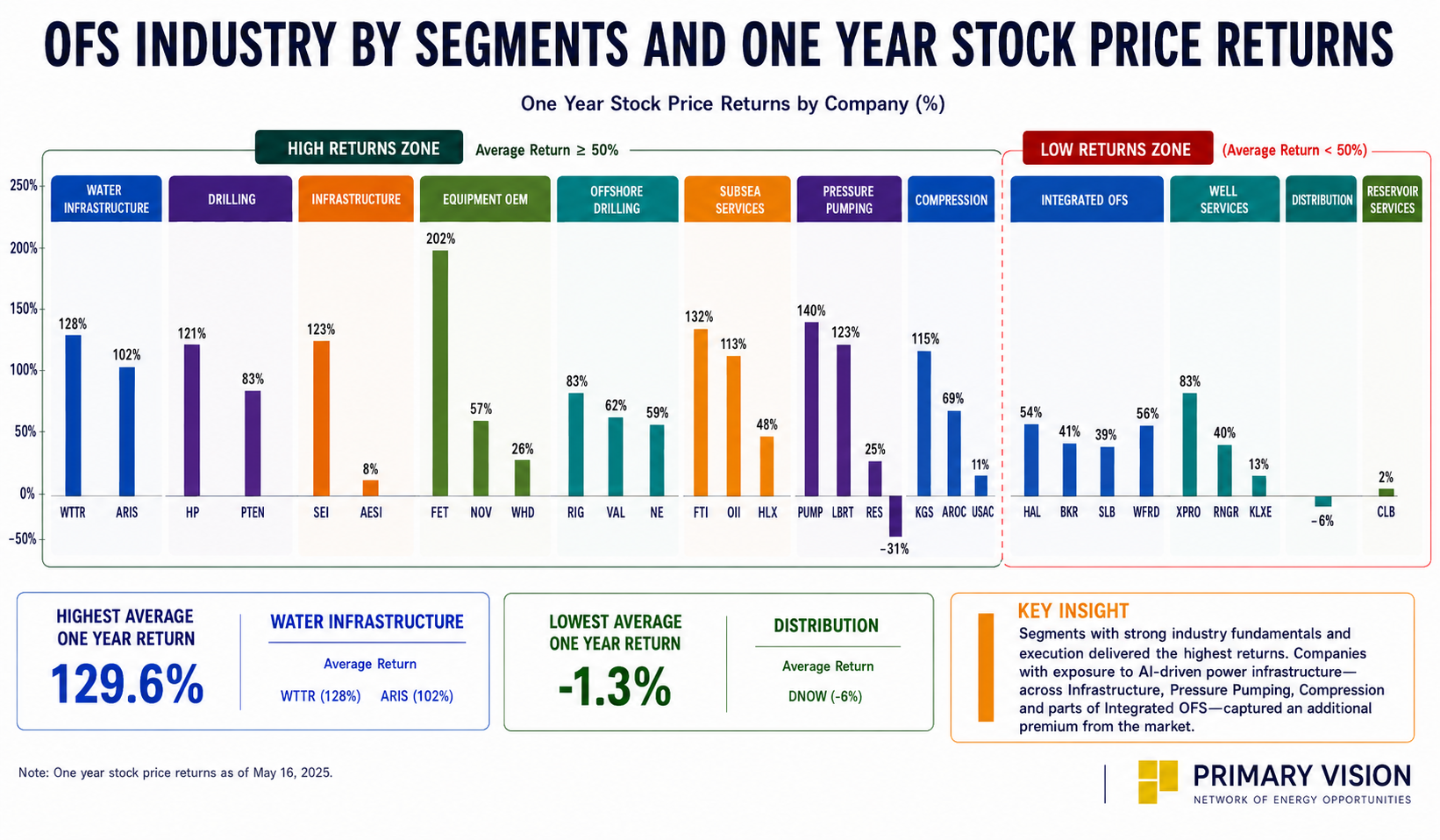
Water Infrastructure remained the top-performing segment with an average return of 115%, supported by resilient demand for produced-water management and stable cash flow generation. Drilling followed at 102%, benefiting from stronger international activity and improved capital discipline. Subsea Services (98%), Equipment OEMs (95%), and Offshore Drilling (68%) also generated solid returns, reflecting healthy project backlogs, improving offshore investment, and sustained equipment demand.
At the other end of the spectrum, Distribution (-6%) remained the weakest-performing segment, while Reservoir Services (2%) produced only modest gains. These businesses remain more closely tied to mature service lines with fewer structural growth catalysts and limited opportunities for differentiated earnings growth.
Overall, the dispersion in returns suggests investors continued to reward segments with stronger industry fundamentals, improving capital allocation, and clear secular demand drivers, while assigning lower valuations to businesses facing slower growth and more competitive end markets.
Emissions Transition Created an Unexpected AI Advantage
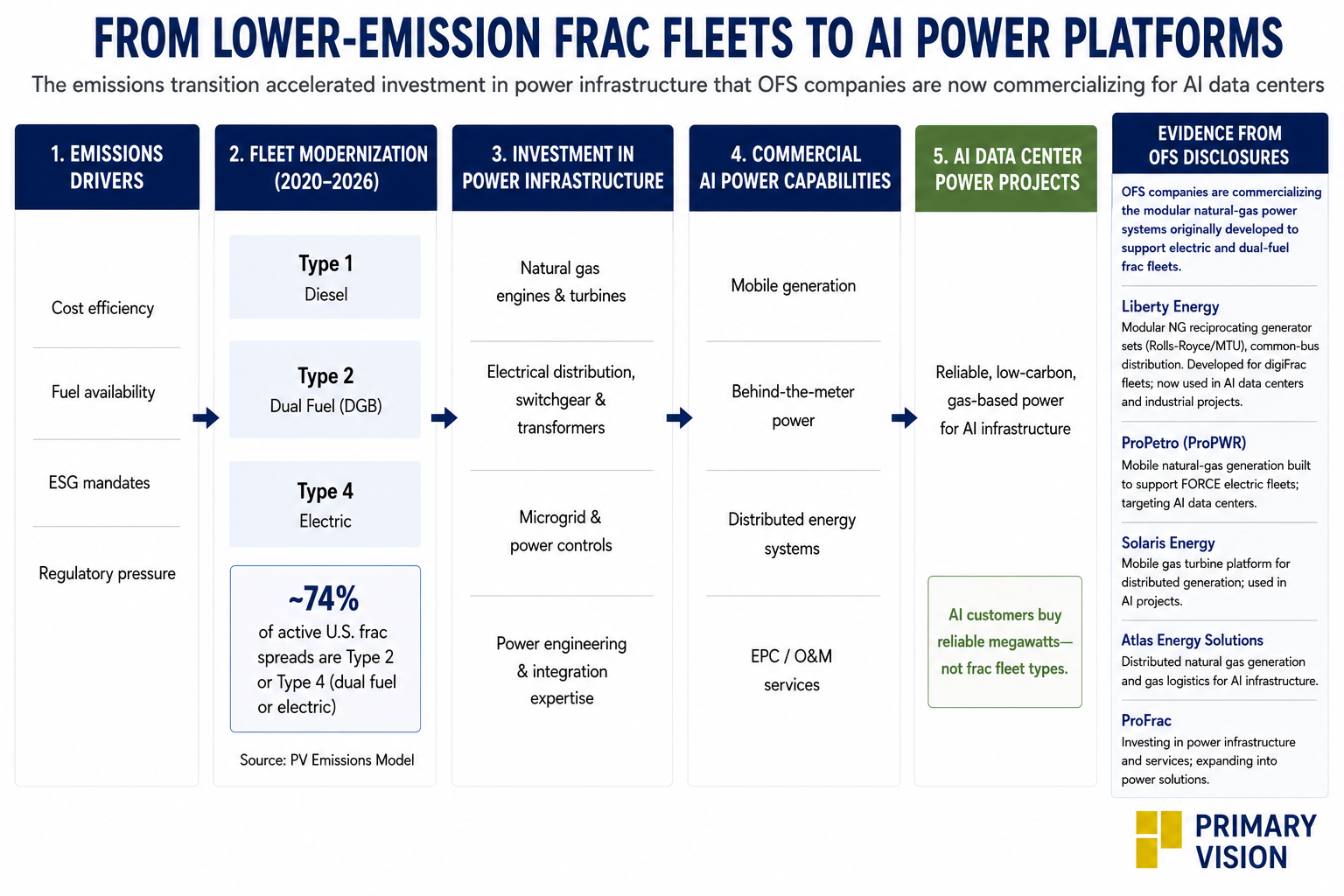
The link between lower-emission fracturing and AI infrastructure is becoming clearer through company disclosures. Rather than repurposing pressure pumping equipment, OFS companies are commercializing the modular natural gas power systems originally developed for electric and dual-fuel frac fleets.
Liberty Energy provides the clearest example. Its digiPower platform is built around modular MTU (Rolls-Royce) natural gas reciprocating generator sets, electrical distribution, and common-bus controls. The system was initially designed to power digiFrac electric fleets. Today, the same technology platform forms the foundation of Liberty Power Innovations' distributed power business, serving industrial customers and AI data center projects.
This pattern extends beyond Liberty. ProPetro's ProPWR business leverages mobile natural gas generation originally deployed to support its FORCE electric fleets while identifying AI data centers as a major growth market. Solaris and Atlas are similarly building AI power businesses around modular natural gas generation rather than pressure pumping equipment itself.
Key Takeaway
The past year suggests that investors are no longer valuing oilfield services solely through the lens of drilling activity. Industry fundamentals continue to determine which segments outperform, while company execution separates leaders from followers. Increasingly, however, AI-driven power infrastructure is emerging as a third differentiator.
Rather than replacing the traditional OFS cycle, AI is expanding it. This creates new revenue opportunities, supports higher valuation multiples, and rewards companies positioned at the intersection of energy production and electricity supply. As the AI buildout accelerates, that power premium may become an increasingly important component of OFS valuations.
Upgrade to Pro Today and get…
• This article — plus dozens more each month, all within our full Research Module
• Frac Hits — our National-Level Frac Spread Count and Frac Job Count, updated weekly
• Frac Operator Monitor — detailed FSC & FJC by operator
• And so much more, designed to help you track, forecast, and outperform